
REVIEW · LONDON MUSEUMS AND GALLERIES
British Museum Highlights Private Tour in London including the Rosetta Stone
Two hours can feel like ten here.
If you want the British Museum without the usual overwhelm, this private highlights tour is a smart shortcut. You meet at the north entrance area, get a guide who can answer questions on the spot, and head for the big-name displays like the Rosetta Stone and the Egyptian Rooms before you lose time wandering.
I especially like the way the tour is built for real time pressure. The museum is huge, so having someone steer you to the right galleries saves energy. I also like that this is private, meaning you can steer the conversation, slow down for the parts you care about, and keep it moving when you do not.
One drawback to consider: you are only seeing a curated slice of a museum that has millions of objects. If you want to linger for hours or read everything at ground level, you will likely need extra time after the tour to do it your way.
In This Review
- Key highlights to look for
- Entering the British Museum from Montague Place, fast
- The Rosetta Stone and Egyptian Rooms, where the story makes sense
- Parthenon Frieze and Athenian marbles, classical Greece in one loop
- Anglo-Saxon culture and Sutton Hoo, the survival story
- How long it really takes, and what that means for your plan
- Price and value at about $141.56 per person
- Who this private highlights tour fits best
- When it goes right, it goes really right
- A balanced caution: meeting and guiding can vary
- After the tour: how to keep the momentum inside the museum
- Should you book this private British Museum highlights tour?
- FAQ
- How long is the British Museum highlights private tour?
- Where do we meet the guide?
- Is this a private tour?
- What’s included in the price?
- What is not included?
- What language is the tour guide?
- Is a mobile ticket provided?
- Are strollers allowed?
- Can I cancel and get a refund?
- How close is the meeting point to public transportation?
Key highlights to look for
- A true private pace with Q&A time, so you are not stuck guessing what you are seeing
- Rosetta Stone explained in context, not as trivia
- Egyptian Rooms focus on the afterlife, with the mummies and belief system tied together
- Parthenon Frieze shown as an actual survivor from Athens, with scale and significance
- Anglo-Saxon storytelling via Sutton Hoo, including why these objects survived
- A clear meeting spot at Montague Place by the stone lions, aimed at avoiding museum maze problems
Rainy afternoon fixed: more museum visits we tried
- British Museum London Guided Tour Semi-Private 8ppl Max★ 5.0 · 984 reviews
- The British Museum London – Exclusive Guided Museum Tour★ 5.0 · 555 reviews
- British Museum Guided Tour★ 4.0 · 470 reviews
- Private Guided Tour of the British Museum – Tickets Included★ 5.0 · 193 reviews
Entering the British Museum from Montague Place, fast
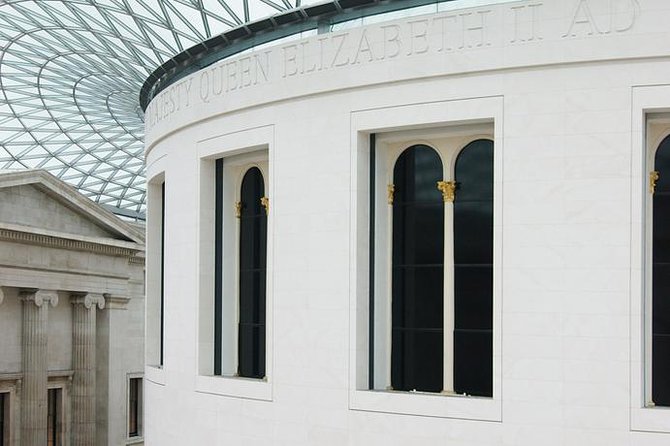
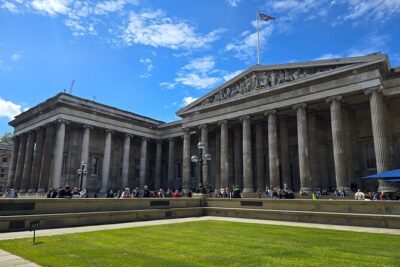
Your day starts at Montague Place, near the museum’s north entrance. Look for a guide holding a sign by the stone lions at the doorway. It sounds simple, but it matters, because the British Museum is open to everyone and the crowds can make first-time navigation feel like a video game with the map turned off.
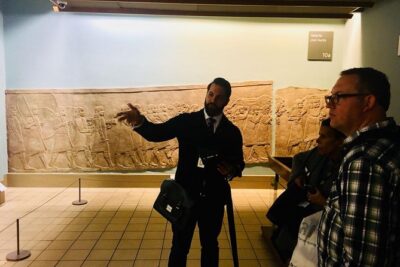
This tour is set up as a private visit for just your group, with an English-speaking professional guide. That private setup changes everything about the experience. Instead of silently reading labels while others cut across your line of sight, you can ask questions right in the moment and get the kind of context that turns objects into stories.
The tour uses a mobile ticket, and the meeting point is near public transportation, which helps if you are fitting this into a busy London itinerary. You also return to the meeting point afterward, so it is easy to plan your next step without a complicated end location.
Practical note: strollers are not permitted on this tour. If you are traveling with small kids, plan for carriers that comply with the operator’s rules and be ready for a lot of walking across multiple galleries.
The Rosetta Stone and Egyptian Rooms, where the story makes sense
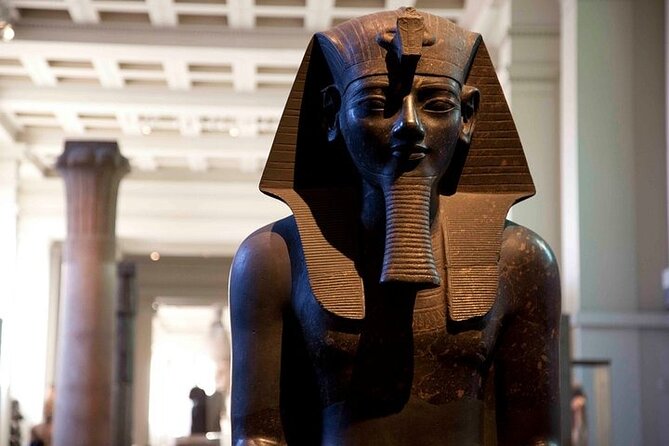
The British Museum can be intimidating. This tour’s Egyptian section is the antidote. You head into the Egyptian Rooms and get guided context before you get lost in the scale of what is on display.
The Rosetta Stone is the obvious headline, but the value is in why it matters. You will learn that it played a key role in deciphering Egyptian hieroglyphs, which turns it from a famous name into an actual tool that unlocked understanding. Seeing the stone in person also helps you connect the idea of language systems, not just ancient art, to the real human goal of reading what came before.
Then comes the part I think many people underestimate: the guide ties the Egyptian objects to beliefs about death and the afterlife. When you know that the afterlife was a core concept shaping how Egyptians prepared for death, the mummies and related artifacts stop feeling like isolated oddities. They start feeling like part of a single belief system that shaped daily life, ritual, and art.
If you have heard a quick summary of Ancient Egypt before, this is where you will notice the difference. You are not just collecting facts. You are getting a framework so you can connect what you see across rooms.
If you want a guide who brings that framework to life, names like Rob Smith, Trudy, Norma, Guy, and ZoZo appear in past visitor feedback. The consistent theme across those guides is that they explain meaning, not just description, and they answer questions without making you feel rushed.
Parthenon Frieze and Athenian marbles, classical Greece in one loop
After Egypt, you move into another big draw: the Parthenon Frieze. This is one of those objects where size alone can change your reaction.
You will pass highlights connected to the Parthenon Frieze, which once stood in the Acropolis in Athens. The tour information gives you a real sense of scale: just over three feet high and about 525 feet long. Standing near it, that long continuous work stops being a line in a textbook and becomes something you can feel physically.
Just as important, you get help placing it historically. The frieze is not random decoration. It is tied to classical Greece, civic identity, and the kind of grand public culture represented by major buildings like the Parthenon.
This part of the tour works well for people who do not want a lecture, but do want the “why should I care” answer. You get a clean path through the key stops, with context added where it improves understanding.
Anglo-Saxon culture and Sutton Hoo, the survival story
One of the most satisfying surprises in this kind of highlights tour is when it reaches beyond the usual world-famous ancient empires. Here, you get a look at artifacts connected to Anglo-Saxon culture in the British Isles, including the Sutton Hoo ship burial.
Sutton Hoo is famous to many people, but the tour angle makes it more than a well-known name. You will hear how objects survived the centuries, including the story of grave robbers and why so much still ended up preserved enough to be studied.
That theme of survival matters. It is easy to imagine ancient history as finished and intact, like everything was kept behind glass. But archaeology and history include loss, disturbance, and chance. When your guide connects that survival to what you are seeing, the artifacts feel more human, less museum-sterile.
If you like your ancient history grounded in real consequences, this is a strong section. It also helps balance the time spent on Egypt and Greece, so the museum does not feel like a single-genre show.
Other collections we queued for



How long it really takes, and what that means for your plan
The tour is listed at about 2 hours 30 minutes. Another part of the experience description notes 1 hour 30 minutes with an admission ticket included. In practice, think of it as a focused half-day sprint that gives you the museum’s top anchor points, plus guidance on how to see the rest on your own afterward.
That time structure is ideal if you have only a few hours in London. It is also ideal if you keep bouncing between museums and do not want to gamble on getting oriented.
But here is the tradeoff: you cannot expect to absorb everything. Even with a guide, the British Museum is too big. This tour is best for orientation and high-impact viewing. You’ll leave with a mental map and a shortlist of what to revisit.
A good strategy is to plan a slower follow-on block right after the tour, even if it is not a full second museum visit. Pick one theme the guide highlighted, then use your time to linger without needing to rush to the next “must see.”
Price and value at about $141.56 per person
At $141.56 per person, this is not a cheap add-on. Still, the value can make sense because you are paying for more than entry.
First, admission is included, which matters at a museum where many people assume the experience is basically free. The guide is the real product here. You are buying interpretation, speed, and a route that avoids the “where do I even start” spiral.
Second, the private format helps. When your group is the only group, you get a better shot at personalized pacing and clearer explanations. The price also lists group discounts, which can reduce the per-person cost if you are traveling with friends or family and can keep your group size reasonable.
Third, time is expensive in London. Two to three hours with a guide can be a better deal than spending the same time wandering while trying to figure out what matters most. If you are the kind of person who likes to ask why, this tour can feel worth every minute.
What is not included is also important for budgeting. Food and drinks are not part of the tour, and there is no hotel pickup or drop-off, so you will handle transit yourself. That is typical, but it changes how you plan your day: build in a snack break nearby instead of trying to eat before your meeting.
Who this private highlights tour fits best
This tour fits you if:
- You want the British Museum hits without spending half your day figuring out logistics
- You care about Egyptian culture, especially the afterlife beliefs and the role of the Rosetta Stone
- You like classical art, and you want the Parthenon Frieze placed in context
- You also want British and Anglo-Saxon connections, like Sutton Hoo, not only Egypt and Greece
- You prefer being able to ask questions instead of just reading labels
It is less ideal if you want a slow, deep reading experience. The British Museum rewards wandering, but this tour is structured for highlights. If you want to study every object, you might be happier coming back for a longer self-guided day.
Also keep in mind that you should be reasonably comfortable with walking. The tour covers multiple galleries and you are moving between major rooms, not standing in one area for long stretches.
When it goes right, it goes really right
Most of the strong experiences come down to the guide. When the guide is sharp, the museum stops being a “collection of stuff” and starts becoming a chain of connected ideas.
You will hear the kind of praise that matters for this place: guides arriving early, giving a briefing of the key items without overwhelming you, and keeping the pacing workable even when school groups and crowds are around. You also see appreciation for friendly, patient explanations and an ability to answer questions cleanly.
I also think the sign-and-meet pattern is a real quality-of-life factor. A guide holding a sign near the stone lions helps you avoid the awkward moment of trying to locate a group while you are standing in front of a doorway with lions staring back at you.
A balanced caution: meeting and guiding can vary
There are a couple of risk points worth acknowledging so you can protect your time. Some experiences report trouble finding the guide when the meeting instructions were not followed as expected, like no sign visible. If this is your first time at the museum, I strongly suggest you arrive a few minutes early and be ready to call or message if you cannot spot your guide.
There are also occasional complaints about guides who rely too heavily on display cards instead of explaining meaning, or about inaccurate information in rare cases. If you care about precision, ask one or two pointed questions early. If the answers feel off, switch your expectations and treat the tour as an orientation tool rather than a definitive lecture.
After the tour: how to keep the momentum inside the museum
Once your guided highlights are done, you get to explore on your own. That is the best part if you use the tour as a compass rather than a finish line.
Here is how I would do it:
- Revisit the one or two areas that made the biggest impression, especially the Egyptian Rooms or the classical highlights
- Use what you learned to pick labels you actually want to read, instead of trying to read everything
- If a topic sparked curiosity, follow it sideways into adjacent rooms rather than chasing every headline display
Think of the tour as your museum map plus your first layer of meaning. The British Museum rewards that approach because you can stop at the objects that suddenly feel personal.
Should you book this private British Museum highlights tour?
Yes, I would book it if you have limited time and you want to see the British Museum’s headline objects with real context, not just selfies and labels. The combination of Rosetta Stone focus, Egyptian afterlife explanation, the Parthenon Frieze scale, and Anglo-Saxon Sutton Hoo storytelling is a strong mix that covers multiple eras without turning into a marathon.
I would skip it or reconsider if you want a full-day, slow, deep museum experience. In that case, you might do better with a self-guided plan and museum materials so you can linger without worrying about fitting into a fixed route.
If you do book, go in with one mindset: use the guide to get oriented and to understand what matters, then spend your independent time on what you genuinely want to see again.
FAQ
How long is the British Museum highlights private tour?
The experience is listed at approximately 2 hours 30 minutes, with the museum-focused portion described as 1 hour 30 minutes.
Where do we meet the guide?
The meeting point is Montague Place (Montague Pl, London) by the north entrance of the British Museum, near the stone lions.
Is this a private tour?
Yes. It is a private tour, and only your group participates.
What’s included in the price?
A professional English guide and all fees and taxes are included, and an admission ticket is included.
What is not included?
Food and drinks are not included, and there is no hotel pickup and drop-off.
What language is the tour guide?
The tour is offered in English.
Is a mobile ticket provided?
Yes, the tour uses a mobile ticket.
Are strollers allowed?
No, baby strollers are not permitted on the tour.
Can I cancel and get a refund?
Yes, you can cancel for a full refund up to 24 hours in advance of the experience start time.
How close is the meeting point to public transportation?
The meeting point is near public transportation.
More Private Departures





Other Collections Worth An Hour




Museum Days In London


Fresh off the notebook in London
- Private Rock ‘n’ Roll Music Tour of Central London
★ 5.0 · 7 reviews - London Walking Tour: Camden Town Photography Walkabout
★ 5.0 · 7 reviews - Private Transfer from London accommodation to Cruise terminal
★ 5.0 · 7 reviews - Amazing Nightlife in London East Tour
★ 4.5 · 7 reviews - The British Museum: a highlights tour with a TV historian
★ 5.0 · 7 reviews - Heathrow Airport to Cambridge private taxi transfers
★ 5.0 · 7 reviews
London Museums and Galleries, compared.
 ★ 5.0British Museum London Guided Tour Semi-Private 8ppl MaxFrom $108984 reviews
 ★ 5.0The British Museum London – Exclusive Guided Museum TourFrom $108555 reviews
 ★ 4.0British Museum Guided TourFrom $18470 reviews
 ★ 5.0Private Guided Tour of the British Museum – Tickets IncludedFrom $187193 reviews
 ★ 5.0British Museum Guided Tour with Priority Timeslots(Small Group)From $48192 reviews
 ★ 5.0National Gallery of London Museum Tour Semi-Private 8ppl MaxFrom $108178 reviews
 ★ 5.0British Museum & National Gallery of London Semi-Private 8ppl MaxFrom $201168 reviews
 ★ 5.0Natural History Museum London – Exclusive Guided Museum TourFrom $108153 reviews
Browse the lists this tour appears in