
REVIEW · WALKING TOURS
Crime and Policing London Walking Tour
London has a policing trail worth walking. This tour takes you past major landmarks while unpacking the people, systems, and cases that shaped law enforcement, led by former police officer Francis and his team stories. I love the street level storytelling tied to real places, and I also like that you get hands on time with historic police regalia. One drawback to consider: the themes can get dark, so if you want only light sightseeing, this may feel more intense than you expect.
You walk at a gentle pace with a small group size, and the stops are built around iconic spots like Scotland Yard, Trafalgar Square, and Downing Street. The route also ends near Westminster Underground, so you can roll right into more sightseeing and pubs after.
In This Review
- Key Points Worth Knowing Before You Go
- Start Smart at Covent Garden, Finish Near Westminster
- Bow Street: The Police Station, Magistrates Court, and Bow Street Runners
- Aldwych: The Unsolved Murder and the Espionage Thread
- Charing Cross: Busy Police Presence and the Blue Lamp of London
- Sherlock Holmes Pub Break and Great Scotland Yard
- Trafalgar Square: Celebrations, Riots, and the Worlds Smallest Police Station
- Whitehall and Downing Street: Women in Policing and Wartime London
- Great Scotland Yard and the Metropolitan Police Revolving Sign
- The Real Value: What You Get from a Former Officer Guide
- Price and Value: Why $48.61 Can Make Sense
- How the Timing Works on a Two Hour 15 Minute Walk
- Who This Tour Suits Best
- Should You Book This Crime and Policing Walking Tour?
- FAQ
- How long is the Crime and Policing London Walking Tour?
- How much does the tour cost?
- Where does the tour start and where does it end?
- Is the tour offered in English?
- How big is the group?
- What is included in the ticket price?
- Are there admission tickets required for the stops?
- Is there a pub stop during the walk?
- Is comfortable walking required?
- What happens if weather is poor or the minimum number of travelers is not met?
Key Points Worth Knowing Before You Go
- Former police officer guide: you hear practical perspective, not just dates and headlines.
- Historic police regalia to examine: the tour includes kit and equipment you can look at closely.
- Bow Street focus: you learn about the Bow Street Runners area and the early policing setup.
- Top central London landmarks: you hit Scotland Yard related sites, Trafalgar Square, and Whitehall in about two hours.
- Small group, gentle pace: max 20 travelers, and you get comfortable sightseeing timing at each stop.
More on foot, at a pace you can hear the guide
- Tour for Muggles The Ultimate Harry Potter Walking Tour in London★ 5.0 · 4,684 reviews
- London Jack The Ripper Guided Walking Tour★ 5.0 · 3,131 reviews
- Changing of the Guard Guided Walking Tour in London★ 5.0 · 1,793 reviews
- The Great British Rock and Roll Walking Tour★ 5.0 · 1,371 reviews
Start Smart at Covent Garden, Finish Near Westminster
I like tours that help you see the city in a logical line, and this one does that. You start in Covent Garden at Long Acre (easy Tube access), then finish at 35 Victoria Embankment near New Scotland Yard, a short walk from Westminster Underground.
That finish matters. In practice, it means you are not stuck at some out of the way place after the tour ends, and you can immediately connect to other sights, or grab a meal nearby. It is also a sensible way to spend part of a day focused on a single theme without feeling stranded.
Bow Street: The Police Station, Magistrates Court, and Bow Street Runners
Your first stop puts you right at the center of early policing. You see the Police station and Magistrates Court at Bow Street, described as the heart of where policing was introduced, and you also get the story of the famed Bow Street Runners.
What I like here is how the guide frames policing as a system, not just a job. You are looking at places tied to the shift toward organized enforcement, and the Bow Street Runners story gives you a human entry point into why people cared about crime control in the first place.
Practical note: this is a short stop, about ten minutes. Ten minutes sounds quick, but if you keep your eyes open and ask questions, it is enough to build context before you move on.
Aldwych: The Unsolved Murder and the Espionage Thread
At the Aldwych area, the mood turns sharper. You visit the site tied to one of London’s saddest unsolved murders, and you hear how international espionage connects to the case story you are given.
This stop is valuable because it shows how crime stories in London often pull in more than local street life. Even with limited time, the espionage angle helps you understand why some cases become bigger than a single neighborhood and why facts can stay tangled for a long time.
The tradeoff is time. Like most central London walking tours, each location is a brief stop, so you are not going to get the full deep case file at the street corner. You get the narrative spark, and the guide’s job is to point you toward what to notice and what to remember.
Charing Cross: Busy Police Presence and the Blue Lamp of London
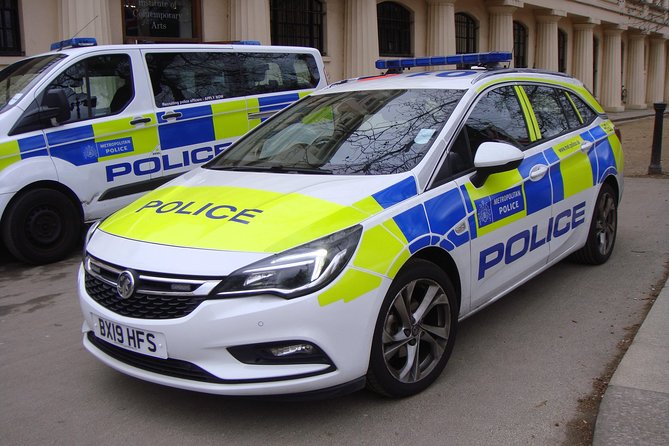
Next you are at Charing Cross, and the tour leans into the darker side of the city’s past. You hear tales of grisly murder and mayhem, then you also get to see one of the busiest police stations in Europe.
Even if you have no interest in crime history, I think the built environment helps. Police work is not abstract when you are standing in the shadow of a major station, and it gives weight to the guide’s explanations about what policing looked like in different eras.
You also discover the famous Blue Lamp of London. For a lot of visitors, that is the kind of detail you later see in photos and realize it is more than a random prop, it is part of how people remembered law enforcement in the public imagination. This stop is also about ten minutes, so keep your questions focused.

Sherlock Holmes Pub Break and Great Scotland Yard
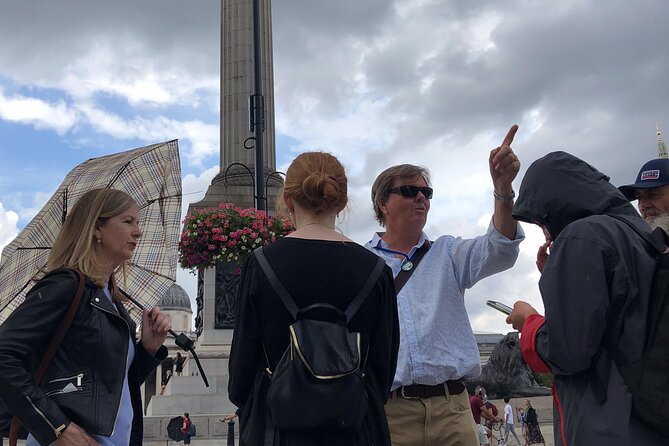
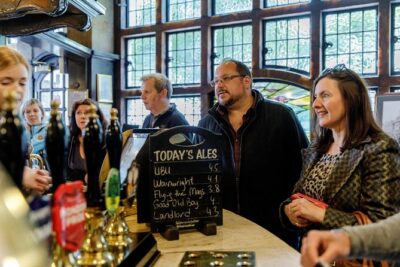
Then comes a very London-style pause at the Sherlock Holmes Pub. The guide stops for a drink at the pub connected to Arthur Conan Doyle’s world famous fictional detective.
I actually like this break because it gives your brain a reset. You go from grimy history to a familiar pop culture anchor, and you get time to relax for a moment without losing momentum.
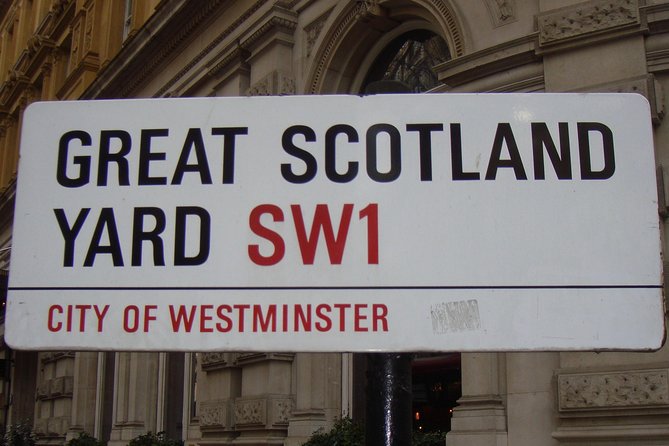
After that, you cross over to Great Scotland Yard to see where policing was described as invented. That last part is important: the tour keeps returning to the idea that the modern system formed through specific institutions, not just gradual vibes.
This part of the walk is around twenty minutes, so it gives you breathing room compared to the faster photo stops.
Trafalgar Square: Celebrations, Riots, and the Worlds Smallest Police Station
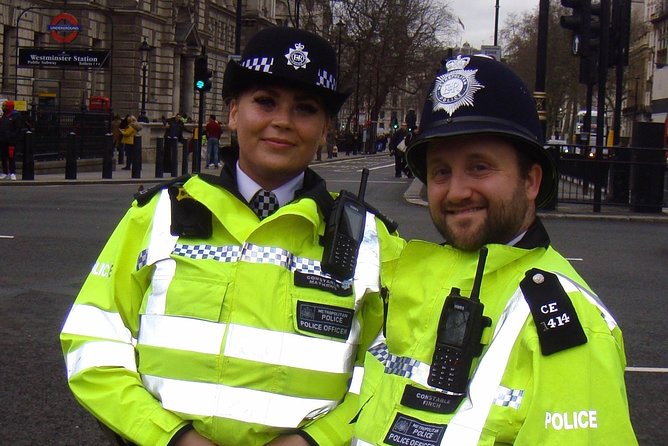
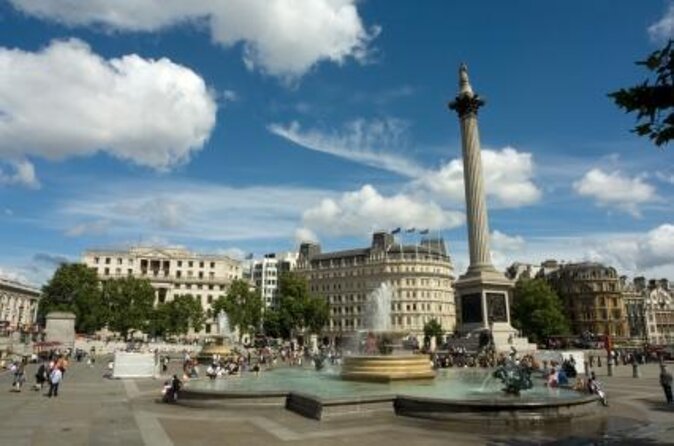
At Trafalgar Square, the tour zooms out to show policing in the middle of public life. The guide connects the space with national celebrations, demonstrations, and riots, all under the watchful eye of what is described as the worlds smallest police station.
This is one of my favorite types of stop because it ties law enforcement to everyday civic energy. You are not only thinking about detectives and courtrooms, you are thinking about crowds, order, and how policing gets tested when people show up in big numbers for big feelings.
There is also a useful lesson here if you like understanding cities beyond the obvious. Places like Trafalgar Square are designed for spectacle, and policing has to adapt to that reality.
The time is about ten minutes, so you will likely do this as a photo plus quick explanation stop. Still, it lands well because the square is already a major landmark you probably plan to see anyway, and now you see it with a different lens.
Whitehall and Downing Street: Women in Policing and Wartime London
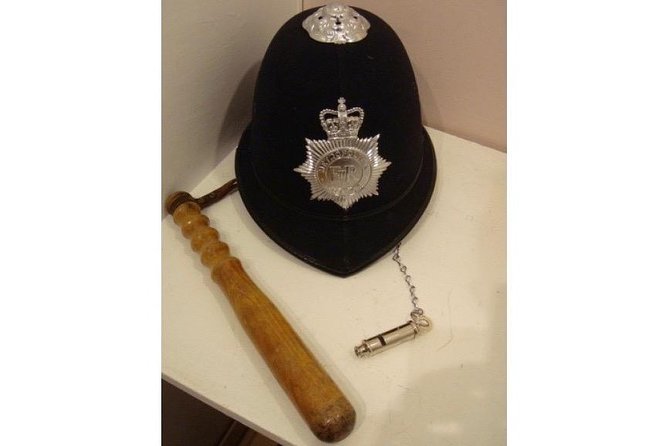
Whitehall is next, and you are getting a view into the governmental spine of London. You see the heart of government at Downing Street, then you learn about the role of women in policing and the police in wartime London.
This stop is valuable because it changes the angle. Instead of focusing only on crime scenes, you are looking at institutional history and social change within enforcement. The mention of women in policing is also a reminder that law enforcement evolved through people stepping into roles, often against resistance.
If you are the kind of traveler who enjoys how history connects to modern governance, this is a good match. You are literally standing in the vicinity of the political center while the guide points out how policing operated during pressure points like wartime.
Again, the stop is about ten minutes. It is short, but the themes are broad, so the guide has to keep things crisp and story driven.
Great Scotland Yard and the Metropolitan Police Revolving Sign
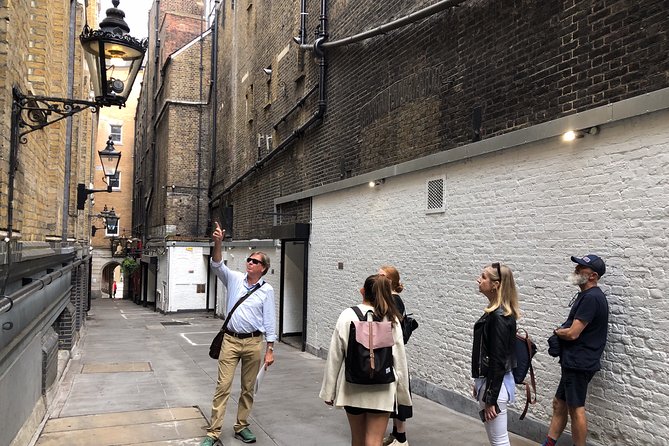
You end with two closely related locations, both tied to London policing’s identity.
At Great Scotland Yard, you see where London Police was created, described as the first Police HQ. It is one of those moments where you can feel the tour tightening into a conclusion. You start with early policing introduction at Bow Street, and by the end, you are seeing the institutional core sites.
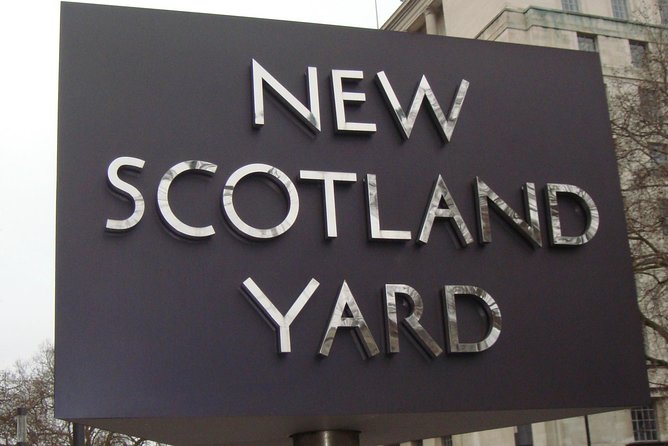
Then you also see the iconic revolving sign linked with the Metropolitan Police. This is the kind of landmark detail that sticks because it is visual. Even if the sign is familiar in photos, it hits differently once you have the context of what it represents and why it is associated with the organization.
These final stops are short, about ten minutes each, but they work as a wrap up. By the time you finish, you should be able to picture how policing grew from early structures into something recognizable and still present today.
The Real Value: What You Get from a Former Officer Guide
What makes this tour more than a checklist is the guide’s background. The experience is led by Francis Mullan, with a former police officer perspective, and that shows in the kind of details offered on the street.
In particular, I like that the stories mix history with a sense of present day realities, including cold case type references mentioned in the tour style. Even when you do not know the case specifics, the guide helps you understand how investigations are built, how evidence gets treated, and why police work depends on both procedure and people.
You also get practical conversation. The guides answer questions, and because it is a small group, you are not stuck shouting into a crowd. If you travel with family, this format also works because the guide can explain the context in a way that keeps it understandable.
One more value point: the tour includes kit and equipment and an opportunity to examine real historic items of police regalia. That hands on element is huge for many visitors because it turns history from something you read into something you can see up close. Even a short look can change how you picture the past.
Price and Value: Why $48.61 Can Make Sense
The price is $48.61 per person for about two hours and fifteen minutes. On its face, that is not the cheapest way to see central London. But it can be good value because you are buying three things at once: a guided walk, a tight thematic route through major sites, and included kit time to examine historic regalia.
Also, you do not have to budget for separate admission tickets at each stop. The tour description indicates admission ticket free at the major locations, so you are mainly paying for the guide and the experience of tying it together.
Another value signal is the small group size, max 20 travelers. In a theme tour, that tends to improve the quality of interaction. You get more chances to ask what you actually care about and get answers that fit your questions.
If you are the type of traveler who enjoys museums but also likes getting out onto the street, this sits in the sweet spot. It is not just a bus tour, and it is not a long marathon walk either.
How the Timing Works on a Two Hour 15 Minute Walk
You should expect a steady rhythm. The walking segments are broken up by short stops, and most locations are around ten minutes, with a longer stretch at the Sherlock Holmes Pub plus the move over toward Great Scotland Yard.
This timing is practical for two reasons. First, it helps you cover major sights without draining your legs. Second, it keeps the stories focused, because a short stop forces the guide to highlight what matters rather than throwing every fact at you.
It also means you should show up with comfortable footwear. Even though the pace is gentle, you are still on city pavement and you are still walking between several key points. If you plan to do other activities the same day, this is a solid way to anchor a half day theme without taking over the whole itinerary.
Who This Tour Suits Best
I think this tour is a great fit if you like one of these styles of travel.
First, if you enjoy crime and justice history, you will like the combination of famous locations and specific policing evolution, from Bow Street to Scotland Yard related sites. The tour keeps returning to institutions, not just sensational events.
Second, if you like meeting an expert who can answer questions, you will appreciate the former police officer perspective. It is the kind of guide background that changes how you experience the information, especially when you ask about investigations or how policing operated at different times.
Third, it can work for families who are curious but not looking for gore. The pace is manageable, and the stop structure makes it easy to keep younger travelers engaged.
If you dislike dark subject matter, or you simply want the clean, cheerful highlights, you might find parts of it a bit heavy. In that case, you could still enjoy the landmark focus, but know the tour theme leans into murders and mayhem.
Should You Book This Crime and Policing Walking Tour?
Book it if you want an efficient, small group walk through central London with a real policing perspective. The combo of major landmarks, early policing history, and hands on regalia time is a strong value package for the price.
Skip or consider something lighter if you want only upbeat sightseeing. This is not a ghost tour, but it does discuss murders, cold case style references, and other grim themes tied to real locations.
If you do book, I suggest you come ready to ask questions. With a group size of 20 max and a guide who answers, your experience improves fast when you steer the conversation toward what you genuinely want to understand.
FAQ
How long is the Crime and Policing London Walking Tour?
It runs for about 2 hours and 15 minutes.
How much does the tour cost?
The price is $48.61 per person.
Where does the tour start and where does it end?
It starts at Covent Garden, at Underground Ltd, Long Acre, London WC2E 9JT. It ends at 35 Victoria Embankment, London SW1A 2JH, near Westminster Underground Station.
Is the tour offered in English?
Yes, the tour is offered in English.
How big is the group?
The tour has a maximum of 20 travelers.
What is included in the ticket price?
The tour includes kit and equipment, and it includes the opportunity to examine real historic items of police regalia.
Are there admission tickets required for the stops?
The stops listed are shown as admission ticket free.
Is there a pub stop during the walk?
Yes. There is a stop at the Sherlock Holmes Pub for a drink.
Is comfortable walking required?
It is a walking tour at a gentle pace. Comfortable footwear is recommended, and refreshment and toilet stops will be available if required.
What happens if weather is poor or the minimum number of travelers is not met?
The experience requires good weather. If canceled due to poor weather, you will be offered a different date or a full refund. If canceled because the minimum number of travelers is not met, you will be offered a different date or a full refund.
More Of London On Foot


Fresh off the notebook in London
- Private Rock ‘n’ Roll Music Tour of Central London
★ 5.0 · 7 reviews - London Walking Tour: Camden Town Photography Walkabout
★ 5.0 · 7 reviews - Private Transfer from London accommodation to Cruise terminal
★ 5.0 · 7 reviews - Amazing Nightlife in London East Tour
★ 4.5 · 7 reviews - The British Museum: a highlights tour with a TV historian
★ 5.0 · 7 reviews - Heathrow Airport to Cambridge private taxi transfers
★ 5.0 · 7 reviews
Walking Tours, compared.
 ★ 5.0Oxford University Walking Tour With University Alumni GuideFrom $416,905 reviews
 ★ 5.0Tour for Muggles The Ultimate Harry Potter Walking Tour in LondonFrom $234,684 reviews
 ★ 5.0London Jack The Ripper Guided Walking TourFrom $03,131 reviews
 ★ 5.0Cambridge University Walking Tour by Alumni™ Kings College OptionFrom $332,336 reviews
 ★ 5.0Blackbeard to Banksy – The Ultimate Walking Tour of BristolFrom $181,961 reviews
 ★ 5.0Air Raid Shelter + St. Nicholas Market Walking TourFrom $171,950 reviews
 ★ 5.0Walking Tour of Bath with Blue Badge Tourist GuideFrom $301,877 reviews
 ★ 5.0Changing of the Guard Guided Walking Tour in LondonFrom $251,793 reviews