
REVIEW · WESTMINSTER AND PARLIAMENT TOURS
London: Churchill & World War 2 Walking Tour
London history comes with street-level detail. This 2 to 3 hour walking tour threads Winston Churchill and World War II through major government and memorial sites in central London. I love the way it mixes Churchill’s public image with the machinery of the war effort, and I also love how the stops are easy to follow on foot, with short time in each place so you never feel stuck in one spot.
One thing to plan for: the Churchill War Rooms are only viewed from the outside on this tour, and entry tickets are not included. If you want to go underground and see the exhibits, you’ll need to buy that separately.
In This Review
- Key things to know before you go
- A Churchill walk that is more than statues and speeches
- Timing, meeting point, and how the route feels on your feet
- Churchill War Rooms: what you see, what you do not
- Downing Street and the Churchill statue in Parliament Square
- Battle of Britain Memorial: reading courage in bronze friezes
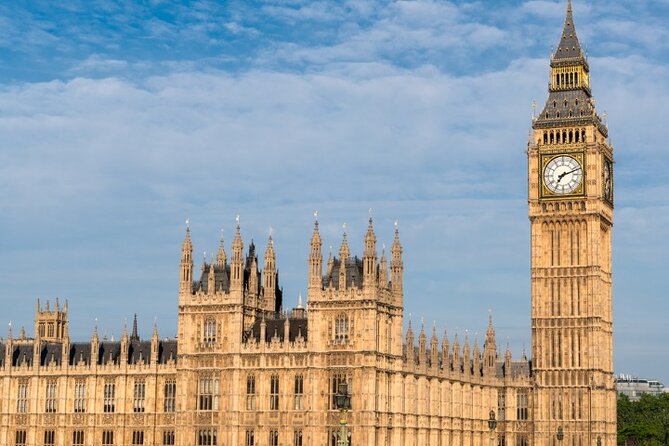
- Houses of Parliament: resilience in the middle of air raids
- Women of World War II Memorial and the Cenotaph: two styles of remembrance
- Ministry of Defence and HM Treasury: the war machine behind the headlines
- St Margaret’s Church on Parliament Square: Churchill’s wedding connection
- So, what you really learn from this tour
- Price and value: $19.01 is fair, but plan for War Rooms tickets
- Who should book, and who may prefer another format
- Should you book this Churchill and World War II walking tour?
- FAQ
- Is the Churchill War Rooms ticket included?
- How long is the walking tour?
- Where does the tour start and end?
- What time does the tour depart?
- What sites are included on the walk?
- Is it suitable for prams or mobility aids?
- Can I cancel for a full refund?
Key things to know before you go
- Churchill War Rooms exterior only: you’ll see the complex, but entry is not part of the tour
- A tight central route: you hit Parliament Square, Downing Street, and major memorials without long detours
- Memorials with clear meaning: the Battle of Britain, Women of World War II, and the Cenotaph each add a different lens on sacrifice
- Government as a theme: Downing Street, the Houses of Parliament, Ministry of Defence, and HM Treasury connect Churchill to how Britain functioned
- Small-ish group size: up to 25 travelers, guided in English with mobile ticketing
The Westminster end of town, walked a few ways
- Westminster to Greenwich Sightseeing Thames Cruise in London★ 4.5 · 2,969 reviews
- London’s Palaces & Parliament Tour (See Over 20+ London Top Sights)★ 5.0 · 1,609 reviews
- Westminster Guided Walking Tour with Abbey Entry★ 5.0 · 1,282 reviews
- Walking Tour of London Westminster Abbey, Big Ben, Buckingham★ 4.5 · 1,213 reviews
A Churchill walk that is more than statues and speeches
If you’re the kind of traveler who likes your history grounded in real places, this tour fits well. You’re not stuck reading plaques. You walk from iconic landmarks to commemorative monuments, and the guide ties each stop back to wartime leadership and decision-making.
What makes it especially worthwhile is the balance. Yes, you’ll spend time on Churchill’s story and legacy. But the route also leans hard into how the British government kept operating under pressure, even when London was being targeted.
Timing, meeting point, and how the route feels on your feet
The tour starts at 1:30 pm at Embankment station (Embankment Pl, London WC2N 6NS). It ends in front of the Churchill War Rooms at King Charles St, London SW1A 2AQ, with the note that entrance tickets are not included.
Expect about 2 to 3 hours total. The stops are short, which is good if you get restless on long walks. It also means you see a lot of key sites without draining your energy.
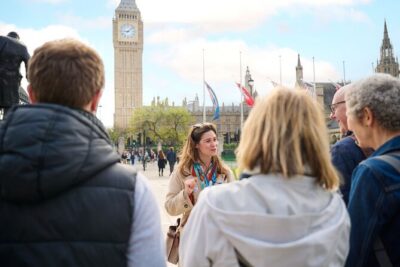
This is also a practical tour for central London logistics. It’s near public transportation, and you get a mobile ticket. The group is capped at 25 travelers, which usually makes it easier to hear the guide and ask questions.
One caution: the tour is not suitable for guests with walking or mobility difficulties, and it is not suitable for prams, buggys, or strollers. If you need step-free access or extra mobility support, you’ll want to choose another option.
Churchill War Rooms: what you see, what you do not
The walk begins with Churchill War Rooms, described as the historic underground nerve centre of British operations during World War II. The bunker complex is where Churchill and his staff worked to steer Britain through the crisis, shielded from bombings.
Here’s the key practical point: you only get an exterior look. The stop explicitly notes Churchill War Rooms admission tickets are not included. So while you can take in the location and context, you should not expect to go inside for the underground exhibits.
If the War Rooms are a must-see for you, plan to add an extra visit either before or after the tour. That way you get both experiences: the guided street-level story here, plus the full interior museum experience on your own.
Downing Street and the Churchill statue in Parliament Square
From the War Rooms area, the route heads toward 10 Downing Street, the famous address tied to Britain’s political leadership. The guide’s angle here is what Downing Street represented during wartime, as the government’s decision-making hub.
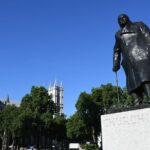
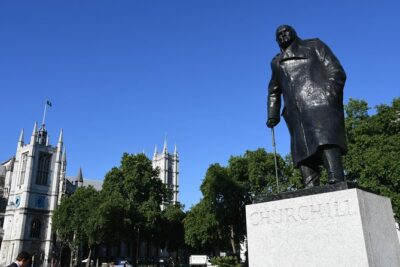
Next up is the Winston Churchill statue in Parliament Square, near the Houses of Parliament. The bronze figure shows Churchill in a determined posture, wearing a military overcoat and leaning on his cane. It’s the kind of statue that’s easy to rush past, but on this tour it’s treated like a public message: Churchill as the face of defending democracy during the war.
The payoff at these stops is perspective. You start seeing the war not just as battles and air raids, but as leadership in plain sight, in the center of political London.
More on foot, at a pace you can hear the guide

Battle of Britain Memorial: reading courage in bronze friezes
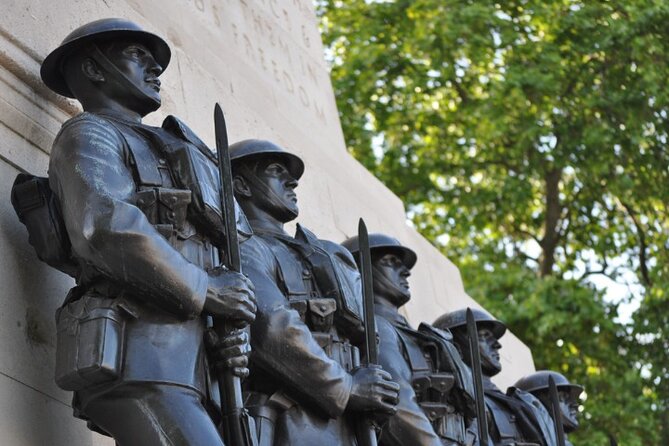
One of the most moving stops on the route is the Battle of Britain Memorial. This monument commemorates the Royal Air Force pilots who defended Britain during the critical air campaign of World War II.
The memorial isn’t just a name wall. It includes a detailed bronze frieze that depicts scenes from the battle and also includes the names of airmen who served. It’s one of those places where the guide can slow your pace a bit, because the details matter.
When a tour includes this kind of stop, you should treat it as a chance to absorb. Take a moment to look at the frieze and scan the names if you can. Even if you’re not an aviation history buff, this stop turns the war into something specific: people and missions, not just dates.
Houses of Parliament: resilience in the middle of air raids
The tour then lands at the Houses of Parliament, and the point is resilience. During World War II, the buildings were targeted in air raids, including significant damage to the Commons chamber in 1941. Yet parliamentary sessions continued, and that continuity is part of the story.
You also get Churchill connected to the setting. The route frames the Houses of Parliament as a stage for some of Churchill’s most iconic wartime speeches, speeches meant to rally the nation.
This is a good moment to pay attention to what you’re seeing. Even if you already know Churchill’s role, the connection to how government kept working under threat makes the story feel more complete.
Women of World War II Memorial and the Cenotaph: two styles of remembrance
The tour includes two separate memorial stops that complement each other.
First is the Women of World War II Memorial, which honors the contributions of British women during the Second World War. The memorial includes a bronze statue of a woman in overalls, representing women who worked in essential wartime roles, including civil defense, military services, and wartime industries.
This matters because it shifts the lens. A lot of WWII storytelling gets stuck on combat. This stop helps balance the picture by emphasizing that the war effort relied on far more than frontline action.
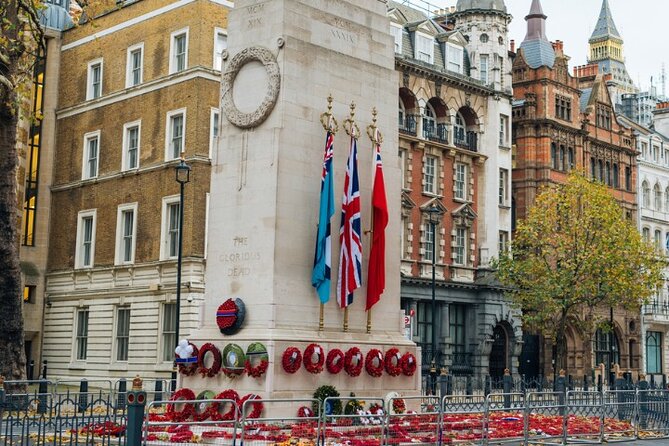
Then you reach the Cenotaph, a solemn war memorial dedicated to British and Commonwealth soldiers who died in both World Wars and later conflicts. Every year on November 11, Remembrance Day ceremonies honor fallen soldiers here.
It’s hard to keep your tone light at the Cenotaph. That’s the point. This stop gives the tour emotional weight, and it works well after the Women of World War II stop, because it widens remembrance from roles in wartime to ultimate sacrifice.
Ministry of Defence and HM Treasury: the war machine behind the headlines
A lot of Churchill tours focus on speeches and symbolism. This one also walks through the places tied to the practical work of national defense and war administration.
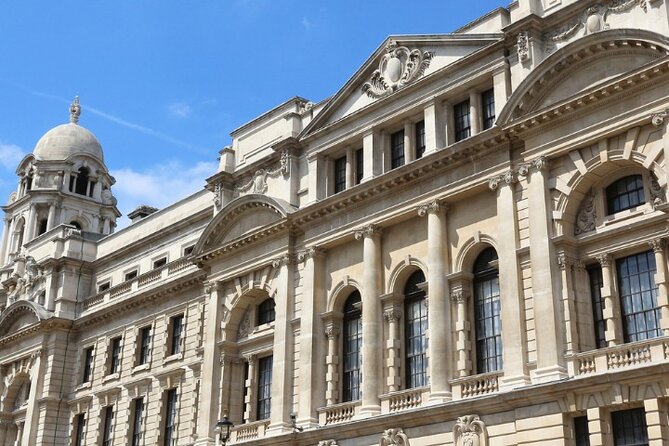
At the Ministry of Defence (MOD), the guide frames it as the British government department responsible for national defense and military affairs. You learn how it coordinates defense policy and oversees the armed forces, with the MOD headquarters in a historic building.
Then the route continues to HM Treasury, where the focus is wartime finances and administration. The Treasury Building is described as a key site for managing Britain’s war economy. It’s also noted that its basement served as an emergency hub during air raids, protecting officials.
Even if you feel like you don’t know anything about war budgets, this is a valuable part of the walk. The war didn’t just happen on battlefields. It required coordinated funding, supply decisions, and continuity under threat. Seeing those departments on a map of central London helps the story stop being abstract.
St Margaret’s Church on Parliament Square: Churchill’s wedding connection
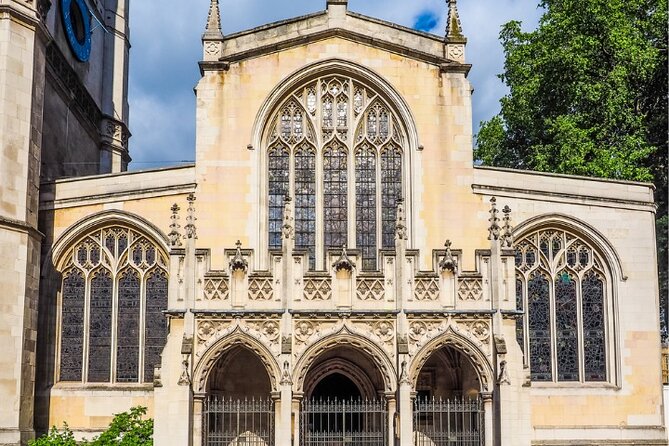
One of the more personal stops on the route is St Margaret’s Church near Parliament Square. The church has a special connection to Winston Churchill because it is the site of his 1908 wedding to Clementine Hozier.
The church dates back to the 12th century and is known as the Church of the House of Commons. For the tour, the point is to remind you that Churchill’s wartime role lived alongside a personal and cultural life rooted in Britain’s long political tradition.
If you like history that includes people, not just institutions, this stop gives you a human thread to hold onto as the walk moves between government buildings and memorials.
So, what you really learn from this tour
By the time you reach the end in front of the Churchill War Rooms, you should feel you’ve learned two connected things.
First, you get Churchill as a symbol in public space. That includes the statue in Parliament Square and the broader focus on his leadership during the air war and the wider fight for democracy.
Second, you learn how government functioned during World War II. That thread runs through Downing Street, the Houses of Parliament, the Ministry of Defence, and HM Treasury. Even without going inside the underground War Rooms, the route helps you understand that leadership meant coordination across politics, defense, and money.
That combination is likely why people rate this tour so highly. It’s not only Churchill as a name. It’s Churchill as a working system, built into London’s core institutions.
Price and value: $19.01 is fair, but plan for War Rooms tickets
At $19.01 per person, this is priced for what you get: a guided walk through multiple major central London landmarks and memorials, in English, timed for a 2 to 3 hour experience.
A big part of the value comes from the mix of stops. Many of the memorial sites and landmarks are effectively pay-to-view by existing in public space, so the tour itself is doing the heavy lifting by adding context.
The main cost to think about is the Churchill War Rooms admission, which is not included. Since the tour ends in front of the War Rooms, it’s easy to see them as a natural add-on. If the War Rooms are at the top of your list, budget extra so you are not disappointed when you realize the underground exhibits are not part of this guided route.
Also, since the tour ends at the War Rooms area, you can tack on your War Rooms visit without having to make a whole new plan across town.
Who should book, and who may prefer another format
This tour is a strong fit if you want a walking route that connects Churchill, World War II, and the institutions that kept Britain running. It also works well if you like memorials that give you something to read visually, like the Battle of Britain Memorial frieze and names.
It may be less suitable if you want an all-in museum experience. Because Churchill War Rooms entry tickets are not included and the tour covers the War Rooms exterior only, you won’t get the full underground exhibit on this outing.
And if walking is a challenge for you, or you rely on a stroller or pram, the tour is not suitable based on the provided accessibility notes.
Should you book this Churchill and World War II walking tour?
I think it’s a smart choice for the right kind of traveler. If you want a guided way to see central London through the lens of Churchill and wartime government, this tour is good value and easy to fit into a schedule.
Just go in with one expectation set: you will not be touring the War Rooms underground during this walk. If you want that, plan to add tickets separately. If that’s okay with you, this is an efficient, meaningful way to understand why Churchill is tied to both speeches and decision-making, not just a statue in Parliament Square.
FAQ
Is the Churchill War Rooms ticket included?
No. Churchill War Rooms admission tickets are not included. The tour covers Churchill War Rooms as an exterior stop, and it ends in front of the War Rooms entrance.
How long is the walking tour?
The tour lasts about 2 to 3 hours.
Where does the tour start and end?
It starts at Embankment station (Embankment Pl, London WC2N 6NS) and ends in front of the Churchill War Rooms at King Charles St (London SW1A 2AQ).
What time does the tour depart?
The start time is 1:30 pm.
What sites are included on the walk?
Stops include Churchill War Rooms (exterior only), 10 Downing Street, the Winston Churchill statue, the Battle of Britain Memorial, the Houses of Parliament, the Women of World War II Memorial, the Cenotaph, the Ministry of Defence, Saint Margaret’s Church, and HM Treasury.
Is it suitable for prams or mobility aids?
No. The tour is not suitable for guests with walking or mobility difficulties, and it is not suitable for prams, buggys, or strollers.
Can I cancel for a full refund?
Yes, you can cancel for free up to 24 hours in advance of the experience start time for a full refund.
More Of London On Foot


Around Westminster And Whitehall

Fresh off the notebook in London
- Witchcraft, Ancient Cults & MI15 Spy Secrets
★ 4.0 · 3 reviews - Arrival Transfer: London Train Stations to London Hotels
★ 5.0 · 3 reviews - Royal Afternoon Tea & Walk at Kensington Palace
★ 4.5 · 3 reviews - Bridgerton Tour in London
★ 5.0 · 3 reviews - Private Transfer from central London to Southampton Cruise Terminal
★ 5.0 · 3 reviews - Photographer, Professional Photo Shoot – London
★ 5.0 · 3 reviews
Westminster and Parliament Tours, compared.
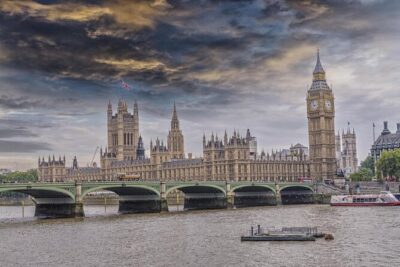 ★ 4.5Westminster to Greenwich Sightseeing Thames Cruise in LondonFrom $222,969 reviews
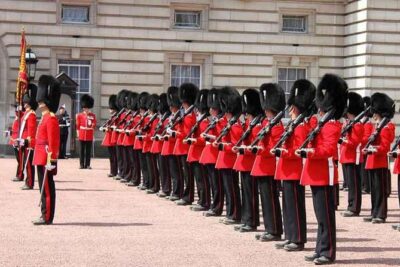 ★ 5.0London’s Palaces & Parliament Tour (See Over 20+ London Top Sights)From $301,609 reviews
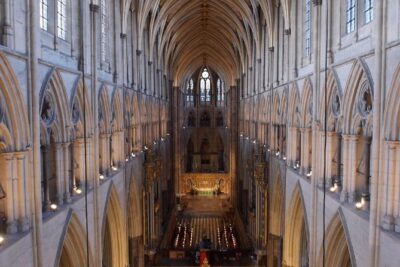 ★ 5.0Westminster Guided Walking Tour with Abbey EntryFrom $1221,282 reviews
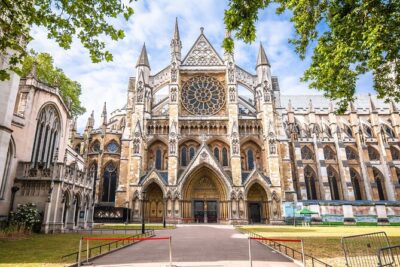 ★ 4.5Walking Tour of London Westminster Abbey, Big Ben, BuckinghamFrom $951,213 reviews
 ★ 5.0Westminster 3 Hour Walking Tour and Visit of Churchill War RoomsFrom $135967 reviews
 ★ 4.5WW2 London Walking Tour & Churchill War Rooms Entrance TicketFrom $60933 reviews
 ★ 5.0Speedboat Cruise Tour: Embankment OR Westminster Pier -70 minutesFrom $102777 reviews
 ★ 5.0Skip the Line Tower of London & Westminster Tour and River CruiseFrom $165730 reviews
Browse the lists this tour appears in