
REVIEW · WALKING TOURS
London Mystical and Dragons Walking Tour
London hides dragons in plain sight. This London Mystical and Dragons Walking Tour strings together sacred stones, Roman rites, and church symbols across the City of London, with small group attention. You’ll also take home a PDF of the locations you saw, so the stories can keep going after you leave the sidewalk.
My favorite part is the way guide Arjun ties myth and street-level details into one easy walk. Expect lots of stops where you can actually spot the symbols you’re hearing about, and a pace that leaves room for questions and quick check-ins.
One thing to consider: on some public holidays, a few key churches or sites may be closed, so you might get photos or alternative viewing instead of going inside. If you hate surprises, plan for that.
In This Review
- Key things to know before you go
- A City of London walk built on myth, symbols, and “sacred plumbing”
- Start at Cannon Street, end at Temple Bar, and keep your shoes ready
- London Stone, the protector rock, and the idea of a city that stays “safe”
- Bloomberg Arcade and Walbrook: where “forgotten rivers” make sense of the streets
- The Roman Mithras moment, where occult knowledge meets street view
- Bank of England and the City of Dragons, power built on layered ground
- St Mary Le Bow and Bow Bells: why church details matter
- Cheapside’s oldest tree reminder: the lost and the remembered
- St Paul’s Cathedral: ceremony, time, and the phoenix idea
- St Martin-within-Ludgate and the “ancient enigmas” angle
- Ludgate Circus and lost rivers, plus a mythic origin story
- St Bride’s Church and the well: pagan history in a very specific place
- St Dunstan in the West: medieval symbolism, quick and sharp
- Temple Church and the Knights Templar link to the Holy Sepulchre
- Temple Bar Memorial: the fiercest dragon guardians and myth crossover
- The PDF recap: your take-home map for re-walking the stories
- Value and who this tour is really for
- Should you book the London Mystical and Dragons Walking Tour?
- FAQ
- How long is the London Mystical and Dragons Walking Tour?
- What is the price per person?
- Where is the meeting point and where do we end?
- How many people are in the group?
- What language is the tour offered in?
- Do the tour stops have admission fees?
- What if the weather is poor?
Key things to know before you go
- Small group of up to 8 means you get personal attention instead of feeling like a number.
- London Stone and the under-city water stories set the tone for how the walk connects protection myths to real streets.
- A Mithras stop brings the Roman layer of London into focus, with esoteric symbolism you can reason about on site.
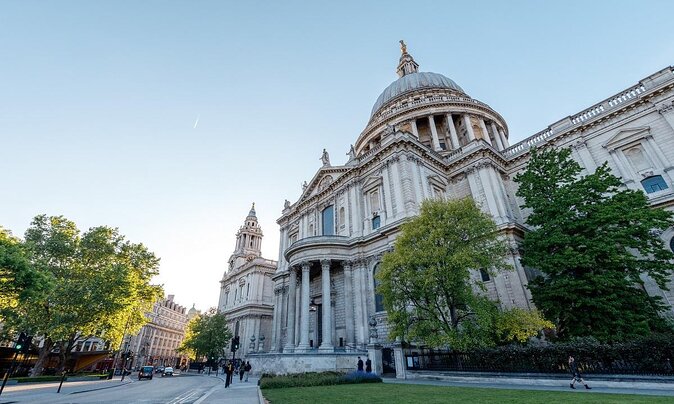
- Iconography stops in working churches include St Mary Le Bow and St Paul’s phoenix themes.
- Temple Church and its Templar connection adds a medieval, symbol-heavy chapter to the route.
- Temple Bar’s protector dragons closes the tour with mythology that stretches from Beowulf to St George.
More on foot, at a pace you can hear the guide
- Tour for Muggles The Ultimate Harry Potter Walking Tour in London★ 5.0 · 4,684 reviews
- London Jack The Ripper Guided Walking Tour★ 5.0 · 3,131 reviews
- Changing of the Guard Guided Walking Tour in London★ 5.0 · 1,793 reviews
- The Great British Rock and Roll Walking Tour★ 5.0 · 1,371 reviews
A City of London walk built on myth, symbols, and “sacred plumbing”
This tour is for people who like London beyond the standard postcard hits. The big theme is simple: the City of London is packed with repeating symbols, old meanings, and stories that supposedly map to something deeper than street names. You walk through that idea in layers, from ancient protection tales to Roman ritual to medieval religious symbolism, and finally to the City’s dragon guardians.
I liked that the tour doesn’t feel like a lecture you endure. It feels like a map you can follow. You stop, look, listen, then look again, because the guide points out details you would miss on your own. Even if you’re not sure how to interpret everything, the sights are real and the thinking is fun.
Start at Cannon Street, end at Temple Bar, and keep your shoes ready
The walk starts at 113 Cannon St, London EC4N 5AW, and it begins at 1:30 pm. You end at Temple Bar Memorial in the City of London, a spot conveniently close to the Royal Courts of Justice. It’s roughly 2 to 3 hours, and because the group is capped at 8 travelers, the pace stays human.
It’s also a walking tour in the truest sense. Even with frequent short stops, you’ll cover a fair amount of ground across the City. I’d plan on a solid afternoon and wear comfortable shoes. One practical bonus: the stops are shown as admission ticket free, which usually means you’re viewing from outside, in church areas that do not require extra ticket purchases, or making quick on-site look-ins as you go.
The tour runs in English, and you get a mobile ticket plus confirmation at booking. And yes, it needs decent weather. If the day is too rough, the experience can be moved or refunded.
London Stone, the protector rock, and the idea of a city that stays “safe”
Stop one is the London Stone, a sacred stone tied to the belief that it helps keep London safe. Even if you take the myth as myth, the stop works because it forces you to ask a useful question: why do people put meaning onto particular places?
You only spend about 10 minutes here, so treat it like a “read the page before moving on” moment. The guide frames London Stone as more than a curiosity. It becomes your first example of how the City’s identity is carried through physical objects, not just monuments.
Drawback to watch for: it’s brief. If you love lingering, this is more of a quick orientation stop than a deep museum moment.
Bloomberg Arcade and Walbrook: where “forgotten rivers” make sense of the streets
Next up is Forgotten Streams at Bloomberg Arcade, tied to the old Walbrook river story. The point here is not to memorize a hydrology lesson. It’s to realize the City’s streets may sit on a past world, and that past world shows up in how stories are told about power and direction.
You’re there for about 5 minutes, and that short time works if you’re paying attention to what the guide connects: present-day London layouts versus the idea of buried or lost waterways. You’ll walk differently after hearing this, because even small street turns feel like they’re holding older routes.
What you’ll like: the tour treats the idea of “water under the city” as a thread that helps tie later stops together.

The Roman Mithras moment, where occult knowledge meets street view
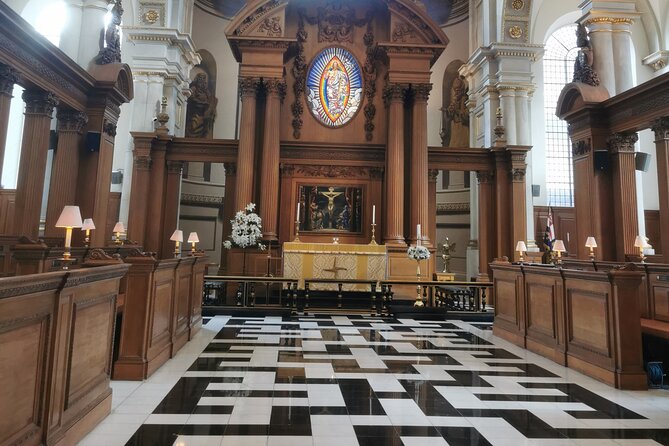
At the middle of the route, you hit a stop tied to the Sun god Mithras, worshipped by Romans, with the tour presenting it as a doorway into ancient occult knowledge. The framing is esoteric, but the value is practical: it gives you another lens for how symbols travel across time.
This is one of those moments where the guide’s storytelling matters. You’re not just hearing the name Mithras. You’re learning how this Roman layer shows up in meaning, symbolism, and the way people interpreted spiritual power in physical spaces.
Consideration: if your idea of a great London tour is mainly big-venue interiors, this part may feel more “symbol explanations from the outside” than “ticketed excavation experience.” Still, it’s one of the strongest jumps in time on the itinerary.
Bank of England and the City of Dragons, power built on layered ground
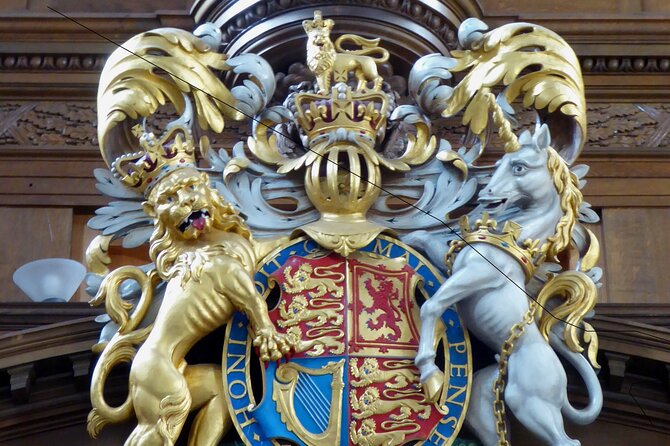
Then you reach the Bank of England, described as a seat of power for the City of Dragons, with a link back to a forgotten river idea. This stop is short, about 5 minutes, which again means it’s set up for pattern-spotting.
Here’s what makes it satisfying: you’re not only seeing famous buildings. You’re seeing them as part of a bigger symbolic map. When you hear the “dragons” concept applied to the City’s power centers, it stops being fantasy and becomes a way to interpret how Londonians might have explained dominance and protection long before modern banking.
St Mary Le Bow and Bow Bells: why church details matter
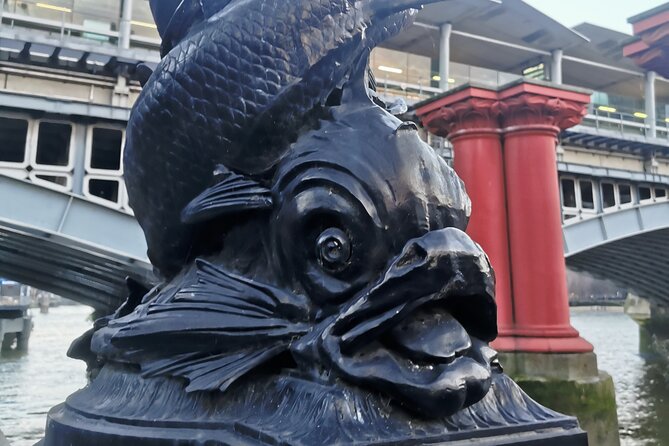
At St. Mary Le Bow Church, you explore sidelined symbolisms linked to Bow Bells. You’ll spend around 10 minutes here. This is one of those stops where the tour shifts from “old myth” to “look closer at the present.”
The church details become your clue practice. The guide points out how symbol language can travel, even when the public ignores it. If you’ve ever stared at a church facade and thought, “I know it’s old, but I don’t know what I’m looking at,” this is built for you.
Small downside: church time can depend on access and opening. If a building cannot be entered, expect the emphasis to shift to exterior features and explained symbolism.
Cheapside’s oldest tree reminder: the lost and the remembered
Next is Cheapside, where the tour connects the area to the oldest tree in the City of London and also to the memory of trees that are now lost. You stop for about 5 minutes, and the emotional impact can surprise you.
This moment works because it adds a different kind of “mythical London.” Not every symbol is stone or carving. Sometimes it’s the idea of continuity, a living marker that tells you the City has changed but meaning tries to stick around.
If you enjoy walking tours that include nature references inside an urban core, this stop gives you a breather between heavier symbolism.
St Paul’s Cathedral: ceremony, time, and the phoenix idea
At St. Paul’s Cathedral, you’re guided to the idea that the cathedral has been a place of ceremony since time immemorial, and that it connects to the phoenix as a symbol. This stop is about 10 minutes.
I like this stop because it’s both big and specific. St Paul’s is already famous. The tour makes it feel personal by pointing you to a symbolism thread you might not notice on your own. The phoenix theme works as a metaphor for London itself, repeatedly rebuilt and reimagined.
What to expect: you’ll mostly be looking and listening, not doing a full inside visit. If St Paul’s interior is your top priority, you may want to plan a separate time for that.
St Martin-within-Ludgate and the “ancient enigmas” angle
Stop seven is Church of St. Martin-within-Ludgate, with an emphasis on its long history and the “ancient enigmas” it holds. You get about 20 minutes, which is longer than several stops on the route.
This is where the tour starts to feel like slower reading. The guide gives you background, then uses that background to help you interpret what you see. If you like thinking rather than just watching, this part delivers.
Tip for your own experience: if you’re the type to look at architecture patiently, take advantage of this longer stop. Ask questions. This tour is built for them.
Ludgate Circus and lost rivers, plus a mythic origin story
At Ludgate Circus, you revisit the “lost rivers” idea and also hear about a king tied to how London got its name. The stop is about 5 minutes.
It’s short, but the stop is useful because it reinforces the route logic. The walk keeps returning to the same “core idea” using different locations: protection and power, buried waterways, and how myths help explain origins.
If you’re prone to getting tired of quick stops, focus on the guide’s connections. That’s what turns the time into value.
St Bride’s Church and the well: pagan history in a very specific place
Then you head to St Bride’s Church, which the tour frames as having pagan history and hosting a Well. You spend around 20 minutes here.
This stop is one of the most interesting shifts on the itinerary. It takes you from “big city power” and “Roman symbolism” into something that feels more grounded: a particular well, a particular place, and the idea that belief systems layer onto one another over time.
Even if you’re skeptical of interpretation, the practical payoff is that you’ll notice church spaces differently afterward. You’ll stop treating old buildings like decoration and start treating them like systems of meaning.
St Dunstan in the West: medieval symbolism, quick and sharp
At St. Dunstan in the West, you spend about 5 minutes. This one is framed as a medieval church with ancient symbolism.
This stop is fast, but it’s not random. It’s part of the tour’s steady rhythm of: stop, theme, symbol, move. If you like a tour that builds momentum rather than sitting in one place too long, you’ll appreciate it.
Temple Church and the Knights Templar link to the Holy Sepulchre
The route then includes Temple Church, associated with the Knights of the Templar and described as modeled on the Church of the Holy Sepulchre, with esoteric wisdom revealed through its story. You’ll spend about 20 minutes.
This is a big highlight for myth lovers. The Templars are already a magnet topic. The tour makes it more than trivia by using that connection to explain why symbols and layouts matter.
Practical drawback to consider: sometimes specific churches are not open to visitors. If Temple Church is closed on your day, the guide may pivot to still explain the symbolism and show images. It’s not ideal, but the tour is designed to keep you moving.
Temple Bar Memorial: the fiercest dragon guardians and myth crossover
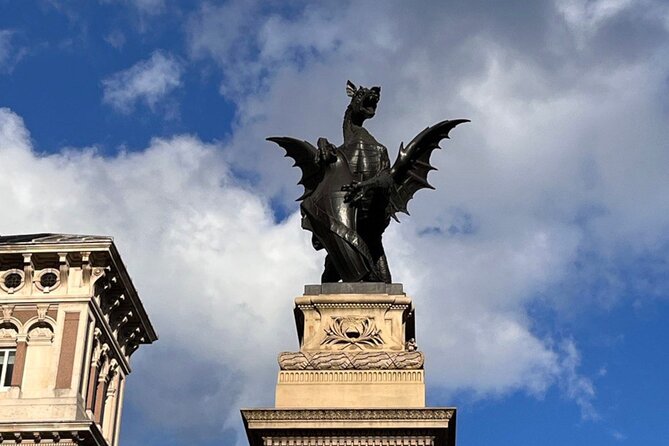
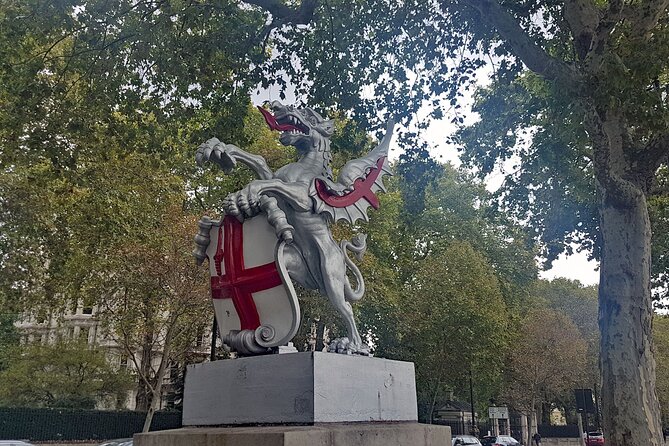
Finally, you end at Temple Bar Memorial, described as the fiercest of the City’s protector dragons. The mythology link here reaches back across sources like Beowulf, Tiamat, and St George.
This ending matters. The tour starts with the idea of protection and sacred stones, and it closes with dragon guardians protecting the City. It’s the same theme expressed in a mythic collage, and it gives you a satisfying sense that the walk had an arc.
If you want a photo moment, this is the one. If you want a final symbol to think about, it’s also the one.
The PDF recap: your take-home map for re-walking the stories
One of the best parts is the included PDF of the locations you saw. That turns your afternoon into a lasting mini self-guided tour.
I recommend using the PDF in two ways:
1) Read it right after the walk while the images are still in your head.
2) Pick one or two stops to return to later if they hooked you.
Small caution: occasionally, timing can affect when you receive it. If you’re traveling with tight plans, give yourself a little buffer before you assume everything arrives instantly.
Value and who this tour is really for
At about $29.48 per person for 2 to 3 hours, the price feels fair for what you get. You’re paying for a guided interpretive walk, and the stops themselves are admission ticket free in the tour format, so you’re not getting nickeled and dimed with entry fees at each stop.
This tour is a great fit if:
- you like folklore, mythology, and symbol spotting
- you want a London walk that feels off the main track
- you enjoy hearing how one theme (like dragons or sacred rivers) links multiple locations
It may not be ideal if:
- you want mostly indoor museum-style stops
- you need everything to be open every single day, including holidays
- you prefer a strict factual approach with minimal myth framing
Should you book the London Mystical and Dragons Walking Tour?
Yes, if you’re the type who likes seeing the City of London as a living symbol machine. This is a fun, thoughtful route that mixes Roman and medieval threads, then lands on dragon protector mythology in a memorable way. The small group size and the guide’s ability to connect what you hear to what you can actually see is the real value.
If you’re going on a big holiday or you’re anxious about closures, go in with flexibility. Expect short stops, outdoor views, and the occasional photo-based substitution. If that’s okay, you’ll probably leave with a fresh way of looking at London, plus a PDF you can use to revisit the same trail on your next free afternoon.
FAQ
How long is the London Mystical and Dragons Walking Tour?
It runs about 2 to 3 hours, depending on pacing and stops.
What is the price per person?
The tour costs $29.48 per person.
Where is the meeting point and where do we end?
You start at 113 Cannon St, London EC4N 5AW, and you finish at Temple Bar Memorial in the City of London, near the Royal Courts of Justice.
How many people are in the group?
The tour has a maximum group size of 8 travelers.
What language is the tour offered in?
The tour is offered in English.
Do the tour stops have admission fees?
The stops on the itinerary are listed as admission ticket free.
What if the weather is poor?
This tour requires good weather. If it is canceled due to poor weather, you will be offered a different date or a full refund.
More Of London On Foot




Fresh off the notebook in London
- Private Rock ‘n’ Roll Music Tour of Central London
★ 5.0 · 7 reviews - London Walking Tour: Camden Town Photography Walkabout
★ 5.0 · 7 reviews - Private Transfer from London accommodation to Cruise terminal
★ 5.0 · 7 reviews - Amazing Nightlife in London East Tour
★ 4.5 · 7 reviews - The British Museum: a highlights tour with a TV historian
★ 5.0 · 7 reviews - Heathrow Airport to Cambridge private taxi transfers
★ 5.0 · 7 reviews
Walking Tours, compared.
 ★ 5.0Oxford University Walking Tour With University Alumni GuideFrom $416,905 reviews
 ★ 5.0Tour for Muggles The Ultimate Harry Potter Walking Tour in LondonFrom $234,684 reviews
 ★ 5.0London Jack The Ripper Guided Walking TourFrom $03,131 reviews
 ★ 5.0Cambridge University Walking Tour by Alumni™ Kings College OptionFrom $332,336 reviews
 ★ 5.0Blackbeard to Banksy – The Ultimate Walking Tour of BristolFrom $181,961 reviews
 ★ 5.0Air Raid Shelter + St. Nicholas Market Walking TourFrom $171,950 reviews
 ★ 5.0Walking Tour of Bath with Blue Badge Tourist GuideFrom $301,877 reviews
 ★ 5.0Changing of the Guard Guided Walking Tour in LondonFrom $251,793 reviews