
REVIEW · STRATFORD AND SHAKESPEARE TOURS
Shakespeare in the City Walk – In Shakespeare’s footsteps North of the Thames
Shakespeare’s London feels brand-new on this walk. You’re guided through a Shakespeare in the City route north of the Thames, built around places most people miss and the links that connect them. I especially like the live performance moments by guide Declan, because they turn dry dates into something you remember.
A couple of practical notes: this is a real walking tour, so you’ll want comfortable shoes and a weather-ready outfit. It runs in all conditions, and the pace expects moderate physical fitness.
In This Review
- Key things to know before you go
- Starting at Blackfriars Underground, getting it right fast
- A two-hour Shakespeare walk with live speeches, not just facts
- EC4Y 0JP to Ireland Yard: the overlooked Shakespeare clues
- St Andrew’s Hill: where the writing story gets personal
- Queen Victoria Street: the totem pole speech and the coat of arms story
- St Paul’s Cathedral outside, Cheapside, and Love Lane’s mixed message
- London Wall to St Giles Cripplegate: houses, marriage regret, and a goodbye speech
- Price and value: what $20.83 buys you in London time
- Who this Shakespeare in the City Walk is best for
- Should you book this Shakespeare in the City Walk?
- FAQ
- Where do I meet the guide?
- Which Blackfriars station should I use?
- What time does the tour start?
- How long is the walk?
- Is the tour offered in English?
- Can I use a mobile ticket?
- What group size should I expect?
- Is it suitable for kids?
- Does the tour run in bad weather?
- What’s included in the price?
- Where does the tour end?
Key things to know before you go
- Meet at Blackfriars Underground, not the overground station across the river area.
- Declan brings Shakespeare speeches to life, including a full speech performance at Queen Victoria Street.
- You focus on overlooked sites tied to Shakespeare’s world, not just the obvious photo stops.
- Small-group feel with a maximum of 15 per booking, which helps with questions and pacing.
- You get literary context in plain English, including how and why certain sites mattered.
- You end at Barbican Underground, with an optional walk to the station for onward travel.
Prefer to see it from the water? Start here
- High-Speed Thames River Speedboat in London★ 5.0 · 3,971 reviews
- London Tootbus Hop on Hop off Bus Tour and Thames River Cruise★ 4.0 · 3,834 reviews
- Westminster to Greenwich Sightseeing Thames Cruise in London★ 4.5 · 2,969 reviews
- London Dinner Cruise on the Thames River★ 4.0 · 1,772 reviews
Starting at Blackfriars Underground, getting it right fast
The whole experience hinges on one location: Blackfriars Underground Station. You meet outside Blackfriars UNDERGROUND, on the Circle and District Lines. The key detail is the warning not to head to Blackfriars overground, which can send you the wrong way fast.
The good news is the setup is simple. There is only one exit at the meeting spot, and your guide will be right there, wearing a sign with Shakespeare’s face. That clarity matters in London, where entrances and exits can multiply like magic tricks. Arrive a few minutes early, so you can scan the area without rushing.
This tour is scheduled for 11:00 am and runs about two hours. It’s ideal if you like starting your day with a plan you can actually follow. And it also works well for locals, because the route is built to point out London details that are easy to ignore when you pass by them every day.
A two-hour Shakespeare walk with live speeches, not just facts

What makes this one different is the way the guide uses performance. Declan, who has a professional actor background, doesn’t just summarize Shakespeare. He delivers key parts like you’re hearing them for the first time, which changes how the words land.
You also get a steady rhythm of story and place. Each stop is short enough to keep energy up, but detailed enough to feel like you’re building a picture. The tour is designed for people who like history and literature, but also for people who are not trying to become walking encyclopedias. You get the meaning, not just the name of the street or building.
The route also keeps you north of the Thames, which is a big reason it feels fresh. London’s Shakespeare story is not only about the big headline landmarks. This walk threads together smaller, easily skipped corners, from a statue most people overlook to church areas linked to theatre and daily life.
Practical upside: the tour is in English, uses a mobile ticket, and includes live entertainment. So you’re not paying for a lecture you could read off a brochure.
EC4Y 0JP to Ireland Yard: the overlooked Shakespeare clues
After you’re set at Blackfriars Underground, the walk begins by placing you in the real Shakespeare zone. The first big lesson is that Shakespeare’s presence in London is not limited to one famous address. It’s scattered, layered, and often hidden in plain sight.
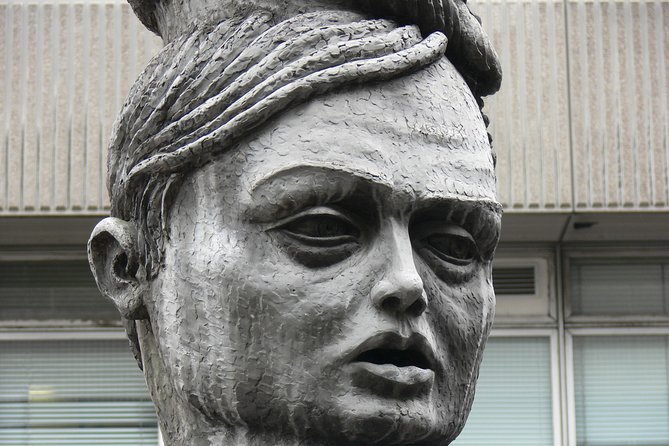
One early highlight is a Shakespeare statue at EC4Y 0JP that many people miss. That’s a theme here. You’re not chasing only famous statues. You’re learning how fame works in cities, and how some memorials get ignored because they’re not on your usual route.
Then you move into church-linked territory connected to the original Blackfriars Theatre. The guide explains why you had to be rich to attend, and how Shakespeare’s fortunes changed over time. That matters because it reframes the idea of Shakespeare as only a poet. He was also a working man in a world where entertainment had price tags and social boundaries.
Next comes Ireland Yard, where you can see a remaining fragment tied to the Blackfriars Monastery. It’s a small physical piece, but it carries heavy storytelling weight: you start to notice the way religious space and theatre space overlap in London’s older streets.
If you like pattern spotting, Carter Lane adds to that. The guide points out a quieter connection that links Shakespeare and King James, using the street layout and nearby context to show how power and culture brushed shoulders.
St Andrew’s Hill: where the writing story gets personal
At St Andrew’s Hill, you hit a cluster of details that make the walk feel more like narrative than sightseeing. The site is connected to a Shakespeare house in London, and the guide shares what happened to it. You also get the claim that a play was likely written in this area, which adds a sense of immediacy. Even if you treat the idea as suggestive rather than absolute, it’s still a strong way to help you imagine Shakespeare moving through these streets.
This stop also includes a church element with hidden depth. You’ll see a hidden sculpture of Shakespeare praying, plus a very important document connected with research. The guide also brings in the story of a researcher who makes Americans proud, which adds an international twist to what can otherwise feel like a purely British setting.
Another reason this stop is worth your attention is tone. The walk doesn’t just say, Shakespeare was great. It asks how greatness got built: the places where time, money, and personal circumstance likely shaped what he wrote and how he lived.
Photo tip: bring your camera, but don’t treat photos as the goal. The sculpture and document references are the kind of thing that are hard to absorb from a distance.
More Shakespeare country, stage and street
Queen Victoria Street: the totem pole speech and the coat of arms story
At Queen Victoria Street, the tour turns showy in the best way. There’s an extraordinary hidden totem pole made from a famous William Shakespeare speech, and you almost certainly would not find it by yourself. Declan delivers the speech in full, which makes the monument feel less random and more intentional.
After the performance, you get the College of Arms connection and the Shakespeare family coat of arms. The guide explains why that honour arrived two months later than expected, and he also shares Ben Jonson’s joke at Shakespeare’s expense. Those bits of London literary gossip matter because they place Shakespeare inside a living network of writers, patrons, and public relationships.
Then the tour circles back to Shakespeare’s children, giving context to how legacy played out in real time, not just as a romantic myth. It’s one of the moments where the walk balances admiration with the less neat reality of family life.
St Paul’s Cathedral outside, Cheapside, and Love Lane’s mixed message
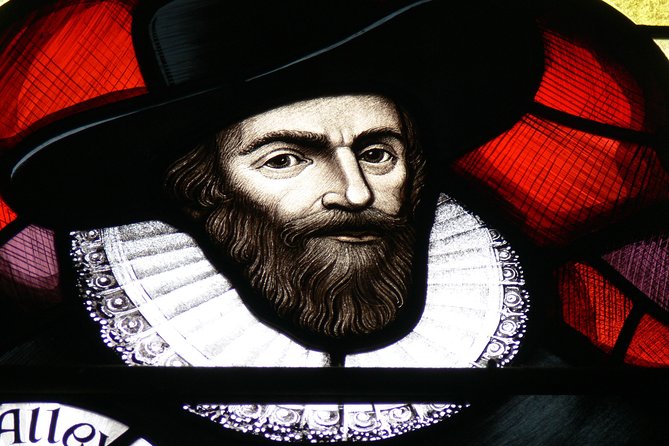
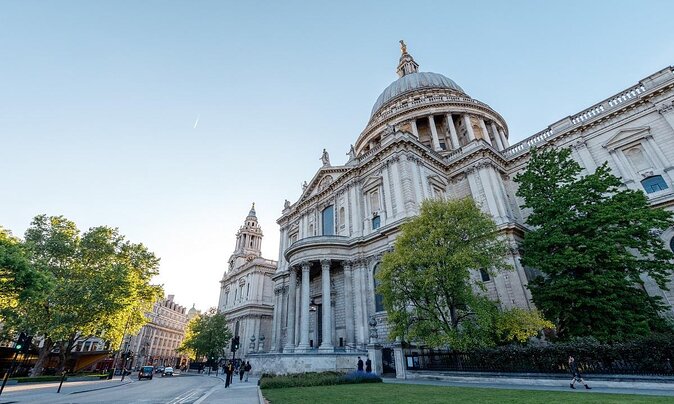
The walk continues toward St Paul’s Cathedral. You don’t go inside, but you get a revealing take on what you’re looking at from outside. The guide links the cathedral setting to Shakespeare’s sonnets and shares a reasonable interpretation of sexuality. Because it’s framed as an interpretation, you’re not forced into one single takeaway. You get to think while you listen, which is usually more memorable than being told exactly what to believe.
You’ll also get a playful mystery element around Declan’s favourite four words by Shakespeare that he describes as cosmic. Even without the exact phrase being the main point, the approach is smart: it gets you listening closely for what makes Shakespeare’s language feel universal.
Then comes Cheapside, where the focus turns to vocabulary. Shakespeare’s word choices get treated as something strategic, not accidental. You also hear about a pub linked to where Shakespeare drank, and you get a section on Shakespeare’s religion, including why the guide suggests Shakespeare may have felt lonely and reclusive.
Finally, Love Lane adds a twist. You’ll see a bust of William Shakespeare and hear about the men who honoured him. But the guide also cautions against getting too starry-eyed about the romantic surface of the street. That balance is one of the best signs of a good tour: it doesn’t sell you a tidy fairytale. It helps you hold two ideas at once, admiration and skepticism.
London Wall to St Giles Cripplegate: houses, marriage regret, and a goodbye speech
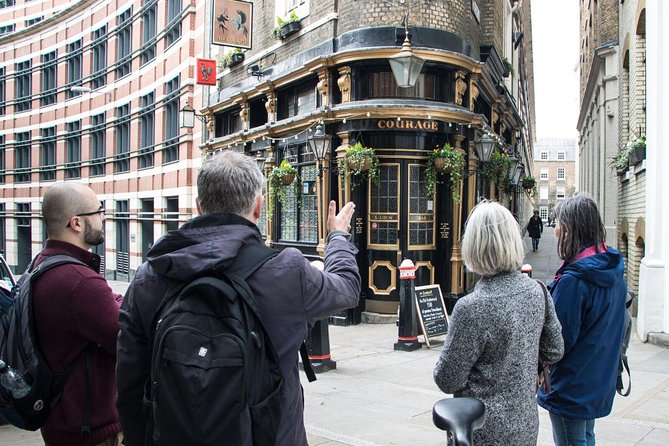
At London Wall, the guide connects you to Shakespeare’s second house and explains why he ended up in this area. Then the tone shifts to personal life, including the story of a marriage and the regret that followed. This is where the walk feels almost like character development, not just sightseeing.
St Giles Cripplegate is the final big literary and emotional landing. The tour references a church Shakespeare knew, and it brings in the sad case of Shakespeare’s brother Edmund. The guide also ties in two of the era’s best-known actors, so the space becomes a stage in your mind again.
The ending is performance-led. Declan finishes with another complete and haunting speech from Shakespeare’s last play, focused on saying goodbye. The guide frames it as cosmic again, tying the finale back to the tour’s earlier theme of language reaching beyond its moment.
At that point, you’ll be walking toward Barbican Underground Station. Barbican is on multiple Underground lines, including the Circle, Metropolitan, and Hammersmith and City lines, and you can follow the guide if you want to join the train system.
Price and value: what $20.83 buys you in London time

At $20.83 per person for about two hours, you’re paying for four things that are hard to replicate on your own:
- Guided sequencing across sites that are easy to overlook
- Live performances that turn text into sound
- Context that helps you connect streets to stories
- A route designed for a north of the Thames Shakespeare thread, not a random day of plaques
The tour also includes professional guidance, pickup and drop-off from designated meeting points, and live entertainment, which all reduce friction. London is not cheap, and time is expensive. If you want Shakespeare without spending hours planning micro-sites, the value is strong.
Group size is another quiet win. With a maximum of 15 people per booking, you’re more likely to get interaction instead of being one face in a crowd. That helps especially if you like asking about how the guide connects one location to another.
Who this Shakespeare in the City Walk is best for
This works especially well for you if:
- You love Shakespeare, but you also want the London connections explained in real-world terms
- You like tours where the guide does more than talk, and the performance angle matters
- You want a morning plan that feels compact, focused, and walkable
- You’re curious about the less obvious corners of London, not only the famous ones
It may not be your best match if you hate walking or prefer long indoor museum stops. The tour involves steady outdoor time and expects moderate physical fitness. If you’re sensitive to weather, dress accordingly.
For families, the recommended age is 10 years and above, and children must be accompanied by an adult. If your kids are Shakespeare-curious, this style of storytelling can land better than a traditional lecture.
Should you book this Shakespeare in the City Walk?
If you want Shakespeare London with personality, this is an excellent bet. The biggest reason is the format: you’re shown places, then you hear the words that tie them together, with Declan delivering key speeches in a way that makes the city feel like part of the play.
Book it if you enjoy:
- Literature in context
- A guided route that helps you find hidden references
- A tour that balances wonder with grounded details, like theatre pricing and family realities
Skip it if you’re hoping for mostly indoor time, or if you need a very gentle pace. Also, if you only want the most famous stops, you might feel the route is intentionally picky about what gets highlighted.
If you’re choosing a Shakespeare tour in London and you like the idea of performance plus real street-level storytelling, this one is worth your money. It’s specific, focused, and built to make the bard feel like a person who walked these streets.
FAQ
Where do I meet the guide?
You meet outside Blackfriars Underground Station at Underground Ltd, Blackfriars Rd, London EC4R 2BB. The tour starts at the Underground exit, with the guide standing near the exit with a Shakespeare sign on a rucksack.
Which Blackfriars station should I use?
Use Blackfriars Underground Station. The tour is on the Circle and District Lines, and you should not go to Blackfriars overground.
What time does the tour start?
The start time is 11:00 am.
How long is the walk?
It runs for about 2 hours.
Is the tour offered in English?
Yes, it is offered in English.
Can I use a mobile ticket?
Yes. The tour uses a mobile ticket.
What group size should I expect?
There is a maximum of 15 people per booking, and the activity has a maximum of 45 travelers overall.
Is it suitable for kids?
Children must be accompanied by an adult. The recommended age is 10 years and above.
Does the tour run in bad weather?
Yes. It operates in all weather conditions, so dress appropriately.
What’s included in the price?
You get a professional guide, pickup and drop-off from designated meeting points, and live entertainment.
Where does the tour end?
The tour ends at Barbican Underground Station at Underground Ltd, Aldersgate St, London EC1A 4JA. The guide walks there and you can follow if you want to connect to the Underground lines.
More Of London On Foot






More Shakespeare Country






Seen From A Boat Instead






Fresh off the notebook in London
- Private Rock ‘n’ Roll Music Tour of Central London
★ 5.0 · 7 reviews - London Walking Tour: Camden Town Photography Walkabout
★ 5.0 · 7 reviews - Private Transfer from London accommodation to Cruise terminal
★ 5.0 · 7 reviews - Amazing Nightlife in London East Tour
★ 4.5 · 7 reviews - The British Museum: a highlights tour with a TV historian
★ 5.0 · 7 reviews - Heathrow Airport to Cambridge private taxi transfers
★ 5.0 · 7 reviews
Stratford and Shakespeare Tours, compared.
 ★ 4.5Oxford, Stratford-upon-Avon, Cotswolds & Warwick Castle Day TripFrom $1092,943 reviews
 ★ 4.5England in One Day: Stonehenge, Bath, the Cotswolds and Stratford-upon-Avon Day Trip from LondonFrom $1871,344 reviews
 ★ 4.5Warwick Castle, Oxford, Stratford-upon-Avon & Cotswolds Day tripFrom $109828 reviews
 ★ 4.5Oxford, Stratford, Cotswolds & Warwick Castle Tour from LondonFrom $106756 reviews
 ★ 5.0Shakespeare Distillery Tour – 1pm TicketFrom $27598 reviews
 ★ 4.5Shakespeare’s Globe Guided TourFrom $37481 reviews
 ★ 4.0Oxford, Stratford-upon-Avon & Cotswolds Day Trip from LondonFrom $102373 reviews
 ★ 4.5From London: Shakespeare’s Stratford-upon-Avon Day Trip by CoachFrom $122352 reviews
Browse the lists this tour appears in