
REVIEW · OXFORD TOURS
Women and Queer Histories Tour – by Uncomfortable Oxford™
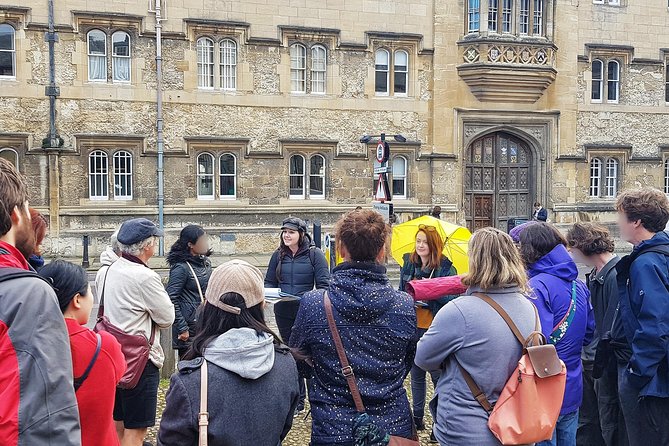
Oxford gets real when stories get uncomfortable. This 90-minute Women and Queer Histories tour uses small groups and student guides to map how architecture and social life shape people’s chances. You’ll walk from the Radcliffe Observatory Quarter to the Clarendon Building, with stops tied to women, trans history, and power.
I love the feminism and women’s rights focus, from early barriers for women entering Oxford to the everyday obstacles that still affect education, like childcare.
The main drawback is that the topics can feel heavy, so it’s best when you’re up for direct, thoughtful conversations, not a light walk of postcard views.
In This Review
- Quick hits
- Before You Go: what makes this Oxford walk worth your time
- Radcliffe Observatory Quarter: why the built environment hides stories
- Somerville College: seeing the early obstacles women faced at Oxford
- St Paul’s Nursery: childcare and the academic barrier
- War Memorial Garden: learning Laurence Michael Dillon’s trans story
- Lamb and Flag Passage: tracing masculinity in town and university
- Wadham College: women’s representation across class lines
- Clarendon Building: policing women from the vice-chancellor’s office
- The discussion format: how the tour stays engaging and respectful
- Pricing and value: what $27.54 is really buying
- Who should book, and who might feel it’s not for them
- Should you book Women and Queer Histories in Oxford?
- FAQ
- How long is the Women and Queer Histories Tour in Oxford?
- What is the group size for this walking tour?
- Where does the tour start and end?
- Is admission included for the stops?
- Are service animals allowed?
- Can I get a refund if I cancel?
Quick hits
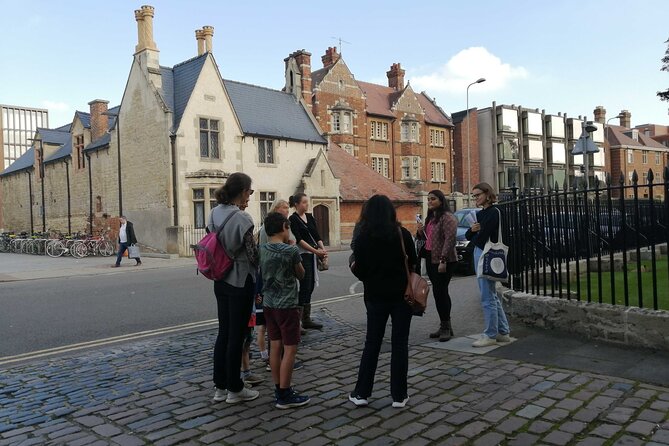
- Max 15 people means you get time to ask questions, not just listen.
- Discussion-first format pushes you to form your own view instead of getting a script.
- Women’s colleges to vice-chancellor offices connects campus life to real rules and enforcement.
- Queer and trans history is part of the route, including the story of Laurence Michael Dillon.
- Small stops across the city centre make it easy to pair with other Oxford sights before or after.
Other Oxford walks, colleges included
- Oxford University Walking Tour With University Alumni Guide★ 5.0 · 6,905 reviews
- 1.5-hour Oxford City and University Walking Tour★ 4.5 · 1,383 reviews
- Oxford Official University & City Tour★ 5.0 · 1,134 reviews
- City Sightseeing Oxford Hop-On Hop-Off Bus Tour★ 4.5 · 1,042 reviews
Before You Go: what makes this Oxford walk worth your time

This tour is built for people who feel a little annoyed by the same old Oxford script. It’s a walking route that treats buildings like evidence, not scenery. In about 90 minutes, you’ll move through a tight set of locations where gender, sexuality, and institutional control show up in walls, rules, and public space.
At $27.54 per person, the value is mostly in the ratio of time to attention. With a maximum of 15 travelers, you’re not competing for the guide’s focus. And since the stops are free admission from the tour info, you’re paying for the interpretation and discussion, not a stack of museum fees. Add in the mobile ticket and the fact it runs with University of Oxford students, and you get an experience that feels local and current, not just “facts pasted onto a map.”
The route is also timed to keep things moving: the stops range from 10 to 15 minutes each. That matters because you’re not stuck in one long lecture. Instead, you get short scenes, then a pause to talk through what you’re seeing and what it might have meant for real people.
Practical tip: wear comfortable shoes. Oxford streets are walkable, but this is still a city walk where you’ll want to move smoothly between stops.
Radcliffe Observatory Quarter: why the built environment hides stories
You start at Radcliffe Observatory Quarter, meeting at the Old hospital site (Woodstock Rd, Oxford OX2 6GG). The opening focus is unusually smart for a walking tour: how the histories of certain communities become hard to access when the evidence is missing, re-labeled, or simply not built into the way we read the city.
What I like here is the mindset shift. You’re not just looking at pretty architecture and “who lived here.” You’re asked to think about visibility, memory, and access. If a community’s story is absent from signage, institutions, or public monuments, that absence shapes what people assume is “the true Oxford.”
This first stop sets the tone for the rest of the walk. It gives you language for uncomfortable questions. And it helps you notice patterns as you move, like who gets represented and who gets pushed to the margins.
Somerville College: seeing the early obstacles women faced at Oxford
Next you’re outside Somerville College. The tour frames this as more than a view of one of Oxford’s most famous women’s colleges. It’s a chance to confront the difficulty women experienced when they first attended the university.
This stop works because it links the academic world to social friction. Even when women were in the university system, that didn’t mean the environment was designed for them. The guide nudges you to think about barriers that weren’t always stated as bans, but still showed up as restrictions, expectations, and unequal treatment.
You’ll likely come away with a clearer idea of how “getting in” is not the same as “being supported.” And that’s important, because the tour keeps returning to practical obstacles, not just abstract fairness.
St Paul’s Nursery: childcare and the academic barrier
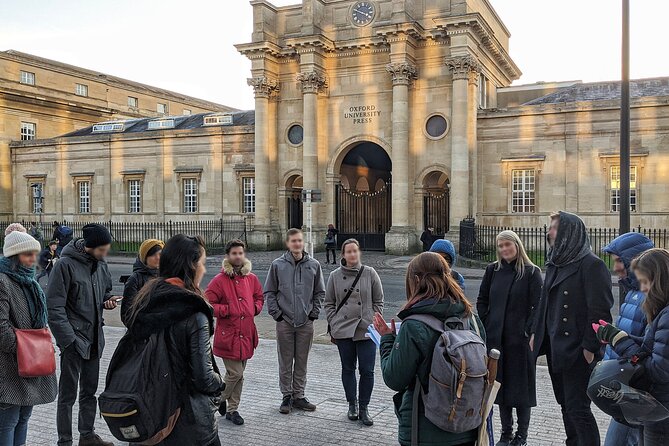
At St Paul’s Nursery, the discussion turns to access to childcare and how that creates academic barriers. This is where the tour gets grounded in daily life. It’s easy to talk about equality in big ideas. It’s harder, and more useful, to talk about the practical costs that determine who can stay, attend, and succeed.
If you care about gender equity, you’ll probably appreciate how this stop connects systems to schedules. Childcare is not a side issue. It affects attendance, timing, mobility, and stress. In a university context, those pressures can become structural.
Even if you already know the general concept, the tour’s approach helps you connect it directly to Oxford’s institutions and social expectations. You’re not just learning that “women had obstacles.” You’re hearing how obstacles can be operational, built into the everyday functioning of academic life.

War Memorial Garden: learning Laurence Michael Dillon’s trans story
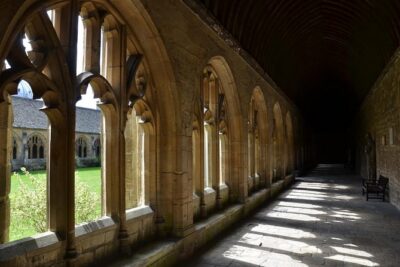
At War Memorial Garden, the tour highlights the story of Laurence Michael Dillon, using that person’s history to discuss trans history in Oxford. This is a key stop because it pulls queer history out of the abstract and into a specific human narrative.
What makes this kind of stop valuable is that it refuses to treat trans life as a footnote. The tour places trans history in the same street-level conversation as women’s rights and institutional power. You’re left thinking about how communities navigate visibility, risk, and recognition in public space.
It’s also a good moment to watch how the group discussion works. The tour aims to create room for questions and respectful discussion around uncomfortable subjects. If you’re someone who wants to learn carefully and thoughtfully, this is likely where you feel the most engaged.
Lamb and Flag Passage: tracing masculinity in town and university
Next you move through Lamb and Flag Passage, into older areas of the city centre. Here the tour highlights the history of masculinity in both the town and the university.
This part is clever because it widens the lens. The tour is focused on women and queer histories, but it doesn’t treat masculinity as a background topic. It treats it like a system. The idea is that gender roles were enforced by institutions, social spaces, and expectations about who belonged where.
As you walk, you can start noticing how “belonging” is designed into everyday city life. Not by one official rule, but by patterns: what kind of spaces get funded, what kind of behavior gets tolerated, and whose presence feels assumed. You’ll probably come away with a more nuanced sense of how gender power works in a university city where tradition often becomes policy.
Wadham College: women’s representation across class lines
At Wadham College, the tour points to representations of women from the early Modern period, including women from both wealthy and humble backgrounds.
This is an important balance point. Many history stories about women focus on one class lane, often the most documented and politically visible. Here, the emphasis is on contrasts, which helps you see that feminism and women’s rights were never one-note.
What I’d tell you to pay attention to: how the tour frames “representation.” It’s not just about whether women existed. It’s about how women were pictured, discussed, and permitted within the university and its orbit. Once you start looking at representation as something political, you’ll notice it everywhere in Oxford.
Clarendon Building: policing women from the vice-chancellor’s office
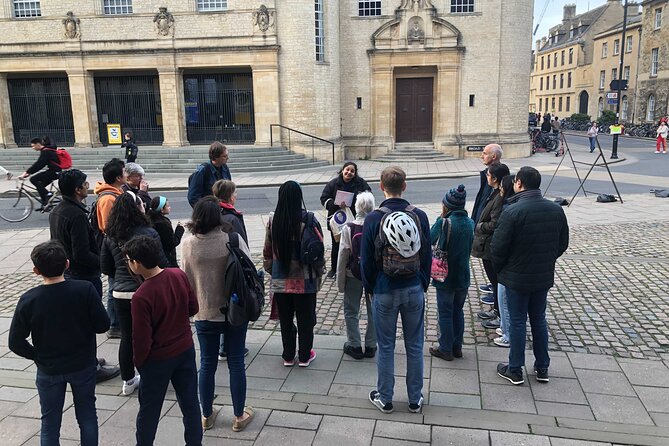
The final stop is the Clarendon Building on Broad St (48 Broad St, Oxford OX1 3AZ), outside the historic office of the vice-chancellor. The discussion centers on the policing of women in the city.
This is the “power” stop. You’re connecting social rules to institutional authority. The vice-chancellor office is an obvious anchor for the idea that universities did not operate in a bubble. Their influence spread into the city, shaping how women were treated and controlled.
I especially like how the tour’s structure makes this feel earned. By the time you reach Clarendon, you’ve already covered obstacles to entry, childcare access, trans history, gendered spaces, and representation. So the “policing” theme lands as part of a wider pattern, not a random grim chapter.
If you’re someone who wants Oxford to make more sense, this ending is a strong one. It gives you a sense of how systems of control work, and how they can be enforced through institutions that appear neutral on the surface.
The discussion format: how the tour stays engaging and respectful
The standout theme across the experience is that it’s not a lecture. It’s discussion-led. The guides ask opinions and invite ideas from the group, and the tone aims to feel safe enough for real questions. That approach shows up in the feedback around guides like Devika for an engaging, interactive style, Julie for a conversation-friendly format, Cameron for energy and engagement, and Olivia for passion and thought-provoking questions.
I also like that the tour doesn’t treat discomfort as a problem to avoid. It treats discomfort as information. When the guide helps you work through difficult legacies, you’re learning how to think critically, not just what to think.
One practical advantage of the small group size is that silence doesn’t automatically mean you missed something. You can ask something simple, or complicated, and still get an answer that fits your question. For a topic like queer and women’s histories, that matters, because the best learning comes from interaction, not from a one-way monologue.
If you prefer a totally passive sightseeing experience, you might find this demanding. But if you like guided conversation, this tour is built for you.
Pricing and value: what $27.54 is really buying
Let’s talk money honestly. At $27.54, you’re paying for a focused 90-minute route with student guides, guided interpretation at multiple city-centre stops, and time to discuss what you’re learning. That’s the main value: not just the locations, but the way the guide connects them into an argument about power, access, and representation.
The route also includes multiple free admission stops, based on the tour info. So you’re not being nickel-and-dimed by entry fees. The tour’s cost is concentrated in the human part, the discussion, and the student-led research style that comes through in the guide work praised for being engaging.
Also, the mobile ticket plus meeting points in central Oxford makes it simple to fit into a travel day. You don’t need a complicated plan to get to the start, and the walk ends right in the centre near Clarendon.
Who should book, and who might feel it’s not for them
Book this tour if you want Oxford to feel human, political, and specific. You’ll probably enjoy it if you care about women’s rights, gender power, and queer history, and especially if you like learning through questions.
You might want to skip it if you’re mainly looking for classic Oxford highlights with minimal emotional weight. The tour is designed around uncomfortable and difficult topics, and it treats that seriously. If you want light entertainment, this is not that kind of walk.
It’s also a strong pick for solo travelers, because the group size is small and the format invites interaction. Couples and friend groups often do well too, since you’ll likely end up talking after the stops.
Should you book Women and Queer Histories in Oxford?
I think this is a smart booking if you’re the type of traveler who likes their city walks to mean something. The combination of a tight 90-minute route, a max 15-person group, and a discussion-led format makes it feel more like learning with a guide than being processed by one.
If you’re ready to face the uncomfortable side of Oxford, you’ll leave with new questions and a better ability to read the city around you. If you want only the smooth, famous surface, you’ll probably find it too serious.
FAQ
How long is the Women and Queer Histories Tour in Oxford?
It runs for about 1 hour 30 minutes.
What is the group size for this walking tour?
The tour has a maximum of 15 travelers.
Where does the tour start and end?
You meet at Radcliffe Observatory Quarter, Woodstock Rd, Oxford OX2 6GG, and the tour ends in the city centre outside the Clarendon Building, 48 Broad St, Oxford OX1 3AZ.
Is admission included for the stops?
The tour info lists admission ticket free for the stops on the route.
Are service animals allowed?
Yes, service animals are allowed.
Can I get a refund if I cancel?
Yes, you can cancel for a full refund if you cancel up to 24 hours in advance of the experience start time.
More Oxford, College By College






Fresh off the notebook in Oxford
- Women and Queer Histories Tour – by Uncomfortable Oxford™
★ 5.0 · 60 reviews - Oxford: Official CS Lewis and JRR Tolkien Walking Tour
★ 4.5 · 63 reviews - New College Oxford Harry Potter Insights PRIVATE TOUR Daily
★ 5.0 · 67 reviews - Tours of Oxford private walking tours for the Discerning Traveler
★ 5.0 · 70 reviews - Explore the Hidden Gems of Cotswolds Private Tour
★ 5.0 · 72 reviews - Small and Exclusive Oxford Highlights Tour
★ 5.0 · 79 reviews
Oxford Tours, compared.
 ★ 5.0Oxford University Walking Tour With University Alumni GuideFrom $416,905 reviews
 ★ 4.5Windsor Castle, Stonehenge, and Oxford Day Trip from LondonFrom $1235,292 reviews
 ★ 4.5Oxford, Stratford-upon-Avon, Cotswolds & Warwick Castle Day TripFrom $1092,943 reviews
★ 4.5Windsor Castle, Stonehenge, and Oxford Day Trip from LondonFrom $1232,474 reviews
★ 4.5Oxford, Stratford-upon-Avon, Cotswolds & Warwick Castle Day TripFrom $1092,943 reviews
★ 4.5Windsor Castle, Stonehenge, and Oxford Day Trip from LondonFrom $1232,474 reviews
 ★ 4.5Windsor Castle, Stonehenge and Oxford Day Guided Tour from LondonFrom $1111,486 reviews
 ★ 4.51.5-hour Oxford City and University Walking TourFrom $381,383 reviews
 ★ 4.5Oxford and Traditional Cotswolds Villages Small-Group Day Tour from LondonFrom $1001,196 reviews
 ★ 5.0Oxford Official University & City TourFrom $411,134 reviews
Browse the lists this tour appears in