
REVIEW · JACK THE RIPPER TOURS
Women of Whitechapel 2 hour Walking Tour
Whitechapel has a lot more women than you think. This Women of Whitechapel walking tour follows a smart, mostly compact route through East London, using real streets and landmarks to tell women-centered stories you rarely hear. You get women’s history told in a way that connects names, causes, and the neighborhoods where it all happened.
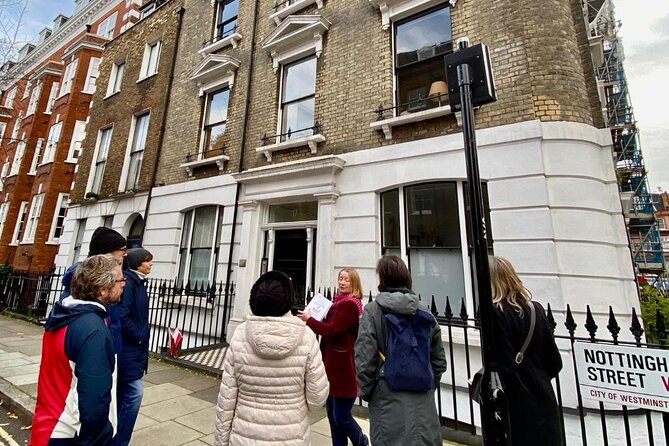
I really like two things about this tour. First, the stops are practical and easy to orient yourself, starting near public transport and ending by Liverpool Street. Second, the guide approach is what makes the stories click, and Mandy is specifically praised for being kind and engaging, with details that keep you listening instead of just reading plaques.
One thing to plan for: this is still a walking tour of about 2 to 3 hours, so you’ll want good walking shoes and clothes that handle the weather. If you dislike walking when it is chilly, wet, or windy, you may find the pace a bit too “steady and outdoors” for your comfort.
In This Review
- Key things you will notice on the Women of Whitechapel tour
- Entering Whitechapel the right way, on a focused walking route
- Price and value, what $27.53 really buys you
- Meeting near Whitechapel Road, then finishing by Liverpool Street
- Stop-by-stop: Whitechapel Road and the women behind WWI resistance
- Brick Lane: Monica Ali’s neighborhood, and women as quiet revolutionaries
- Princelet Street: film-familiar houses and women who lived alone in the 1700s
- Spitalfields Market E1: Queen Victoria’s market and the names that refuse to fade
- Stepney Green: East India connections, a prostitute’s story, and anarchistic HQ
- What the guide style feels like, especially if Mandy is leading
- Walking comfort, group size, and the outdoor reality
- Food and drink: what is included and what you pay for
- When this tour is the best fit for your London day
- Should you book Women of Whitechapel?
- FAQ
- How long is the Women of Whitechapel walking tour?
- What does the tour cost?
- Where does the tour start and where does it end?
- What language is the tour offered in?
- Do I get a mobile ticket or do I need to print something?
- Is coffee or tea included?
- How large is the group?
- Are service animals allowed?
- What if the weather is bad or I need to cancel?
Key things you will notice on the Women of Whitechapel tour
- A route that stays on-theme with women’s activism and everyday courage, not random sightseeing
- Small-group feel, capped at 30 travelers, which helps the guide keep momentum and attention
- Stops connected to major London names, including Mary Wollstonecraft and Sylvia Pankhurst
- Brick Lane’s immigrant layers, told through the lens of women as quiet revolutionaries
- Spitalfields Market and Queen Victoria, tying commerce, streets, and power together
- Stepney Green’s film and TV connections, including Call the Midwife links
Whitechapel after dark, other guides tested
- London Jack the Ripper Guided Tour with Ripper-Vision★ 4.5 · 4,840 reviews
- London Jack The Ripper Guided Walking Tour★ 5.0 · 3,131 reviews
- Ultimate Jack the Ripper : Guided Tour of London★ 5.0 · 1,495 reviews
- The Original Jack the Ripper : Guided Tour★ 5.0 · 1,264 reviews
Entering Whitechapel the right way, on a focused walking route
This tour works because it is not trying to do everything. Instead, it follows a straight line through East London and keeps the theme locked on women, from formal resistance to quieter forms of change. You walk past the kind of buildings and street corners that can feel like background until someone gives you the story behind them.
I also like how you are guided to notice what you might miss on your own. Whitechapel Road, Brick Lane, Princelet Street, Spitalfields Market, and Stepney Green are all recognizable on the map, but the tour makes you look at them with different questions: Who lived here? Who organized? Who pushed back when it would have been easier to stay silent?
And yes, you get the street-level London experience. You are outdoors, you are moving, and you are picking up context the way locals do, block by block.
Price and value, what $27.53 really buys you
At $27.53 per person, this tour is priced like a specialist guided walk rather than a museum ticket. What you are really paying for is the storytelling structure: a guided route that stitches together women’s history across different eras and movements without turning it into a lecture.
Because it is about 2 to 3 hours, the time cost is also part of the value. You are not just hopping between a couple of photo stops, you are getting a full guided circuit that includes multiple neighborhood “chapters.” If you are the type of traveler who likes to understand why a place feels the way it does, this price is easier to swallow.
It also helps that it is offered in English and capped at 30 travelers. Smaller groups tend to feel more personal, and you are more likely to get clear answers when something sparks your curiosity.
Meeting near Whitechapel Road, then finishing by Liverpool Street
Your day starts at 277 Whitechapel Rd, London E1 1BY, and the walk ends at Liverpool Street Station, London EC2M 7QA. That end point matters more than it sounds, because it gives you an easy transit exit if you want to keep exploring after the tour.
Finding the start is also a plus. The tour is designed so you can get to the meeting spot with public transport, and the group stays manageable. In other words, you are less likely to spend the first 20 minutes doing the nervous dance of where to stand.
Bring the usual London walking mindset: arrive a little early, check your phone battery since you use a mobile ticket, and wear something you can layer. If you know you get cold fast, plan for it before you are halfway down the route.
Stop-by-stop: Whitechapel Road and the women behind WWI resistance
The walk begins on Whitechapel Road, where you start with a street-level introduction to the neighborhood. You will pass a busy high street setting and notice the mix of landmark architecture and places of worship, including grade II listed houses as well as churches and mosques.
What makes this segment matter is the way it frames Whitechapel as a place where women were active in major historic currents. You hear about brave women connected to WWI resistance, along with the work of female philanthropists from the late 1800s. Then the story widens to the anarchistic movement of the 1890s, told through the women who were part of that world.
This stop lasts about an hour, which gives the guide time to set up the theme properly. It is long enough for you to absorb the context, but not so long that you feel stuck outside with no payoff.
More on foot, at a pace you can hear the guide


Brick Lane: Monica Ali’s neighborhood, and women as quiet revolutionaries
Next comes Brick Lane, a street that carries layers you can practically feel. The guide connects the area to Monica Ali’s book of the same name, then zooms out to the waves of immigrants who have shaped the neighborhood, from Huguenot weavers to Jewish tailors, and later Bangladeshi restauranteurs.
Here is the tour’s special trick: it keeps returning to women. Even when you are learning about community change across centuries, you still get the women-centered thread as “quiet revolutionaries” in the area. So you are not only thinking about what changed in public life, you are also listening for the human decisions that made life possible.
This stop is shorter, around 20 minutes, which is fine. Brick Lane can be a lot on its own, so a focused burst keeps the tour moving without losing energy.
Princelet Street: film-familiar houses and women who lived alone in the 1700s
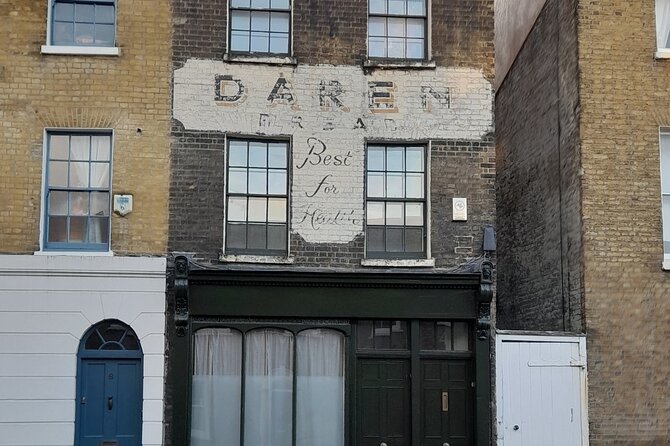
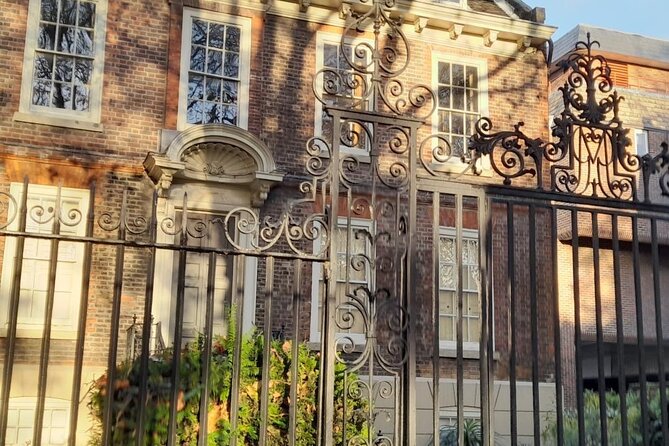
Princelet Street feels like a pause from the noise, at least in how the story is framed. The guide points out that it has appeared in many famous films, and you also get to appreciate the look of the older housing with wooden shutters, similar to what Huguenots used.
The most memorable part of this stop is the detail about women who lived alone in the 1700s. You are not just learning that women existed in history, you are hearing what it could mean to live independently during a time when that was not the norm.
This segment is brief, about 10 minutes. Because of that, I recommend paying attention early in the stop so you do not miss the sharper story beats.
Spitalfields Market E1: Queen Victoria’s market and the names that refuse to fade
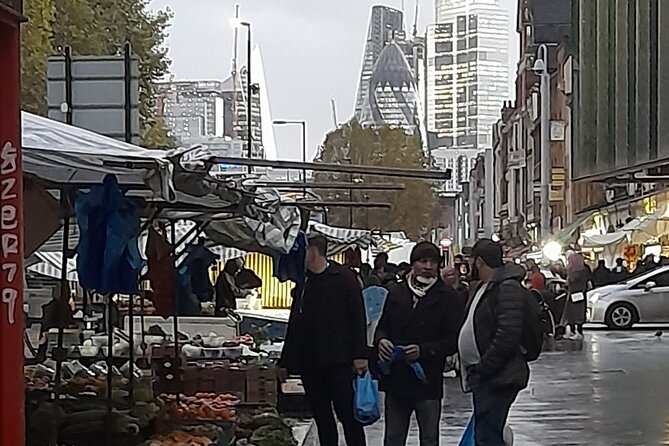
Then you reach Spitalfields Market E1, described as a delight opened by Queen Victoria. Markets are powerful settings for history, because they mix people, money, ideas, and sometimes conflict, all in one place.
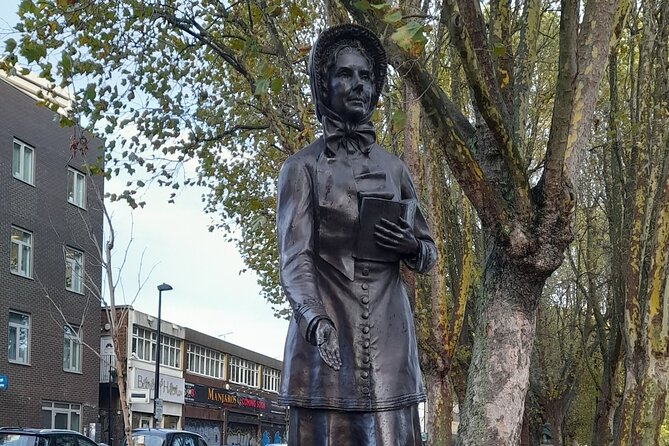
What you will appreciate here is how the guide links the surrounding streets to several major revolutionary figures, including Sylvia Pankhurst, Mary Wollstonecraft, and Sara Wesker. The tour frames them as voices across roughly the last three hundred years, which helps you see change as a long effort rather than a single headline moment.
There is also a practical benefit to this stop: it creates a natural mental transition between neighborhood chapters. The pacing stays friendly, and with around 30 minutes here, you get enough time to take it in without feeling rushed.
Stepney Green: East India connections, a prostitute’s story, and anarchistic HQ
The final stretch takes you into Stepney Green, another pocket with deep roots. The guide brings up a story tied to the widow of an East India employee, showing how wealth and status could still include hardship and personal risk. Then the narrative takes a harder turn with the story of a lowly prostitute who made a name for herself.
This is also where the tour connects to the anarchistic headquarters idea. It is not just a theory talk, you are shown why the area could become a meeting ground for people with strong opinions and strong networks.
And if you like pop culture anchors, you get a mention of Call the Midwife. That connection can make the neighborhood easier to picture even if your brain prefers TV timelines to 18th and 19th century ones.
This stop is about 10 minutes, but it lands as a strong wrap-up. By then, you have enough context to understand why the stories fit together.
What the guide style feels like, especially if Mandy is leading
A lot of walking tours fail when the guide turns into a reciter. This one is different, and that is reflected in the praise for the guide, specifically Mandy. People call out her warmth and a fun, engaging delivery, plus her ability to point out details you would otherwise walk right past.
You also get a sense of balance in the way women are portrayed. You hear about formal resistance and organized movements, but you also hear about female philanthropists and women shaping communities in more everyday ways. That makes the stories feel less like history trapped in a book and more like something that grew from real lives.
If you enjoy learning names and then watching how those names relate to real streets, this tour’s pace should suit you.
Walking comfort, group size, and the outdoor reality
The tour is rated for moderate physical fitness, so it is not described as a strenuous hike. Still, you are outside for 2 to 3 hours, and London weather can change fast.
Plan for walking comfort:
- Wear supportive shoes you can stay in for a while
- Layer your clothing, especially if the day is windy
- Bring a small weather plan, like a light rain layer
Group size is capped at 30 travelers, so you should not feel like you are part of a giant herd. The highlight about making new friends fits this kind of setup, because you stay together long enough for at least some easy conversation.
Food and drink: what is included and what you pay for
The tour includes the guided walk and history of women in Whitechapel. Food is not included.
You will stop off at a Huguenot tea/coffee shop, but coffee and tea are entirely at your cost. That is actually useful. You can grab something if you want, without forcing everyone to stop for a paid add-on.
If you like planning smart, eat before the tour rather than counting on the group to time a meal. You will have a long enough evening plan once you finish near Liverpool Street.
When this tour is the best fit for your London day
This Women of Whitechapel walking tour is especially good for you if:
- You want East London context without hopping between separate museums
- You like guided storytelling tied to street-level details
- Women’s history is a priority for your itinerary
- You want a structured walk that ends conveniently near a major transport hub
It is also a strong choice if you have already seen the biggest London sights and you want a different kind of day. Here, the “sightseeing” is the neighborhood itself, and the stories give the streets meaning.
And if you are traveling with a friend, this kind of small-group walk can be a nice shared experience, not a solo memory project.
Should you book Women of Whitechapel?
I would book it if you want a guided, women-centered look at Whitechapel and nearby areas, with a route that finishes at Liverpool Street. At $27.53, you are paying for a focused 2 to 3 hour history walk that turns everyday streets into a coherent story.
Just make sure you can handle an outdoor walking format, including weather. If that is fine, this is a smart use of time in London, with enough movement to feel like you did something, and enough story to feel like you learned something new.
FAQ
How long is the Women of Whitechapel walking tour?
It lasts about 2 to 3 hours.
What does the tour cost?
The price is $27.53 per person.
Where does the tour start and where does it end?
It starts at 277 Whitechapel Rd, London E1 1BY, and ends at Liverpool Street Station, London EC2M 7QA.
What language is the tour offered in?
The tour is offered in English.
Do I get a mobile ticket or do I need to print something?
You get a mobile ticket.
Is coffee or tea included?
No. Coffee and/or tea is not included, and any stop at a tea/coffee shop is at your own cost.
How large is the group?
The maximum group size is 30 travelers.
Are service animals allowed?
Yes, service animals are allowed.
What if the weather is bad or I need to cancel?
This experience requires good weather. If it is canceled due to poor weather, you will be offered a different date or a full refund. You can cancel for a full refund up to 24 hours in advance of the experience start time.
More Of London On Foot



More Nights In Whitechapel





Fresh off the notebook in London
- Private Rock ‘n’ Roll Music Tour of Central London
★ 5.0 · 7 reviews - London Walking Tour: Camden Town Photography Walkabout
★ 5.0 · 7 reviews - Private Transfer from London accommodation to Cruise terminal
★ 5.0 · 7 reviews - Amazing Nightlife in London East Tour
★ 4.5 · 7 reviews - The British Museum: a highlights tour with a TV historian
★ 5.0 · 7 reviews - Heathrow Airport to Cambridge private taxi transfers
★ 5.0 · 7 reviews
Jack the Ripper Tours, compared.
 ★ 4.5London Jack the Ripper Guided Tour with Ripper-VisionFrom $274,840 reviews
 ★ 5.0London Jack The Ripper Guided Walking TourFrom $03,131 reviews
 ★ 5.0Ultimate Jack the Ripper : Guided Tour of LondonFrom $271,495 reviews
 ★ 5.0The Original Jack the Ripper : Guided TourFrom $221,264 reviews
 ★ 5.0London Jack The Ripper Small-Group Walking TourFrom $1511,013 reviews
 ★ 5.0Jack the Ripper Tour in SpanishFrom $17875 reviews
 ★ 3.5The Original Jack the Ripper Coach Tour of Haunted LondonFrom $82419 reviews
 ★ 5.0Jack the Ripper Walking Tour in LondonFrom $34354 reviews
Browse the lists this tour appears in