
REVIEW · ENGLAND
Coasteering
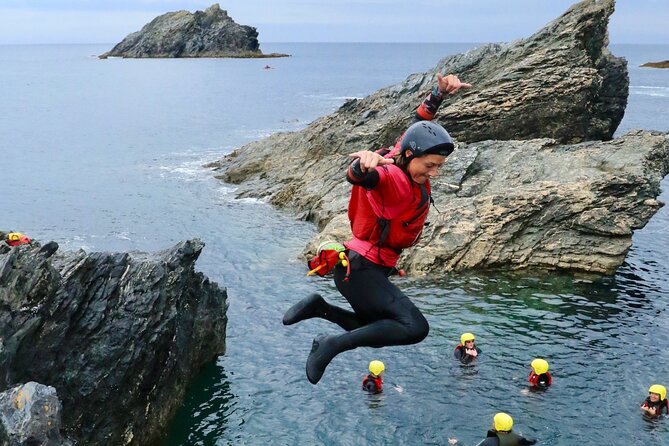
Coasteering is one of those activities that makes you feel alive fast. This private Devon session pairs a bespoke shoreline route with all the kit you need, so you can focus on the fun parts: rock jumps, swims, and cave exploration. I especially like the worry-free setup (wetsuit, helmet, footwear, buoyancy aid) and the way the guides shape the experience for the group. One thing to keep in mind is that you do need moderate physical fitness for scrambling, swimming, and getting in and out of the water.
The vibe here is not crowded, not rushed. With a maximum group size of 16 and a completely private route, you get more space and more hands-on attention while you move along the coast near Ilfracombe and Croyde. A small drawback for some people is the sea conditions matter, and the session needs good weather to run.
You’ll start at 23 Beach Rd, Ilfracombe EX34 9QZ, and end back there. It lasts about 2 hours 30 minutes, so it’s long enough to feel like a real adventure, but short enough that you are not spending your whole day in wetsuit mode.
In This Review
- Key things I’d plan for
- What Makes This Devon Coasteering Tour Feel Worry-Free
- Price and Value: Is $83.34 Worth It for 2 Hours 30?
- Where You Start in Ilfracombe, and Why It Sets the Tone
- How the Tour Flows: From Verity Statue to the Croyde Coast
- Stop 1, Verity Statue: Getting Your Balance Before the Water
- Stop 2, Croyde: The Part With Jumps, Swims, and Caves
- Gear That Actually Matters: Wetsuit, Helmet, Footwear, Buoyancy Aid
- The Coaching Style That People Rave About (and Why You’ll Care)
- Fitness Reality Check: Moderate Means You’ll Work, Not Just Watch
- Weather, Sea Conditions, and Why Flexibility Helps
- Should You Book This Private Coasteering Session?
- FAQ
- What safety gear is provided?
- How long is the coasteering tour?
- How many people are in a group?
- Where does the tour start and end?
- What fitness level do I need?
- What happens if it is canceled due to weather or if I cancel?
Key things I’d plan for
- Private routing to avoid the crowds, so you get a calmer, more controlled outing
- All safety gear provided (wetsuit, helmet, footwear, buoyancy aid)
- A mix of action: swimming, rock jumps, cave exploring, and cliff-base traverses
- Confidence building, not chaos, with jumps and movement paced for your group
- Small-group limit of 16 for closer guidance and more personal check-ins
- Weather-dependent, so you should be flexible if conditions are poor
Undecided so far? Here are further Devon tours we have written up.
- Torquay Coastal RIB Seafari★ 5.0 · 410 reviews
- The story of Agatha Christie’s extraordinary life★ 5.0 · 333 reviews
- Coasteering★ 5.0 · 191 reviews
- 30-Minute Raptor RIB Ride Activity in Torquay★ 5.0 · 182 reviews
What Makes This Devon Coasteering Tour Feel Worry-Free
Coasteering sounds tough, but the practical reality is that a good guide system makes it manageable. Here, you’re not just showing up at the beach. You get fully kitted out with a wetsuit, helmet, footwear, and buoyancy aid, which immediately reduces the “what if I get hurt” anxiety.
I also like that the tour is described as private and bespoke, meaning the route is tailored rather than a one-size-fits-all scramble. That matters because Devon’s coastline can vary a lot by spot, tide, and conditions, so having a plan that fits your group makes the day feel smoother.
The third piece is simple but huge: the guides keep people comfortable and confident as the activity ramps up. In multiple accounts, guides such as Zac, Jess, Eli, Alex, Matt, and Andy are described as patient, organized, and big on safety checks. That combination of gear plus coaching is what turns “I’m nervous” into “okay, I can do this.”
Price and Value: Is $83.34 Worth It for 2 Hours 30?
At $83.34 per person for about 2.5 hours, you’re paying for three things that you don’t have to source yourself:
- a trained guiding team
- the full set of safety gear
- a route that keeps the activity varied and worth your time
If you were to rent gear and try to figure out the safest way to move along a rocky coast on your own, the cost would be higher and the risk would be on you. Here, the value is in the guided structure, especially because coasteering involves both movement skills (scrambling) and water skills (swimming through gullies, getting used to jumps, and staying calm).
Also, the group limit matters. With a maximum of 16 and a private tour setup, you are not fighting for attention. You get better odds of quick technique feedback and reassurance, which is part of what people praise most.
Where You Start in Ilfracombe, and Why It Sets the Tone
Your meeting point is 23 Beach Rd, Ilfracombe EX34 9QZ, and you return there at the end. Starting and ending at the same place is more than convenient. It reduces the day’s friction, so you are not spending energy figuring out logistics while your body is already gearing up for cold water and rock work.
Another practical detail: confirmation is received at booking, and you get a mobile ticket. That’s helpful if you’re also bouncing around Devon on the same trip and want low-stress check-in.
Finally, the session is offered in English. If you’re traveling solo or with family and want instructions you can actually understand, this is a real plus. It’s not just safety briefing language, it’s the coaching that helps you judge jumps, footing, and movement.
How the Tour Flows: From Verity Statue to the Croyde Coast
The outing is laid out in two stops: Stop 1 at the Verity Statue and Stop 2 at Croyde. The exact movement style can vary with sea and conditions, but the day’s rhythm is consistent: you’ll go from briefing and gear-up into active scrambling, then into the water and rock jumping sequence.

Stop 1, Verity Statue: Getting Your Balance Before the Water
Think of the Verity Statue area as the “get your bearings” phase. This is where you can expect the session to transition from standing around to actively moving. Since coasteering uses both rock and sea, it helps to start with a warm-up that lets you practice safe footing, learn how to move with your kit on, and get comfortable with the idea of entering choppy water.
In real-world accounts, people often start with smaller steps and easier jumps, then build confidence. That approach is especially helpful if you are bringing kids or if this is your first time doing anything like this.
Possible drawback here: if you are very sensitive to cold or salt water, the earlier parts of the session can feel like the biggest mental hurdle, because you are still shaking off the nerves while the coastline is already doing what it does.
Stop 2, Croyde: The Part With Jumps, Swims, and Caves
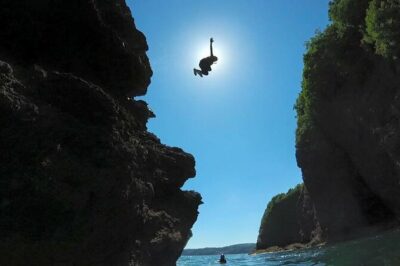
Croyde is where the coast work tends to feel more varied. This is where you should expect the “best bits” of the activity: swimming through gullies, jumping off rocks at different heights, exploring caves, and traversing along cliff bases.
The key to enjoying Croyde is trusting the progression. People described jumps ranging from small to big, with guides adjusting the challenge so everyone can participate. One account mentioned a final jump that reached around 9 meters, and another talked about an epic last jump around 4.5 meters. Those details are reminders that the day can scale up, not just repeat the same easy move.
If you get even a little winded during the swims or after a jump, that’s normal. What you want from the guides is reassurance and technique cues. Multiple people noted guidance that helped them understand how to do it, not just be pushed into it.
Gear That Actually Matters: Wetsuit, Helmet, Footwear, Buoyancy Aid
A lot of outdoor activities advertise safety, then you show up with almost nothing. This one gives you the essentials. You get a wetsuit, helmet, footwear, and a buoyancy aid, which helps in two ways:
- it reduces cold and exposure during swims
- it adds flotation so you can focus on moving rather than panicking
Footwear is a big deal for rocky coast work. You are stepping on uneven surfaces, and good traction helps you scramble with less strain and more confidence. The helmet and buoyancy aid are also part of why people describe the day as professional and safe.
Here’s the practical tip I’d give you: treat the gear fit as part of your prep. If something feels off, say so early. The whole point is that the kit is what lets you move quickly and safely, especially when you are wet and your hands and feet have limited grip.
The Coaching Style That People Rave About (and Why You’ll Care)
The most consistent praise is not just that the jumps are fun. It’s how the guides run the session. Names that come up include Zac, Jess, Eli, Alex, Matt, and Andy, and the common themes are:
- clear briefings before you start
- constant checking in to make sure people feel okay
- technique tips for jumps, swimming, and getting across rock sections
- patience when someone is nervous about taking that next leap
I love that this kind of coaching turns coasteering from a stunt into a skill. You don’t need to be fearless. You need to be guided. One parent mentioned their son got a huge confidence boost, and another described how the staff made the process comfortable even across a wide age range.
If you’re thinking, I’m nervous about jumping off rocks, that is exactly the moment you want a calm guide. The accounts highlight exactly that, including moments where people feel the body warning not to jump, then realize they can do it with the right instruction and timing.
Fitness Reality Check: Moderate Means You’ll Work, Not Just Watch
The tour asks for moderate physical fitness, and that’s a fair signal. Coasteering uses:
- scrambling and climbing up and along rocks
- short swims through rougher areas or gullies
- repeated movement with wet gear and limited traction
You do not need to be a trained athlete. But you should be comfortable with effort, uneven ground, and getting in and out of the sea. People reported successful experiences with a wide range of ages, including kids and adults, which suggests the guides can adapt the challenge within the constraints of safety and conditions.
Who might pause before booking:
- you have a strong fear of open water or heights
- you cannot comfortably swim short distances
- you struggle with getting down to rocky water access points and climbing back up
If any of those hit you, you can still ask questions when booking, but don’t ignore the moderate fitness requirement.
Weather, Sea Conditions, and Why Flexibility Helps
Coasteering is weather-dependent. If conditions are poor, the experience will be canceled and you’ll be offered a different date or a full refund. That’s not just fine print, it’s the reality of doing jumps, swims, and cave exploring safely.
So, plan this like you plan a day at the beach in shoulder season: bring patience and keep your schedule flexible. If you’re visiting Devon for only one or two days, consider whether you can shift plans if this gets weather-canceled.
Also, the activity has a minimum number of travelers to run. If it doesn’t meet that threshold, you’ll be offered a different date or a full refund. That small detail is worth knowing so you’re not blindsided by a last-minute reschedule.
Should You Book This Private Coasteering Session?
I think you should book if you want an outdoor adrenaline hit with structure and gear taken care of. This trip is a strong choice for first-timers because the day is designed to include technique and confidence building, not just throwing you into the water.
It’s also a good fit for families and mixed-age groups, since the guidance is described as attentive and safety-focused, with jump sizes that can range from small to big depending on what the group is ready for.
Skip it if you hate unpredictability or you know you cannot handle water and scrambling. Even with the best coaching, coasteering is still active outdoors, and the sea calls the shots.
If you book, do it soon enough. On average, people book about 18 days in advance, which is usually a sign that spots can fill when the weather looks good.
FAQ
What safety gear is provided?
You’ll be provided with a wetsuit, helmet, footwear, and buoyancy aid, which are included for a safer coasteering experience.
How long is the coasteering tour?
The tour runs for about 2 hours 30 minutes.
How many people are in a group?
This activity has a maximum of 16 travelers.
Where does the tour start and end?
It starts at 23 Beach Rd, Ilfracombe EX34 9QZ, UK, and ends back at the same meeting point.
What fitness level do I need?
You should have a moderate physical fitness level, since the activity involves moving along the coast, swimming, and jumping off rocks.
What happens if it is canceled due to weather or if I cancel?
If the experience is canceled because of poor weather, you’ll be offered a different date or a full refund. You can cancel for a full refund if you cancel at least 24 hours in advance; cancellations within 24 hours are not refunded.
Fresh off the notebook in Devon
- Explore North Cornwall on Electric Bikes
★ 5.0 · 8 reviews - Doc Martin, Fishermans Friends & North Cornwall
★ 5.0 · 9 reviews - Walking Tour of Exmouth in East Devon
★ 5.0 · 12 reviews - Half Day Sea kayak Guided Tour
★ 5.0 · 15 reviews - Ilfracombe Seafront History Walking Guided Tour
★ 5.0 · 18 reviews - Dartmoor Tour
★ 5.0 · 36 reviews