
REVIEW · STREET ART
East End London Instagrammable Street Art and Graffiti Tour
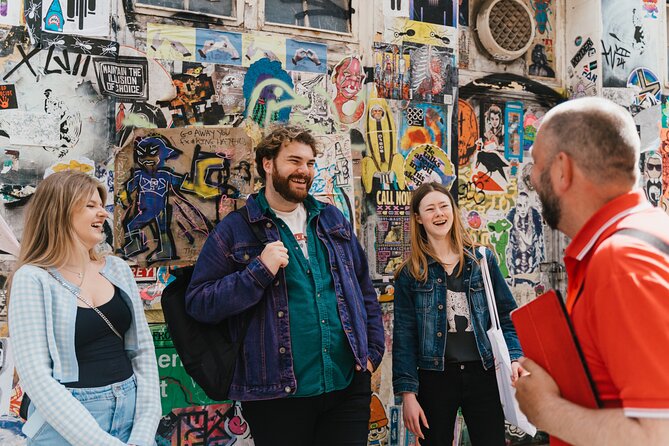
Street art hunting starts in Whitechapel. This East End London walk is built for great photo angles and real context, with a local guide steering you to huge murals, tucked-away pieces, and familiar names like Banksy. I love that you are not just wandering, you are being pointed exactly where to stand so the art actually hits the way it was meant to.
I also like the variety in one short loop. You bounce from long-limbed creatures by Phlegm to sticker art and big readable letter work, so you see how East End graffiti can be playful and technical at the same time. You get Banksy, but also the writers behind the scenes.
One thing to plan for is that some artworks sit in tight yards or can be partially blocked by walls, doors, or angles. Wear comfortable shoes, and keep expectations flexible, since street art changes and a few spots can look different day to day.
In This Review
- Key Things I’d Note Before You Go
- East End Street Art, Built for Photo Angles (Not Random Wandering)
- Price and Timing: Two Hours, Maximum 20 People
- Where You Start and How You Finish (and Why That Matters)
- Stop-by-Stop: From Hidden Yards to Banksy-Protected Works
- Heneage Street: Phlegm’s Stilts and FanakaPan’s Silver Balloons
- Brick Lane: Door-Scale Detail, Dan Kitchener and Perspicere
- The Seven Stars: Sticker Art and the Eighth Star Idea
- Princelet Street: Stik’s Work and Community Resilience
- Hanbury Street: ROA’s Bird, Martin Ron’s Upside-Down Figure, and 20-Year Skill
- Dray Walk: Broccoli Lane and Adrian Boswell’s Framing Idea
- Allen’s Gardens: A Graffiti Park Where Walls Change Every Few Days
- Buxton Street: Number 5 and Collaboration Wall Details
- Ebor Street: Painted Adverts, Pink Portraits by Neon, and Mist-Like Faces
- Ebor Street Again: Ben Eine’s Bold, Readable Letters
- Rivington Street: Banksy in a Secret Setting, Protected Under Glass
- Rivington Street: Otto Schade’s Ribbon-Like Stencils and the Half Soldier
- Rivington Street: Thierry Noir’s Colourful Heads
- art’otel London Hoxton: Banksy’s Reinstalled Wall, Street-Level Access
- Hewett Street: Shakespeare’s Bench and Romeo and Juliet Graffiti
- New Inn Broadway: Graffiti Wallpaper on One Huge Building
- Shoreditch High Street: The Graffiti Wars Story and a Walk Toward the City
- What You’ll Learn That Actually Helps You Look Better
- Who This Tour Fits Best
- Should You Book This East End Street Art and Graffiti Tour?
- FAQ
- How long is the East End London Instagrammable Street Art and Graffiti Tour?
- What does the tour cost?
- Where does the tour start and end?
- Is the tour ticket mobile?
- What is included besides the guided walk?
- How many people are in a group?
- Is public transportation nearby, and are service animals allowed?
- Is there free cancellation?
Key Things I’d Note Before You Go
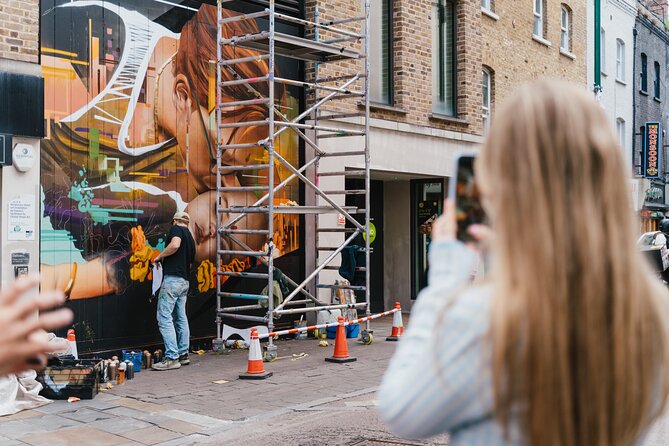
- Photo-first stops where you can step back, look up, and frame big murals or small-door pieces.
- Street art variety in 2 hours, from stickers to stencils to big letter graffiti like Ben Eine.
- Hidden locations behind backyards and narrow passageways, where the best walls are not on the main road.
- Famous names with a twist, including protected Banksy works and collage-style collaborations.
- A chance to make your own street art, not just watch other people do it.
- End point may shift depending on what the guide wants you to see most that day.
Undecided so far? Here are further London tours we have written up.
- Stonehenge, Windsor Castle, and Bath from London★ 4.5 · 18,662 reviews
- London Big Bus Hop-On Hop-Off Tour with Optional River Cruise★ 3.5 · 10,803 reviews
- London Small Group Tour of Historical Pubs★ 5.0 · 10,422 reviews
- Stonehenge, Windsor Castle and Bath with Pub Lunch in Lacock★ 4.5 · 7,402 reviews
East End Street Art, Built for Photo Angles (Not Random Wandering)
This tour is designed for the kind of street art you actually want in your camera roll: big walls, clear subjects, and spots where the view changes as you move a few steps. The route is concentrated in East End London, and the guide keeps you moving with a rhythm that works well for photos, even if you are not a hardcore graffiti nerd.
What makes it especially good value for $49 is that it is not only about seeing famous murals. You also get the “how to look” part. For example, at Brick Lane you start at a distance for the right overall read, then you step forward for the door-based pieces where technical details matter. That kind of direction is what turns a quick sightseeing walk into something you can recreate later, even on your own.
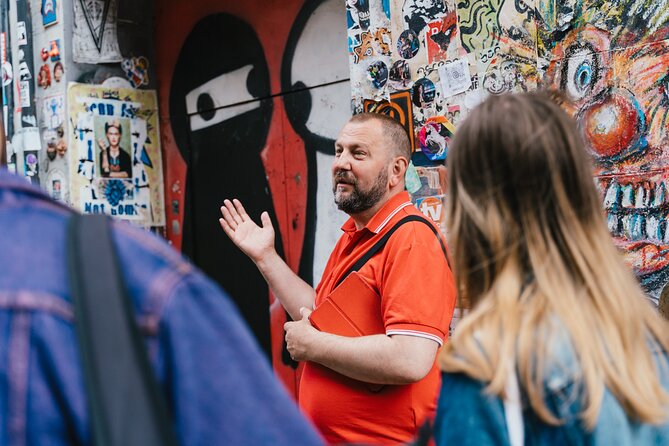
You should also know what kind of vibe you are signing up for. This area mixes Shoreditch grit with trendy storefront energy, and the art ranges from letter graffiti meant to be read to sticker layers that are more about texture than legibility. If you like street art that tells stories, including the darker graffiti wars side, you’ll probably enjoy the narrative thread too.
Price and Timing: Two Hours, Maximum 20 People
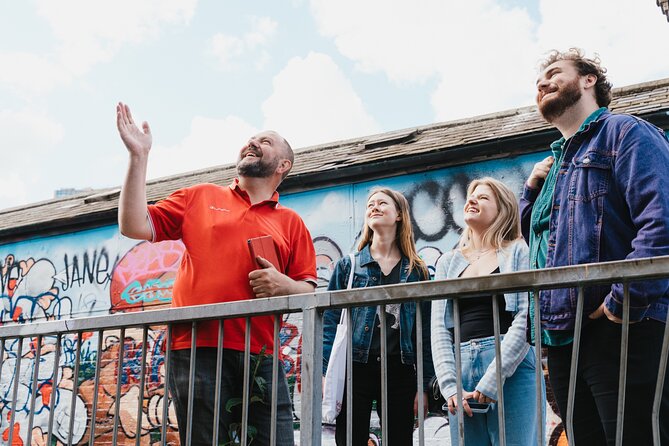
At around 2 hours, this is a compact way to cover a lot of East End walls without burning the day. I like that it runs at 11:00 am, because you catch daylight hours that usually make mural photos easier. You’ll also be in a small group of up to 20, which helps because you need a guide to manage where people stand, especially in tight yards.
You get a mobile ticket, which is practical. And the stops are marked with admission ticket free, meaning you are not buying separate entry fees to see street-level art. For street art tours, that matters because a lot of the cost creep is usually in paid museums or attractions. Here, most of the value is the guidance and the access to specific spots.
Where You Start and How You Finish (and Why That Matters)
The tour starts at 80 Whitechapel High St, London E1 7QX and ends at Liverpool Street Station (nearby), at London EC2M 7QA. The exact end point can shift depending on what the guide wants to show you, which is a smart reality check for a street art route where walls can change.
This affects one key practical thing: plan to finish in the Liverpool Street area rather than expecting a perfectly fixed last corner. If you are trying to connect to public transit or a later dinner reservation, give yourself a little buffer.
Stop-by-Stop: From Hidden Yards to Banksy-Protected Works
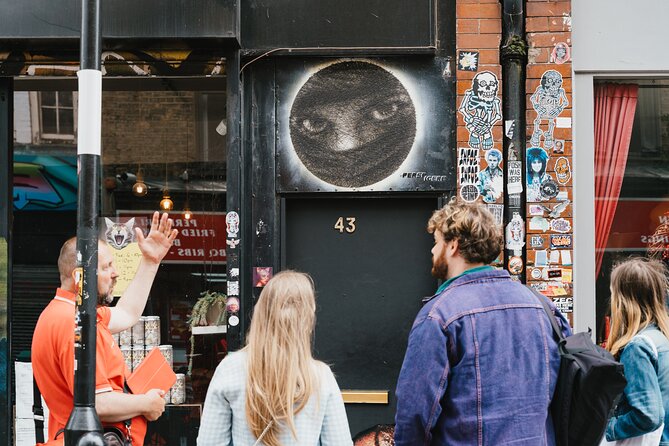
Below is the heart of the tour, and what you should pay attention to at each stop. I’ll also flag what can feel tricky, since a few of these pieces live in places that are not exactly postcard-perfect.

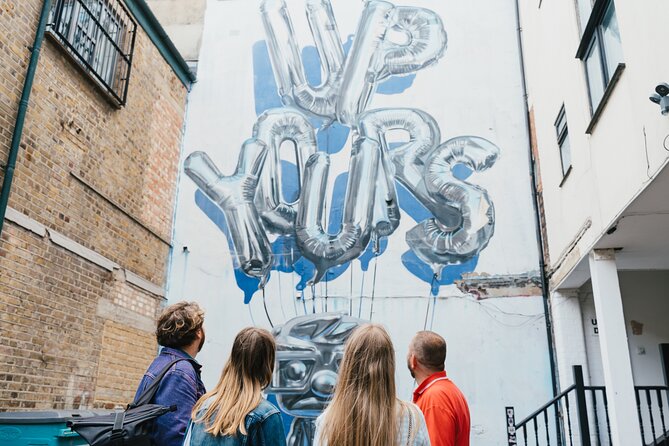
Heneage Street: Phlegm’s Stilts and FanakaPan’s Silver Balloons
This is where the tour shows its first big trick: the best art is sometimes hidden in plain sight, tucked into small backyards.
On one wall you’ll see Phlegm, with signature slim creatures walking on stilts, positioned above layers of other tags. The scale makes it feel slightly surreal, especially when you look up and realize how the animals are placed across the building’s surface.
Across the street, you’ll find FanakaPan, known for silver, helium balloons. The work takes an animated classic and turns it into something more grounded and street-level. Your photo tip here is simple: don’t shoot straight across from street height. Look up, then adjust your angle so the wall fills your frame.
Possible drawback: since it is tucked away, it can take a moment to find the exact viewpoint. Go slowly, because the details are worth it.
Brick Lane: Door-Scale Detail, Dan Kitchener and Perspicere
Brick Lane is the tour’s “step back, then step forward” lesson.
You start from a distance to take in works by Dan Kitchener and Perspicere. Their pieces sit on doors, so you might initially think they are too small to matter. Then the guide has you get closer. That’s where you notice unusual technical skills and the kind of careful execution that does not read at a glance.
If you like street art that rewards patience, this stop is a good one. If you only want huge murals, it can feel quieter, but the technique is the point.
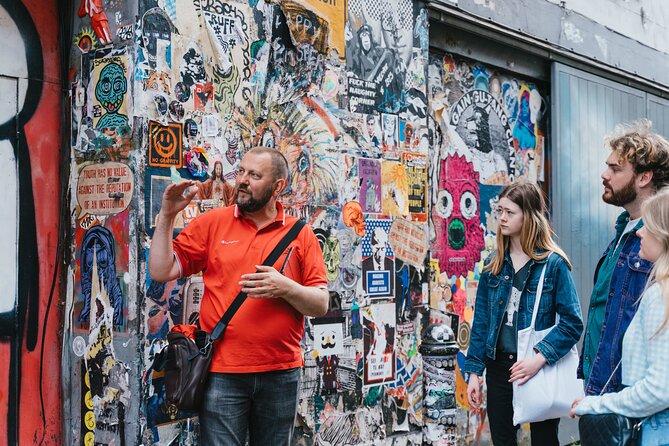
The Seven Stars: Sticker Art and the Eighth Star Idea
This stop moves from the street to a dirty, narrow yard, and yes, it can look a little intimidating for a moment. But the art here is the real show.
Stickers are treated like an art form of their own, and they really rule this space. The guide also brings in a playful prompt: you become the eighth star and leave a little art of your own.
Sticker culture is often about movement, layering, and community. This yard gives you a safe way to see that up close, and the “leave something” idea makes it more than a photo stop.
Princelet Street: Stik’s Work and Community Resilience
On Princelet Street, the focus is on a piece that has local meaning. The guide connects Shoreditch’s long history of refugees and immigrants to the way this work supports the Muslim community.
This art by Stik has been defaced a few times, but it has been repainted again and again. That resilience is the point. You are not just looking at style. You are seeing how street art can function like public memory.
Photo note: strong color and simple form help here. If you are chasing dramatic lighting, wait for a moment when the color reads clearly against the wall texture.
Hanbury Street: ROA’s Bird, Martin Ron’s Upside-Down Figure, and 20-Year Skill
Hanbury Street is the “where do I look first?” stop. A huge bird by ROA leads you in, and then you realize there’s more to take in at different heights.
You’ll also see stickers, black and white painted slogans by Wrdsmth, smaller colourful graffiti pieces that change more often, plus two huge classics:
- the bird by ROA
- a man upside down by Martin Ron
The guide notes these have been there about 20 years, which is ancient in graffiti terms. The upside-down pose is impressive partly because of scale, but also because it incorporates features of the existing building. That is the trick many street artists learn: working with what’s already on the wall, not against it.
Dray Walk: Broccoli Lane and Adrian Boswell’s Framing Idea
At this point, the tour turns playful. You’ll notice broccoli motifs around Brick Lane, often in realistic versions but also in rainbow colours.
Here, you find one attached to the wall, part of a trend that has been popping up for years. The guide even points out that the street changed its name to Broccoli Lane because of it.
Adrian Boswell started the broccoli trend, and the guide explains he now has his own gallery and even sells broccoli in frames. That’s an interesting bridge between street culture and more formal art markets, without killing the joke.
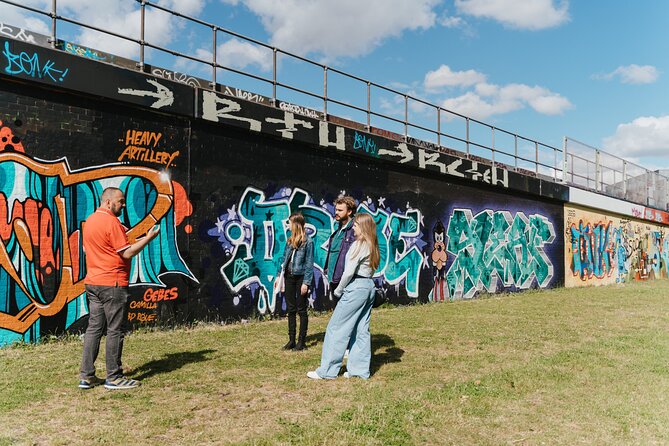
Allen’s Gardens: A Graffiti Park Where Walls Change Every Few Days
Allen Gardens works like a graffiti park version of a gallery wall. It is surrounded by many walls full of graffiti, and the guide warns that some pieces change very often, sometimes every few days.
This is the stop where you should be practical with your camera. If you wait too long, you might lose the exact composition you came to see.
Most of the art is by graffiti writers who focus on letters. It can be hard to read, and that’s not a flaw. The challenge of making something almost impossible to decode is part of the aesthetic. If you like typographic style, you’ll enjoy looking for structure and color rhythm even when the words are not obvious.
Buxton Street: Number 5 and Collaboration Wall Details
As you leave the park, look up for the number 5. You’ll be able to identify the artist responsible for this part of the wall, plus learn about new names and changes.
This is also where collaborations show up, with two or more artists contributing to the same surface. Look for shifts in line weight, color palette, and how different sections relate to the building texture.
Photo note: collaborations often look best when you step back. Shoot one close, one wider.
Ebor Street: Painted Adverts, Pink Portraits by Neon, and Mist-Like Faces
The tour shifts from the rougher vintage vibe toward a more modern, trendy section of the East End, and graffiti follows.
Here you’ll see large format adverts painted by graffiti artists, plus smaller works like pink portraits by Neon. The guide describes these faces like a mist of spray paint that still lands exactly where it needs to, which is a nice way to frame how carefully these images are placed.
This stop can be more visually polished than some of the earlier walls, but that does not mean it’s less creative. It’s just a different approach to scale and visibility.
Ebor Street Again: Ben Eine’s Bold, Readable Letters
Right after that, you get the opposite reading experience with Ben Eine.
His letter style is big and bold, designed to be readable from far away. The guide explains that while the lettering is often the same overall look, he uses different fonts across works. Some are old-fashioned and curved, others sharp and modern, others more square.
I like this contrast because it teaches you something fast: street art is not one thing. It’s a spectrum from representational pieces to pure typography.
Rivington Street: Banksy in a Secret Setting, Protected Under Glass
This is the Banksy stop, and the guide sets expectations in a thoughtful way. The tour takes you to a secret place for some older Banksy works alongside other standout art.
You’ll recognize the Banksy pieces because they are covered in a glass panel. The guide also invites discussion about art, the art market, trends, and what people personally like or dislike.
This is one of the best moments on the tour if you enjoy conversation. It’s also a good reminder that street art can create opinions fast, and that’s part of why it stays interesting.
Rivington Street: Otto Schade’s Ribbon-Like Stencils and the Half Soldier
Another Rivington stop brings you to Otto Schade.
First, you will spot half of a soldier. The guide tells you not to worry, it’s complete, you just need to stand on the corner to fully admire it. Then you’ll find another Otto Schade work that looks like it is made out of ribbons.
These pieces might seem empty inside, but the guide emphasizes they are full of life and energy, plus the stencil technique feels like it has been taken to a new level.
Photo note: these works rely on your position. Move slowly, and trust the guide’s instructions.
Rivington Street: Thierry Noir’s Colourful Heads
Thierry Noir brings brightness. The guide shares that he has been painting colorful heads for over 40 years and is best known for groundbreaking work connected to the Berlin Wall in the 1980s, while still leaving his mark in London.
Even if the day is grey, the character designs are meant to lift mood. If you like playful human faces in street art, this one is a great closer before you jump into the more “institutional” settings later.
art’otel London Hoxton: Banksy’s Reinstalled Wall, Street-Level Access
Here you hit a rare hybrid: street art inside a branded, artsy hotel setting.
The guide explains the street art equivalent of an archaeological chapter: a Banksy wall painted long ago was taken away from the original location and reinstated so people can still admire it. The key practical point is that you do not need to book a hotel room to see it, because it is out on the street where it belongs and where you can criticize it.
This stop is worth your time if you like to think about how street art is preserved, traded, and recontextualized.
Hewett Street: Shakespeare’s Bench and Romeo and Juliet Graffiti
Among all the modern visuals, you suddenly find Shakespeare.
The guide points out the Curtain Theatre area and tells you that Shakespeare sits quietly on a bench that marks the theatre grounds. The joke becomes part of the art moment when you sit next to him and notice a graffiti depiction of Romeo and Juliet, tied to the place where people first heard this love story.
This is a nice reminder that street art can connect to local identity, not only to global pop culture.
New Inn Broadway: Graffiti Wallpaper on One Huge Building
New Inn Broadway is about scale. You’ll see one big building covered by many artists, with different color palettes and different styles that still combine into one overall look.
The guide describes it like graffiti wallpaper, and notes a small policeman is included among the mix.
If you want a “one frame, one photo” finale image, this is likely the one.
Shoreditch High Street: The Graffiti Wars Story and a Walk Toward the City
The last stretch shifts from the artistic old part toward the glass-and-metal skyscrapers of the City.
Before the tour wraps, you’ll hear one last story about the Graffiti Wars. The guide frames it as serious, but also points out that some wonderful art came out of it. It’s a helpful way to understand why certain styles evolved, and why anonymity, territoriality, and style rivalry mattered.
When you get to the end near Liverpool Street Station, the whole route starts to make sense as a timeline: from hidden backyard art to recognizable public icons, with conflict, community, and craft woven through it.
What You’ll Learn That Actually Helps You Look Better
This tour is not just “see art.” It trains your eye.
You learn to:
- Spot layers, like sticker sections and sticker yard textures that change quickly.
- Read positioning tricks, like Otto Schade’s soldier needing a corner viewpoint or door art needing a step forward.
- Appreciate different goals, like letter writers trying to be almost unreadable versus Ben Eine’s clear typography.
- Understand how community meaning shows up in defaced then repainted works, not just in perfect murals.
That is why I think this works for both first-timers and people who already follow street artists. Even if you know a name or two, you still come away with better ways to notice the craft.
Who This Tour Fits Best
I’d steer you toward this tour if you:
- like street art that’s photo-forward, not just street art you stumble across
- enjoy learning the stories behind pieces, including the graffiti wars context
- want a short, structured East End walk rather than planning a self-guided chase
It may be less ideal if you hate narrow yards or you need fully structured indoor viewing. This is outdoors, sometimes in tight spaces, and the whole point is moving with the art.
Should You Book This East End Street Art and Graffiti Tour?
Yes, if you want a high-impact East End experience in about two hours, with clear guidance and a mix of styles you can actually photograph. The value is strongest if you care about the “how to look” parts, from door angles to multi-artist walls to protected Banksy works.
If you are already in London for a short visit and want a safe bet that hits famous art without losing the street level feel, this is a very sensible choice. Just go with comfortable shoes and a flexible mindset, since street art is alive and the walls can change.
FAQ
How long is the East End London Instagrammable Street Art and Graffiti Tour?
It runs for about 2 hours (approx.).
What does the tour cost?
The price is $49.00 per person.
Where does the tour start and end?
It starts at 80 Whitechapel High St, London E1 7QX, and ends at Liverpool Street Station (London EC2M 7QA area). The exact end point can change depending on the art.
Is the tour ticket mobile?
Yes, it includes a mobile ticket.
What is included besides the guided walk?
The tour includes a walking experience led by a local London guide and an opportunity to make your own street art.
How many people are in a group?
The tour has a maximum of 20 travelers.
Is public transportation nearby, and are service animals allowed?
The tour is near public transportation, and service animals are allowed.
Is there free cancellation?
Yes, you can cancel for a full refund if you cancel up to 24 hours in advance of the experience start time.
Fresh off the notebook in London
- Private Rock ‘n’ Roll Music Tour of Central London
★ 5.0 · 7 reviews - London Walking Tour: Camden Town Photography Walkabout
★ 5.0 · 7 reviews - Private Transfer from London accommodation to Cruise terminal
★ 5.0 · 7 reviews - Amazing Nightlife in London East Tour
★ 4.5 · 7 reviews - The British Museum: a highlights tour with a TV historian
★ 5.0 · 7 reviews - Heathrow Airport to Cambridge private taxi transfers
★ 5.0 · 7 reviews
Street Art, compared.
 ★ 5.0London Bike Tour: Landmarks, Secret Gems, Pub Stop & Street ArtFrom $104943 reviews
 ★ 5.0Shoreditch Street Art Tour LondonFrom $29481 reviews
 ★ 5.0The Original London Street Art TourFrom $27303 reviews
 ★ 5.0Shoreditch Street Art and Graffiti Tour (Private Group Booking)From $347108 reviews
 ★ 5.0Street Art: The Modern History of the Northern QuarterFrom $20102 reviews
 ★ 5.0Street Art Tour and Spray Painting Workshop in LondonFrom $5398 reviews
 ★ 5.0Street Art Walking Tour and Workshop in LondonFrom $7258 reviews
 ★ 3.5Bristol Street Art: Banksy Exploration Game and TourFrom $639 reviews
Browse the lists this tour appears in