
REVIEW · MANCHESTER TOURS
Manchester Street Art: Quest Experience
Street art, solved like a puzzle. This Manchester Northern Quarter quest turns murals into a Cities of Hope story trail, with self-guided pacing at street level. My one caution: the whole thing runs on your phone, so you will want solid battery life and correct access details.
You start at Queen Victoria’s Statue and end near Frank Sidebottom, with clue solving that takes about five minutes per stop while you can linger for as long as you like. It feels flexible, and you get directions in the moment, which means you are not fighting maps in a place where turns happen fast.
The price is about $8.68 per person, usually booked around two weeks ahead, and it is set up as a private group activity. For the smoothest experience, plan on everyone in your group having their own ticket, since that is how the app is intended to be used.
In This Review
- Key points before you go
- Northern Quarter murals, connected by the Cities of Hope theme
- How the Questo phone app runs the whole experience
- Price, time, and value in plain terms
- The route at a glance: 12 stops across about 90 minutes
- Stop by stop: from Queen Victoria’s Statue to Frank Sidebottom
- Stop 1: Queen Victoria’s Statue, start clue near Piccadilly
- Stop 2: Hilton House, Inhuman Barriers by Nevercrew
- Stop 3: Ian Curtis Mural
- Stop 4: Cutting Room Square
- Stop 5: Band on the Wall
- Stop 6: Copperas Street, clue tied to Eleven
- Stop 7: Brightwell Walk, Anthony Burgess and Hyuro for Cities of Hope
- Stop 8: Afflecks
- Stop 9: Back Piccadilly, Bee street art
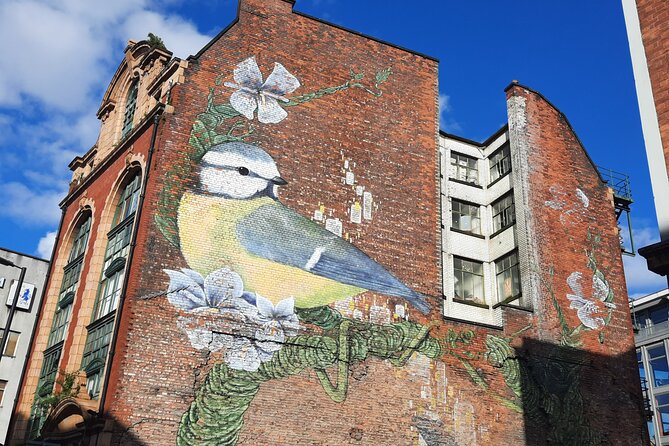
- Stop 10: Newton Street, Blue Tit
- Stop 11: Little Lever Street, Serenity
- Stop 12: 46-50 Oldham St, ending at Frank Sidebottom
- Practical tips to keep your phone quest-friendly
- Who this Manchester street art quest suits best
- Should you book the Manchester Street Art Quest Experience?
Key points before you go
- Questo app navigation: the phone acts like your guide, pointing you to each street art spot without maps.
- Cities of Hope storytelling: puzzles connect what you see to the wider project theme.
- Long pauses for looking: each stop is built for quick clue time plus extra time to simply enjoy the art.
- 24/7 support: help is available any time if you hit a technical snag.
- Phone battery matters: if your phone dies, the quest can feel more stressful than fun.
- Each person needs a ticket: for best play, buy separate tickets for each participant.
More puzzle trails to argue over with friends
- Fun, Flexible Treasure Hunt Around Manchester with Cryptic Clues & Hidden Gems★ 5.0 · 253 reviews
- moviESCAPE Stockport SAWtopsy horror themed escape room game★ 5.0 · 42 reviews
- moviESCAPE Stockport Merlin’s Magic Academy Escape Room Game★ 5.0 · 33 reviews
- moviESCAPE Stockport Haunted House II Demon’s Curse Escape Room★ 5.0 · 27 reviews
Northern Quarter murals, connected by the Cities of Hope theme
This is not a sit-and-listen tour. You are walking a street art trail where the app gives you a sequence of clues, and the art you find becomes part of an unfolding story about the Cities of Hope project.
What I like about the concept is that you are doing more than just “seeing murals.” The quest nudges you to pay attention to details, connect artwork to the project theme, and learn the story behind specific canvases. Even if you are not a hardcore street art fan, the puzzle format gives you a reason to slow down and look.
Manchester street art has personality, and Northern Quarter is a good place for it because it is already made for wandering. This quest fits that vibe: you do it on your terms, in daylight if you can, and at a pace that lets you read and re-read the clues without rushing.
How the Questo phone app runs the whole experience
The experience is a self-guided game on your phone, using the Questo app. You get a mobile ticket, then you use the access code sent after booking to start the experience in the app.
Here is the practical difference between this and a guided tour: you control the timing. The route includes a set of stops, but each one is designed so you can solve your clue, then keep exploring while you are still near the artwork.
One important real-world detail: the quest depends on your phone, so you should plan for battery and signal. The support guidance for this type of quest is to download the game beforehand so you can play with less reliance on the internet, which also helps conserve battery.
Price, time, and value in plain terms
At $8.68 per person, you are paying for a structured walking trail plus a phone-based puzzle and story layer. That is usually good value in a city like Manchester, where street art is free to view but you still want direction and context.
The listed time range is about 1 hour 10 minutes to 1 hour 40 minutes, and the itinerary uses quick clue stops of around five minutes each. You can finish faster if you move briskly, or take longer if you want to spend more time reading the clues and looking closely at each mural.
It is also worth noting that it is booked fairly in advance on average. If you want a specific day and time window, do not wait until the last minute, especially during busy weekends.
The route at a glance: 12 stops across about 90 minutes
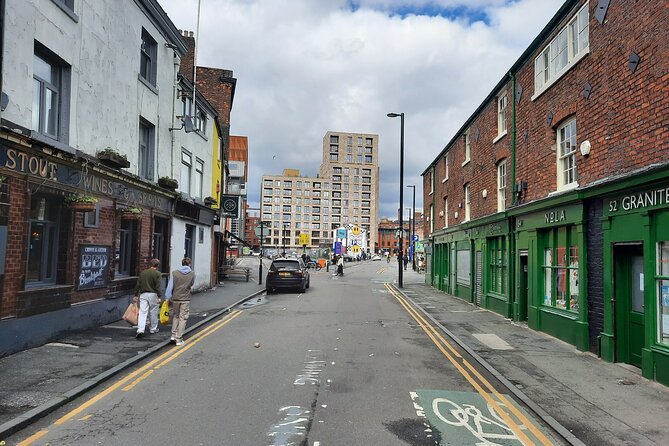
This quest is set up as a straight line from start to finish, with the app giving you directions to each location. You do not need to bring a paper map, and you can play whenever the route is open, which is effectively all day.
The finish point matters because the story and the game both wrap up there. You start at Queen Victoria’s Statue, then you work through the Northern Quarter’s street art stops, ending at 46 to 50 Oldham St where you find Frank Sidebottom.
If you are traveling with friends, the private group format means you are not mixed into a random crowd. It is still a self-paced experience, but the setup makes it feel like your own mini adventure instead of a scheduled group tour.
Other Manchester walks and stadium visits
Stop by stop: from Queen Victoria’s Statue to Frank Sidebottom
Below is what to expect at each stop and what makes each location part of the game.
Stop 1: Queen Victoria’s Statue, start clue near Piccadilly
You begin at Queen Victoria’s Statue at Piccadilly, and you receive the first clue right away. This is where the app starts telling you what to look for and where to go next.
Why it works as a start: it gets you moving quickly and forces you into the routine of reading the clue, spotting the art, and then following the next directions.
Stop 2: Hilton House, Inhuman Barriers by Nevercrew
At Hilton House, the clue connects to Inhuman Barriers by Nevercrew. You can solve the puzzle prompt, then continue looking as long as you like before heading onward.
This stop is your first real “street art hunt” test. By the time you reach it, you should already have a rhythm for using the phone while also keeping your eyes on the walls, not just the screen.
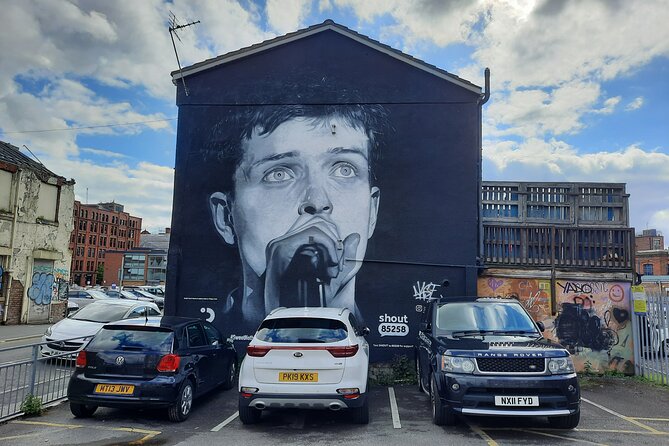
Stop 3: Ian Curtis Mural
Next is the Ian Curtis Mural. The app gives you a clue tied to what you are seeing, and after you answer, you get directions for the next part of the story.
The practical benefit here is pacing. You are not asked to rush through a new concept every time. You get multiple stops that are short clue moments followed by time to just stand there and look.
Stop 4: Cutting Room Square
At Cutting Room Square, you receive the next clue for the game location tied to The Cutting Room Square. Again, you can pause as long as you want, which helps if you like to take photos or read more slowly.
A possible consideration: squares can mean more foot traffic. Keep an eye on your surroundings while you focus on the mural and the phone instructions.
Stop 5: Band on the Wall
The next clue leads you to Band on the Wall. This stop is included like the others, with the same mix of clue time and optional lingering to enjoy the artwork.
What I find useful about stops like this is variety. Even when you are doing a puzzle route, you are still moving through different parts of the neighborhood, not just repeating the same type of street corner.
Stop 6: Copperas Street, clue tied to Eleven
At Copperas Street, the clue connects to Eleven. You solve the prompt, then follow the app’s directions to continue.
Because the itinerary is built to take about 90 minutes, this is one of the stops where it helps to keep your puzzle-solving moving at a steady pace. Otherwise, one long pause can throw off your timing.
Stop 7: Brightwell Walk, Anthony Burgess and Hyuro for Cities of Hope
At Brightwell Walk, the app brings you to Anthony Burgess and Hyuro, connected to Cities of Hope. This is one of the moments where the wider project theme is front and center.
This stop is especially interesting if you like Manchester authors and local creative identity. Even if you do not know the names in advance, the clue-driven format gives you a reason to connect the art to the project story.
Stop 8: Afflecks
Next is Afflecks, where you get a clue related to Afflecks Palace. Solve your puzzle, then spend a few extra minutes looking around at the street art and the surrounding context.
Why this stop can be a good break: it is placed where you might naturally slow down for a quick refresh, and you can choose to do that without derailing the route.
Stop 9: Back Piccadilly, Bee street art
At Back Piccadilly, you receive a clue for Back Piccadilly Bee. This is another stop that is named in a way that likely makes the artwork easier to spot once you are in the right spot.
This is where I recommend you let the app do the heavy lifting for directions, then let your eyes do the rest. You will enjoy it more when you stop using the phone like a map and start using it like a clue sheet.
Stop 10: Newton Street, Blue Tit
At Newton Street, the clue connects to Blue Tit. You solve, move on, and repeat the pattern: look for the mural, answer the prompt, then follow directions onward.
If you are traveling with friends who take longer to read, this is a good stop to regroup. The clue timing is designed to be quick, and you can decide whether to re-check anything before leaving.
Stop 11: Little Lever Street, Serenity
The next clue is at Little Lever Street, tied to Serenity. Like the others, you can take your time with the artwork before continuing.
This stop can be a good moment for slow observation. Even a short mural tour can become repetitive if you rush, so use the built-in flexibility to actually look.
Stop 12: 46-50 Oldham St, ending at Frank Sidebottom
You finish at 46 to 50 Oldham St, at Frank Sidebottom. This is where the story and the city exploration game end.
The best way to handle the final stop is simple: plan to be present for it. Do not sprint toward the end and then half-read the clue, because you are meant to see the conclusion after the full circuit.
Practical tips to keep your phone quest-friendly
This experience is great for independent sightseeing, but your phone is the tool that makes it work. A couple of small habits can make the difference between a smooth puzzle and a frustrating one.
- Download ahead if you can: support guidance for similar quests is that downloading beforehand helps reduce the need for internet during play, which can also save battery.
- Bring a battery pack: if you are out for the full route in busy conditions, phone battery can drop faster than you expect.
- Use each ticket as intended: if you are traveling as a group, buy separate tickets so each participant can play properly.
- Double-check the access code: if your in-app start step fails, contact support. They have 24/7 options and they can help you sort out access issues.
Also, the tour is near public transportation and is generally set up for most travelers. Service animals are allowed, and the activity runs daily from midnight to 11:30 PM.
Who this Manchester street art quest suits best
I think this works best for people who like a plan-free street walk but still want structure and context. If you enjoy solving light puzzles, reading short prompts, and stopping to look at street art the way you would at a gallery, you will likely have a good time.
It also suits families in a flexible way because the stops are short and you can linger as needed. That said, the phone-first nature means younger kids who struggle with reading might need more adult help than a purely outdoor, no-tech activity.
If you want a conversation with a human guide, this is not that. It is a self-guided experience where the phone provides the story beats and directions.
Should you book the Manchester Street Art Quest Experience?
Book it if you want an easy, affordable way to explore Northern Quarter street art with story context and phone-guided directions. The price is low enough that it feels like a smart add-on to your Manchester day, and the route is designed to keep moving without feeling frantic.
Skip it or plan carefully if you know your phone battery is unreliable or you have had app access trouble while traveling. This quest is doable, but it is not a paper map adventure, so bring power and treat the access code step seriously.
If you are the kind of traveler who likes to wander with a purpose, and you enjoy learning while you look, this is a fun way to experience Manchester’s street art scene on your own schedule.
More Of Manchester On Foot






More Trails, Clues And Dead Ends






Fresh off the notebook in Manchester
- Manchester Scavenger Hunt and Highlights Self-Guided Tour
★ 4.0 · 3 reviews - Craft Brews of Manchester – A Private Beer Tour
★ 5.0 · 3 reviews - Manchester One Day Tour with a Local: 100% Personalized & Private
★ 4.5 · 4 reviews - Manchester: Football Experience With A Local Host
★ 3.5 · 6 reviews - 3-Day Lake District Explorer Small-Group Tour from Manchester
★ 5.0 · 6 reviews - Manchester Street Art: Quest Experience
★ 4.0 · 6 reviews
Manchester Tours, compared.
 ★ 5.0The Manchester City Stadium TourFrom $354,176 reviews
 ★ 5.0Alcotraz Prison Cocktail Experience in ManchesterFrom $701,216 reviews
 ★ 4.0LEGOLAND Discovery Centre ManchesterFrom $221,049 reviews
 ★ 5.0Manchester Afternoon Walking TourFrom $241,033 reviews
 ★ 4.0SEA LIFE Manchester Admission TicketFrom $221,007 reviews
 ★ 5.0Rock and Goal Manchester Walking TourFrom $20587 reviews
 ★ 5.0Manchester Cheese Crawl : Guided Food TourFrom $68559 reviews
 ★ 4.5Manchester iFLY Indoor Skydiving Experience – 2 Flights & CertificateFrom $110387 reviews
Browse the lists this tour appears in