
REVIEW · HISTORICAL TOURS
Fashion History Walking Tour in London
London’s style rules are written into the streets. This walking tour connects fashion history to real places, from the Barbican area to St. Paul’s, finishing outside the Bank of England. Along the way, you learn how Londoners have used dress and codes to signal status, work, and belonging.
I especially like how the route is short but focused, so you get real context without burning half a day on transit. The small maximum group size also helps, because you can actually ask your guide questions instead of just listening.
One drawback to consider: it’s a City-style walk. You will be spending a lot of time outdoors on sidewalks and plazas, and the pace is built for covering multiple viewpoints in 90 minutes.
In This Review
- Key highlights you will feel right away
- Fashion history in the real London streets, not a textbook
- Barbican Highwalk: starting above the street and thinking about fashion jobs
- St. Paul’s area: how dress codes show up in big public places
- Royal Exchange: shopping, status, and why the theme fits London’s City core
- Ending outside the Bank of England: dress codes today, not just old photos
- Your guide, Q&A, and how to get more from 90 minutes
- Price and value: what $27.43 is really buying you
- Logistics that matter: start time, route feel, and what to bring
- Who should book this London fashion history walk
- Should you book this Fashion History Walking Tour in London?
- FAQ
- How long is the Fashion History Walking Tour in London?
- What does the tour cost?
- Where do I start the tour, and where does it end?
- Do I need to bring a printed ticket?
- Is there an admission fee for the tour stops?
- Are snacks included?
- What language is the tour offered in?
- How big is the group?
- Is free cancellation available?
- Are service animals allowed?
Key highlights you will feel right away
- Fashion as a lens on the City, not just clothing
- Barbican Highwalk as a starting point, not a random tourist stop
- St. Paul’s area where formality and public life show up in how people dressed
- Royal Exchange time, including the link between shopping and social rules
- End at the Bank of England for a practical look at dress codes today
More on foot, at a pace you can hear the guide
- Tour for Muggles The Ultimate Harry Potter Walking Tour in London★ 5.0 · 4,684 reviews
- London Jack The Ripper Guided Walking Tour★ 5.0 · 3,131 reviews
- Changing of the Guard Guided Walking Tour in London★ 5.0 · 1,793 reviews
- The Great British Rock and Roll Walking Tour★ 5.0 · 1,371 reviews
Fashion history in the real London streets, not a textbook
This tour works because it treats fashion like city infrastructure. Clothing is not just personal style. It is also a language that changes with jobs, neighborhoods, trade, and rules. In London, you can see that shift when you move from one landmark zone to the next and listen to the guide connect what you see with how people dressed.
I like that the emphasis is on dress codes through time, plus what those codes mean right now. When you finish at the Bank of England, it is not just a pretty photo stop. It feels like a closing argument on how formal and professional looks still shape who belongs where.
Price is another part of the value story. At $27.43 for about 1 hour 30 minutes, you are paying for guided interpretation and time-saving routing. The tour also lists admission as free at the stops, which helps keep the experience from turning into a fee-heavy day.
Barbican Highwalk: starting above the street and thinking about fashion jobs
Your tour begins around Barbican, at Underground Ltd on Aldersgate Street, then moves into the Barbican area at Barbican Highwalk. This is a smart opening because it immediately frames the theme in a specific built environment, not generic London streets.
Barbican Highwalk is an elevated walkway, so you get a different view of the neighborhood than you would standing at ground level. That matters for this topic, because fashion history is tied to how people live and work, and how spaces are planned for movement and commerce. Your guide uses this spot to connect the neighborhood to the broader story of the fashion industry around it.
One practical upside: the first stop is 30 minutes, which is long enough for a proper start but short enough that you do not lose energy before you reach the more famous landmarks later.
A consideration here is comfort. As an outdoor, walking-oriented experience, you will want footwear that handles pavement and any uneven sections you might encounter along a highwalk.
St. Paul’s area: how dress codes show up in big public places
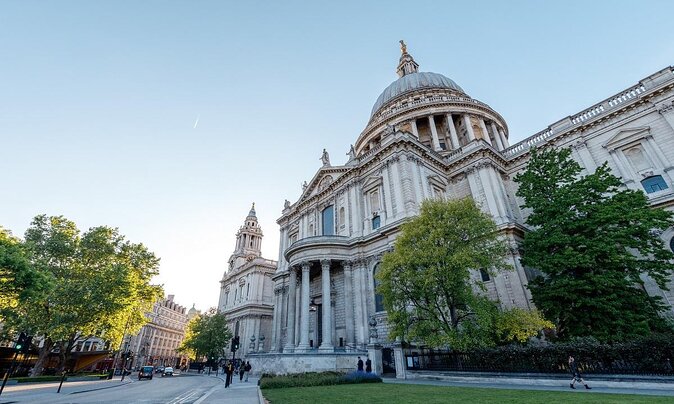
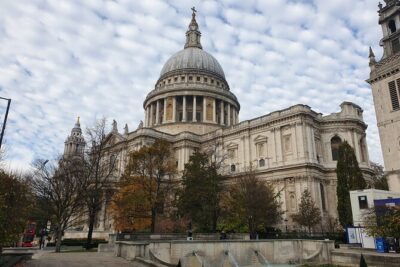
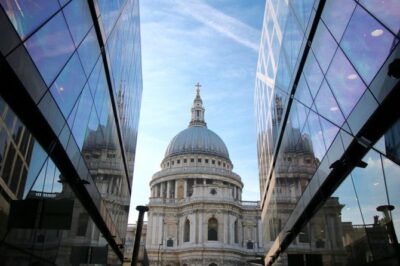
Next, you shift to St. Paul’s Cathedral for another 30 minutes. This stop is where the tour leans into how London public spaces influence clothing choices and how fashion reflects ceremony, work, and social standing.
St. Paul’s is a major landmark. That scale naturally makes you think about display, respect, and public identity. The guide uses the area around it to talk about fashion history tied to this part of London, including how dress codes changed over time.
What I find useful is that you are not stuck in one “museum voice” explanation. You can ask questions as the guide talks, and you can steer the conversation toward what you want to understand more. If you are the type who watches people and wonders why some outfits feel formal while others look casual, this stop will give you language for what you are noticing.
Royal Exchange: shopping, status, and why the theme fits London’s City core
The tour highlights a visit to the Royal Exchange, described as London’s oldest shopping mall. Even if you only spend a limited window there, it is a strong thematic match. This is shopping with social meaning. It has always been about who can buy, who can display, and what kind of appearance makes sense in a marketplace.
For fashion history, that is exactly the point. Retail and professional spaces tend to shape what people wear, because clothing needs to signal credibility and role. The Royal Exchange stop helps connect the ideas from the walk to a real place where shopping and social codes meet.
If you like your history tied to everyday life, this is the moment the tour theme clicks. You can look at the space and think about clothing as “part of the business,” not just part of personal taste.
More history led walks worth the hour

Ending outside the Bank of England: dress codes today, not just old photos
The final stop is outside the Bank of England, for about 30 minutes. The guide uses the nearby City streets and historic alleyways as a bridge, then ends at the Bank to talk about dress codes today.
This part is especially practical because it moves from “how people dressed in the past” to “how we still read clothing now.” In the City, appearance often functions like a passport. You see it in how people choose formality for meetings, client-facing work, and professional roles.
You also finish near public transport, which helps if you are continuing your day elsewhere. The end point is by Bank underground station on Threadneedle Street, so you are not stuck far from a ride home.
A small timing consideration: because the tour is designed to end at the Bank, the conversation can feel like it is wrapping up. If you have one specific question about London’s fashion rules, try to save it for the later portion so you get the most tailored answer.
Your guide, Q&A, and how to get more from 90 minutes
This tour is offered in English, and it is designed for conversation. The format gives you real chances to ask questions about local fashion history and local dress codes.
The small group size, max 15 travelers, is not just a comfort detail. It changes what the guide can do. With fewer people, explanations can stay specific, and you are more likely to hear answers that match what you care about.
If you want to maximize your payoff, come with one curiosity. Examples that fit this theme without needing extra facts are:
- How did business clothing norms develop in London?
- What kinds of dress codes are still common in different parts of the City?
- Why do certain shopping areas tend to attract certain styles?
Your guide is positioned to help you connect those questions to what you see on the street.
Price and value: what $27.43 is really buying you
At $27.43 per person for about 1 hour 30 minutes, you are not paying for entry fees. The tour lists admission as free at each stop. Included in the price are all fees and taxes, which means you are not likely to hit surprise add-ons during the walk.
So what are you paying for?
- A guided route that links fashion to London’s specific landmarks
- Time-efficient sightseeing across multiple key zones
- An expert guide who can answer questions in real time
- A small group setting that supports discussion
Compared with doing “fashion history” by yourself, the value is in the interpretation. Standing outside major landmarks is easy. Making sense of why dress codes shift, and how specific neighborhoods relate to the fashion industry, is the harder part.
And with a rating of 5 out of 5 from 10 reviews, plus 100% recommendation noted in the summary, the track record suggests the experience consistently lands for people who want this theme.
Logistics that matter: start time, route feel, and what to bring
This is a 90-minute walk that starts at 2:00 pm. It begins at Underground Ltd, Aldersgate Street, Barbican (EC1A 4JA) and ends by Bank underground station on Threadneedle Street (EC2R 8AH). That start-to-finish flow makes it easier to plan the rest of your afternoon.
You will also want to think about walking comfort. Even though the tour is not long on paper, you are moving through three main areas with 30 minutes at each. Bring shoes you are confident in, and dress for weather, since you will be outdoors through most of it.
A nice practical touch is that it is a mobile ticket experience. That cuts down on paper and fuss when you are juggling trains, phones, and last-minute route changes.
And if you have mobility or medical considerations, the tour states that most travelers can participate and service animals are allowed. That is worth noting if you need those options to feel safe and comfortable.
Who should book this London fashion history walk
This is a good match if you:
- Like people-watching and want a reason behind what you see
- Prefer guided interpretation over reading on your own
- Want fashion history connected to real City neighborhoods
- Are short on time but still want a theme-based day
It is also a nice choice if you already plan to see St. Paul’s and want to layer meaning onto it. Instead of treating the cathedral as a standalone landmark, the walk gives you a way to connect it to London’s changing dress expectations.
If you are looking for a heavy museum day, this is not that. It is a street-level lens and a conversation-driven format.
Should you book this Fashion History Walking Tour in London?
Yes, if fashion and dress codes are your kind of history. The best case for booking is that the experience focuses on how clothing language changes, and it ties that theme to recognizable London anchors like St. Paul’s and the Bank of England, plus a visit connected to the Royal Exchange.
Book it especially if you enjoy asking questions. The small group size supports that, and the overall rating suggests the guide delivery is a strong part of the value.
Just keep one expectation aligned: it is outdoors and timed. If you want slow wandering with long breaks, you might find this format a bit tight. But if you want a focused, meaningful 90 minutes with strong thematic payoff, this is a smart use of time.
FAQ
How long is the Fashion History Walking Tour in London?
It lasts about 1 hour 30 minutes.
What does the tour cost?
The price is $27.43 per person.
Where do I start the tour, and where does it end?
You start at Underground Ltd, Aldersgate St, Barbican, London EC1A 4JA, UK. You end by Bank underground station on Threadneedle St, London EC2R 8AH, UK.
Do I need to bring a printed ticket?
No. The tour uses a mobile ticket.
Is there an admission fee for the tour stops?
No. The stops listed show admission ticket free, and all fees and taxes are included in the price.
Are snacks included?
No, snacks are not included.
What language is the tour offered in?
The tour is offered in English.
How big is the group?
The tour has a maximum of 15 travelers.
Is free cancellation available?
Yes. You can cancel for a full refund up to 24 hours in advance of the start time.
Are service animals allowed?
Yes, service animals are allowed.
More History Led Walks






More Of London On Foot




Fresh off the notebook in London
- Private Rock ‘n’ Roll Music Tour of Central London
★ 5.0 · 7 reviews - London Walking Tour: Camden Town Photography Walkabout
★ 5.0 · 7 reviews - Private Transfer from London accommodation to Cruise terminal
★ 5.0 · 7 reviews - Amazing Nightlife in London East Tour
★ 4.5 · 7 reviews - The British Museum: a highlights tour with a TV historian
★ 5.0 · 7 reviews - Heathrow Airport to Cambridge private taxi transfers
★ 5.0 · 7 reviews
Historical Tours, compared.
 ★ 5.0London Small Group Tour of Historical PubsFrom $4010,422 reviews
 ★ 5.0Soho Music & Historic Pubs TourFrom $441,993 reviews
 ★ 5.0Shadows of York: Ghost Walk and Horrible History.From $181,403 reviews
 ★ 5.0Private Historical Walking Tour of YorkFrom $1951,324 reviews
 ★ 5.0A Walk Through Time: History of Liverpool Walking TourFrom $27911 reviews
 ★ 5.0Royal Historic Pubs Walking Guided Tour in LondonFrom $44803 reviews
 ★ 5.0Private Group: Historical Pub Walking Tour of LondonFrom $173660 reviews
 ★ 5.0Best Of Liverpool Heritage, History & Culture Guided Walking TourFrom $31539 reviews
Browse the lists this tour appears in