
REVIEW · CITY TOURS
Money and Power in the City Sightseeing Tour
Money and Power in the City is the kind of tour that makes the financial district feel human. In two hours, you move through London’s City of London power places and learn how money, rules, and politics grew into the skyline you see today. You also get the small-group setup, so your questions do not get lost in the crowd.
I especially like the storytelling pace. The guide, Terry (also referenced as Mr. Silvers), uses clear context and humor so the facts land, even if you start with zero background. I also like that the tour feels interactive, with the guide meeting people where they are, from first-timers to those who know their way around the topic.
One thing to consider is that this area is tight on foot, and the tour needs decent weather. If you are not a fan of walking or you are traveling in rainy conditions, plan for some time on your feet and flexible weather expectations.
In This Review
- Key highlights you will feel right away
- Where money becomes a street-level story
- Meeting at Emperor Trajan and how the group stays manageable
- Roman and medieval beginnings: the financial district’s first power moves
- The East India Company stop that changes how you read the area
- Royal Exchange, Bank of England, and Mansion House in one viewpoint
- Exchange Alley, Change Alley, and the coffeehouse origin idea
- Guildhall and the power of medieval guilds
- St Paul’s Cathedral as the skyline boss over the markets
- The Terry factor: what makes this tour feel worth it
- How good value looks for $41.14 in London
- Who this tour is best for
- Should you book Money and Power in the City?
Key highlights you will feel right away
- Small group, max 8 people, which makes it easier to ask questions as you go
- City of London history on foot, so you get the “why here” behind the sights
- The Roman to medieval to modern thread, connecting early finance to the present day
- East India Company context placed next to the major money buildings you recognize
- Exchange Alley and coffeehouse stock-market origins, in a spot you can actually picture
- St Paul’s as the visual anchor, tying today’s markets back to the highest point of the City
More city runs, half day and full
- City Sightseeing London Hop-On Hop-Off Bus Tour & Bookable Extras★ 4.0 · 1,224 reviews
- Eating London: The Heart of ‘The City’ Food Tour★ 5.0 · 206 reviews
- Go City London Explorer Pass: 2-7 Things To do including Shard★ 3.5 · 155 reviews
- London Best of the City Fully Customized Guided Private Tour★ 5.0 · 146 reviews
Where money becomes a street-level story
London’s City of London has a reputation for being intimidating, all serious buildings and big institutions. This tour flips that idea. You walk through the real physical spaces where decisions were discussed, goods were stored, and deals were made, then you learn the plot behind each stop.
What makes it work is the way it connects eras. You do not just see pretty landmarks. You see how power systems form, how they maintain themselves, and how they move when the world changes. That theme is called Money and Power, but it is really about influence, access, and control, and how they show up in stone, streets, and institutions.
Meeting at Emperor Trajan and how the group stays manageable
The tour meets at Emperor Trajan A100, London EC3N 4DR, with an early plan to be in motion quickly after the 2:00 pm start. It runs about two hours and finishes at the London Stock Exchange near Paternoster Square.
The maximum group size of 8 is a major practical plus. It means you are not craning your neck to see over shoulders, and it is easier to hear the guide without constantly repositioning. It also helps if you like context, because the guide can slow down or answer follow-up questions on the spot.
The tour is in English and uses a mobile ticket, with confirmation coming at booking. Service animals are allowed, and the route is near public transportation, which is helpful if you want an easy link to other sights before or after.
Roman and medieval beginnings: the financial district’s first power moves
You start by framing the City’s roots, focusing on the Roman and medieval beginnings of the financial district. This is a useful opening because it gives you a map in your mind before you hit the famous names.
In a place like the City, power often starts quietly. People secure trade, manage movement, and build systems for storing value and coordinating business. When you understand that early foundation, later stops make more sense. The Royal Exchange and the banking institutions feel less random, and more like the next step in a long-running setup.
A good sign of a strong guide is how well they explain the logic of a place without getting lost in dates. Terry’s style, based on the kind of feedback people give, is to connect the dots in plain language so you can follow the story without feeling like you need a textbook.
The East India Company stop that changes how you read the area
Next, you hit a historic location tied to the East India Company, the big force that helped shape global trade and, by extension, wealth and political influence. This stop matters because it explains why the City became a hub far beyond local markets.
Even if you only know the East India Company from broad world history, this kind of street-level context makes it more tangible. You see how commerce can become authority, and how overseas trade connects back to institutions and buildings you can still point to today.
One reason I like including this subject early is that it prevents a narrow view of the City as just finance. The City’s money story is also a story of ships, routes, and risk. When you understand that, your later moments at banking and exchanges feel more grounded.

Royal Exchange, Bank of England, and Mansion House in one viewpoint
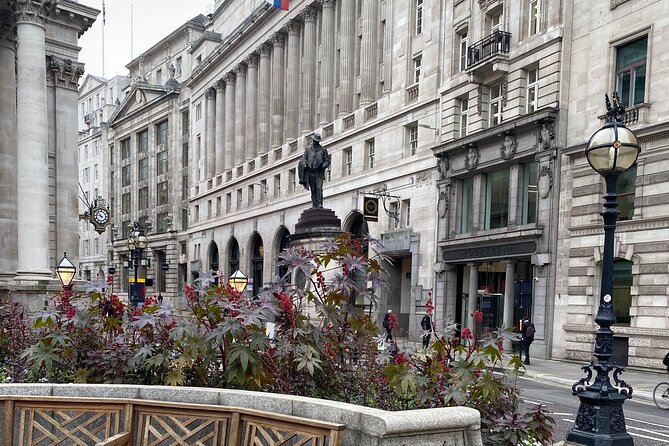
Then you move into the grand, formal architecture that signals official power. You see the neo classical splendour of the Royal Exchange, the Bank of England, and Mansion House, all in the flow of a walking tour rather than as isolated photo stops.
This part is not only about looking. It is about reading. Those buildings are designed to project stability and credibility. That matters because money depends on trust, and trust depends on signals: who runs things, where business is conducted, and what rules seem to govern it.
A practical way to enjoy this section is to slow down mentally. When you are looking at each building, ask yourself: who would want to be seen here, and what kind of agreements would happen under these roofs? The guide’s job is to give you answers, and the best tours make you feel like you can “see” the conversations that once took place.
Exchange Alley, Change Alley, and the coffeehouse origin idea
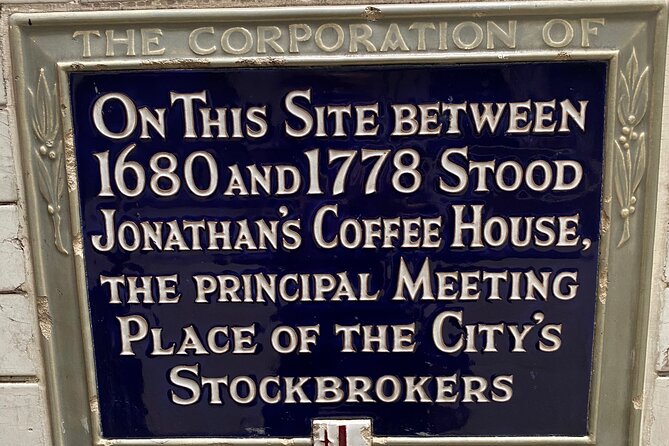
After the big institutions, you step into something much smaller: Exchange Alley, also known as Change Alley. This narrow alley connects shops and coffeehouses in an older City neighborhood, and it served as a shortcut from the Royal Exchange on Cornhill to the Post Office on Lombard Street. It is one of those lanes where the city feels like a lived-in machine.
The standout concept here is the link to the coffee shop where the stock market was first based. Coffeehouses sound casual, but in the 1600s and beyond, they were information hubs. People gathered, talked, compared news, and discussed business. When prices and news circulate quickly, you get markets. When markets form, you get institutions.
So this stop does two things at once. It gives you a real-world route you can picture, and it explains why early finance did not begin in marble halls. It began in places where people met and traded stories, sometimes with rumor, sometimes with hard numbers. Either way, information moved, and that movement created leverage.
Guildhall and the power of medieval guilds
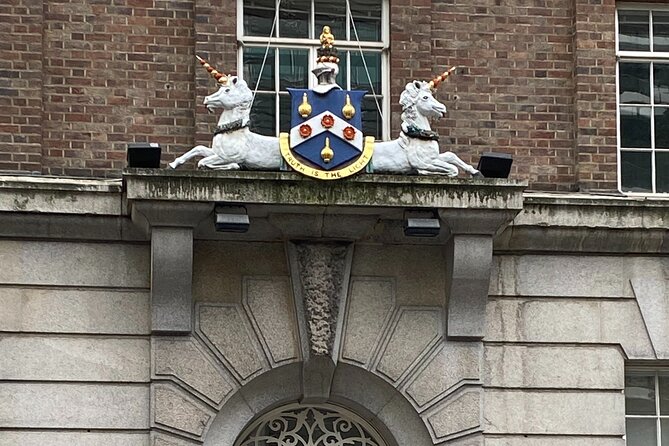
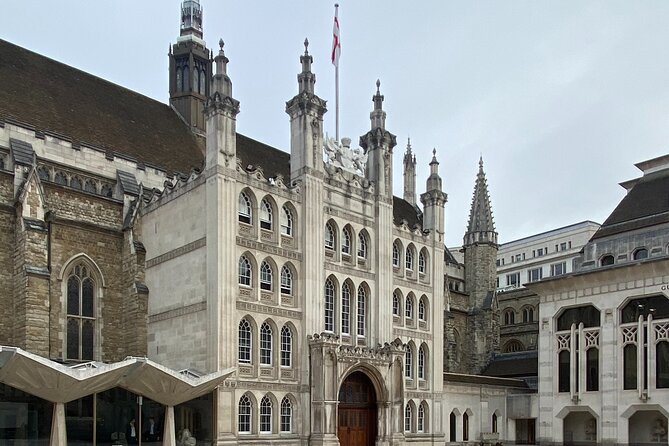
The next shift is medieval, and it is a smart change of pace. You see the medieval Guildhall and nearby guild buildings, and you get a clear sense of what guild halls were for.
Guild halls were used to store goods and host celebratory events. And when they were not needed for members, the space could become a community venue, including entertainment like Passion plays. That detail helps you understand guild power as more than economics. Guilds controlled training, standards, access to markets, and reputation, all of which are forms of power.
If you care about the theme of money and power, this is one of the most satisfying stops because it shows how influence can be local and cultural, not only big and corporate. It also helps you see continuity. Over time, local structures and practices influence the way later institutions operate.
St Paul’s Cathedral as the skyline boss over the markets
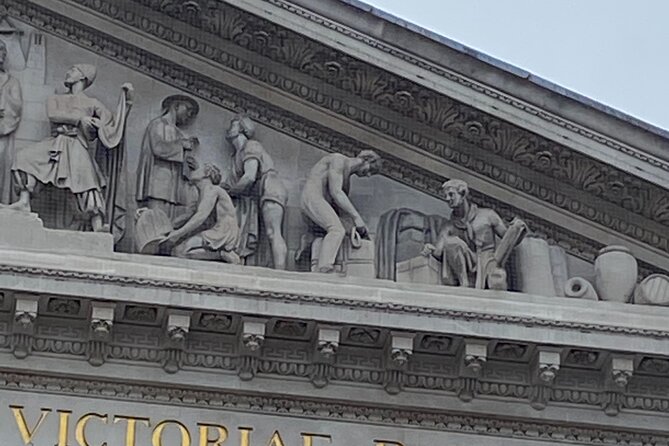
Your final big visual anchor is the modern Stock Exchange area, with St Paul’s Cathedral towering over the scene. This is a moment that works even if you do not care about finance. St Paul’s sits on Ludgate Hill at the highest point of the City of London, and it is the seat of the Bishop of London, the mother church of the Diocese of London. It is also a Grade I listed building.
Why it belongs in this tour: it is a reminder that power has never only been about money. In the City, authority has multiple centers. You get civic, religious, commercial, and political forces all stacking up in one compact landscape.
When you finish near the London Stock Exchange, the contrast lands. You can look at the modern market setting and understand that it is not floating in isolation. It stands over older patterns of decision-making, trade coordination, and community organization that shaped the City long before electronic systems existed.
The Terry factor: what makes this tour feel worth it
The common thread in the strongest feedback is the guide. Terry comes across as the kind of teacher who can explain big concepts without making you feel small. The guide is able to answer questions, keep the energy up, and adjust the pacing depending on what your group knows.
That matters because Money and Power can easily turn into a lecture if the guide only lists facts. Here, the best moments come from storytelling that connects past and present, plus those insider-sounding bits of gossip, scandal, and human behavior that make history stick. You do not only learn what happened. You learn why people behaved the way they did, and how reputation and influence shaped outcomes.
For you, the practical benefit is focus. In two hours, you are not trying to “see everything.” You are learning a line of reasoning through a handful of key sites, and that makes your photos and your memories feel smarter.
How good value looks for $41.14 in London
At about $41.14 per person for roughly two hours, this is not a bargain that feels disposable. It is priced like a focused, guided experience. The value comes from three places.
First, the route compresses major City landmarks into a coherent story, rather than treating them like separate sightseeing postcards. Second, the small group size of up to 8 keeps the experience personal, which you feel in hearing the guide and getting answers. Third, you leave with a framework for understanding the City beyond names on buildings.
If you are comparing options, think about what you want from your London time. If you want quick photos, you can do that independently. If you want to understand why the financial district became what it is, this kind of structured walk is a strong use of time.
Who this tour is best for
This tour fits you if you want a guided overview with real context and you like stories that connect the past to the present. It is also a good first London experience in the area because it helps you get bearings fast in a place that can feel confusing.
It is especially suitable if you enjoy:
- walking and short stops where the guide explains what you are seeing
- history that ties directly to modern institutions
- asking questions and getting answers in real time
If you hate walking, or you have mobility limits that make uneven old streets difficult, you might find the pace challenging. Good weather is also required, so plan for that.
Should you book Money and Power in the City?
I think you should book if you want a small-group, story-led introduction to the City of London, and you care about how money and influence actually grew into the institutions you recognize. The combination of major landmarks, alleyway detail like Exchange Alley, and the human angle of scandal and gossip makes it more memorable than a standard “see these buildings” route.
If you prefer totally free-form sightseeing, or you only want exterior views without explanation, you might be happier doing the area on your own. But if you want your two hours in London to pay off in understanding, this is a solid choice.
More City Runs In London




Fresh off the notebook in London
- Private Rock ‘n’ Roll Music Tour of Central London
★ 5.0 · 7 reviews - London Walking Tour: Camden Town Photography Walkabout
★ 5.0 · 7 reviews - Private Transfer from London accommodation to Cruise terminal
★ 5.0 · 7 reviews - Amazing Nightlife in London East Tour
★ 4.5 · 7 reviews - The British Museum: a highlights tour with a TV historian
★ 5.0 · 7 reviews - Heathrow Airport to Cambridge private taxi transfers
★ 5.0 · 7 reviews
City Tours, compared.
 ★ 5.0Liverpool: “Blue Route” – City & Beatles TourFrom $278,562 reviews
 ★ 5.0The Manchester City Stadium TourFrom $354,176 reviews
 ★ 4.5Liverpool City Sights Hop On Hop Off City Tour – 24hr TicketFrom $192,555 reviews
 ★ 4.51.5-hour Oxford City and University Walking TourFrom $381,383 reviews
 ★ 4.0City Sightseeing London Hop-On Hop-Off Bus Tour & Bookable ExtrasFrom $371,224 reviews
 ★ 5.0Oxford Official University & City TourFrom $411,134 reviews
 ★ 4.5City Sightseeing Oxford Hop-On Hop-Off Bus TourFrom $271,042 reviews
 ★ 4.5Roman Baths and Bath City Walking TourFrom $35762 reviews
Browse the lists this tour appears in