

REVIEW · BATH AND THE ROMAN BATHS
Private Guided Tour of Jane Austen’s Bath
Bath feels made for Jane Austen. This private guided walk strings together the key places tied to her time in Bath, so you spend less time figuring it out and more time enjoying the stories. I especially like the shortcut to Austen linked landmarks and the way the guide adds Regency social context to what you are seeing.
One thing to consider: it is a 2 hours 30 minutes walking route with short stop times, so if you want to linger inside sites or take lots of photos at one spot, you may feel a bit rushed. Also, admission is not included at some major stops, so you will want to be ready for a few extra tickets depending on what you enter.
Key takeaways before you go
- Private group, small scale: only your group participates, so questions feel easy and personal
- Time-saving route: you hit the big Austen linked stops without piecing together routes yourself
- Regency etiquette angle: you do not just see buildings, you learn how people behaved in them
- Smart pacing: short, focused visits keep the story moving across Bath
- A guide can bring it to life: strong guide energy makes the walk fun, not just factual
In This Review
- A Private Jane Austen Walk That Saves You Time
- Price and Value for Up to 6 People
- How the Tour Runs in Real Life
- Stop 1: Bath Abbey at the West Doors
- Stop 2: Sally Lunn’s Museum and the Bath Bun Story
- Stop 3: The Cross Bath and Pump Rooms in One Sweep
- Stop 4: Queen Square and the View From No. 13
- Stop 5: The Circus and Georgian Ambition
- Stop 6: No. 1 Royal Crescent and the Austen Era
- Stop 7: Assembly Rooms and the Social Stage
- Stop 8: Milsom Street, St Swithin’s, and Daily Fashion
- Stop 9: Pulteney Bridge, Shops, and City Life on Water
- Stop 10: Great Pulteney Street to Sydney Place
- The Regency Etiquette Thread You Will Notice Everywhere
- What to Bring, Wear, and Expect on a 2.5-Hour Walk
- Who This Tour Fits Best
- Should You Book This Jane Austen Private Tour?
- FAQ
- How long is the Private Guided Tour of Jane Austen’s Bath?
- How much does the tour cost?
- Is this a private tour?
- Where does the tour start and end?
- Is a mobile ticket provided?
- Are admission tickets included at each stop?
- How long are the individual stops?
- What should I do if the weather is bad?
- Can service animals join the tour?
- What is the cancellation policy?
A Private Jane Austen Walk That Saves You Time

Bath can be a little overwhelming at first, especially if you are bouncing between Abbey, Georgian squares, and bridges while trying to connect it all to Austen. This tour helps you do the connecting for free, with a guide who points out what matters and why it mattered in daily life.
I love the focus on the human details. You get a clear trail from the religious center of Bath (Bath Abbey) to the social stages (Assembly Rooms, squares, and promenades) that show you what Austen could observe in her world. The story threads through the architecture, but it also stays grounded in manners, public life, and who would have been where.
Your private format is part of the value. With a small group, you can ask for clarifications as you go. That matters on a theme tour, because the good parts are often the “small but important” bits.
Bath again, done a few different ways
- Walking Tour of Bath with Blue Badge Tourist Guide★ 5.0 · 1,877 reviews
- Stonehenge, Avebury & the Cotswolds from Bath (Small group)★ 5.0 · 798 reviews
- Roman Baths and Bath City Walking Tour★ 4.5 · 762 reviews
- Fully Guided Bath Ghost Tours★ 5.0 · 539 reviews
Price and Value for Up to 6 People

This costs $205.29 per group for up to 6 people, running about 2 hours 30 minutes. If you fill the group, that works out to roughly $34 per person. That is a lot easier to justify than paying a similar rate per person on a larger group tour.
One practical note: some stops list admission as not included, even though the walk passes by major sights. So you are paying for the guide, the storytelling, and the route planning, and you may pay a couple of site tickets on top if you want to go in.
If you are visiting Bath for a short time, or you already know you want Austen connections but hate doing the homework, this is one of the smarter ways to spend your time.
How the Tour Runs in Real Life
The tour uses a mobile ticket, and your guide meets you at Bath Abbey at the West Doors. It ends at Sydney Place in Bathwick, which is a handy finish if you are staying in that area or plan to continue exploring afterward.
Most people can participate, and it is near public transportation. The tour also allows service animals, so you are not forced into awkward workarounds.
Timing is compact. Each stop is usually brief, which keeps the route moving and prevents decision fatigue. The trade-off is simple: you cannot expect long museum time or a slow wander through interiors at every stop.
Stop 1: Bath Abbey at the West Doors
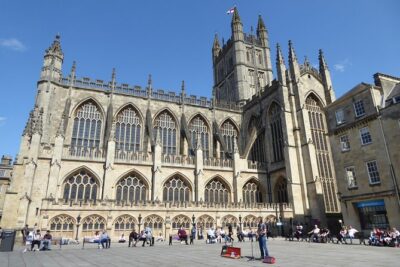
You start outside Bath Abbey at the West Doors, and you get about 10 minutes here. The Abbey is one of Bath’s most iconic landmarks, and starting here makes the rest of the walk feel like a shift from public grandeur to fashionable social life.
The admission note is important. You will not have the Abbey ticket bundled into the tour price for entry. That said, even if you only do an exterior look, it still works because the guide can anchor the story of Bath and then move you along.
If you are the type who likes understanding a place’s role in the city, you will appreciate the way this stop sets the tone.
Stop 2: Sally Lunn’s Museum and the Bath Bun Story

Next up, you head to Sally Lunn’s Museum, again with about 10 minutes. This is a fun stop because it is not only Austen themed, it is also food themed in a very Bath way.
Here is the twist you should be ready for: the famous Bath bun is said not to be the simple Bath Bun name people expect, but tied to the large, light, yeasty Sally Lunn. You also learn a legend about how these buns came to Somerset through a young Huguenot refugee named Solange Luyon.
The Austen connection sits in her letters. The guide explains why she was so taken with them, and you get to see how everyday things mattered in her writing and social world. Since this museum is also a tea room set in Bath’s oldest house, it is a nice chance to pause if you want a snack or a warm drink before continuing.
Other guided options for the same sights

Stop 3: The Cross Bath and Pump Rooms in One Sweep

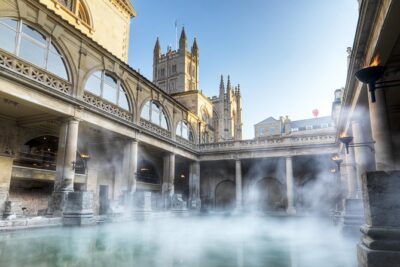
Your third stop is The Cross Bath, a historic bathing pool with natural therapeutic minerals, rebuilt in 1789 in a style linked to Robert Adam. You also visit the nearby Pump Rooms, with about 20 minutes.
This is one of the best stops for understanding why Bath was more than scenery. Bath was a “social technology” as much as it was a health place. People came for relief, yes, but they also came to be seen, to meet, and to trade news.
The tour ties this directly to Austen’s writing, including the idea that in Bath there was always a fashionable rhythm, with different groups appearing at different times. You start noticing how the Pump Rooms functioned like a stage for polite society.
Admission is again listed as not included, so if you want to go inside and fully use the site, plan for that.
Stop 4: Queen Square and the View From No. 13

At Queen Square, you get about 10 minutes, and it is a strong “how Austen would have watched Bath” moment. The square is known for Grade 1 Georgian houses built in the Palladian style by John Wood the Elder.
The Austen connection is very specific. In 1799, Austen stayed with her family at No. 13, and from a bedroom window she would have had a view of elegantly dressed people passing by.
You also see the obelisk in the gardens, erected by Beau Nash in honor of Frederick, Prince of Wales. This gives you a feeling for how Bath’s social world was shaped by major local figures, not just by the famous author.
This is the kind of stop where a guide’s storytelling makes the architecture feel lived-in. You are not just looking at buildings, you are visualizing the daily choreography Austen would have noticed.
Stop 5: The Circus and Georgian Ambition

Then you reach The Circus, about 15 minutes. This is part of John Wood the Elder’s plan to recreate a classical Palladian style idea for Bath.
The Circus can be photographed a thousand times, but on this tour it becomes more than a postcard. Your guide helps you understand how unusual it is as a piece of Georgian urban planning and why it would have stood out in Austen’s Bath.
If you like architecture, this is a highlight. If you do not, it still works because the guide keeps bringing it back to people, movement, and the feeling of a city built for display and conversation.
This stop is listed with admission as free, so it is more about viewing and learning than ticketing.
Stop 6: No. 1 Royal Crescent and the Austen Era

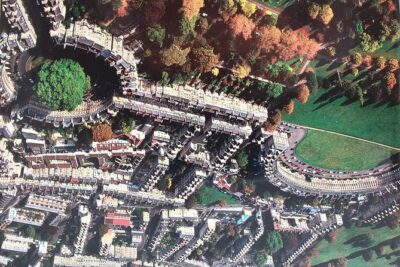
Next is No. 1 Royal Crescent, about 15 minutes. This is the sweeping, iconic crescent overlooking Royal Victoria Park, designed by John Wood the Younger and built between 1767 and 1775.
The tour frames Royal Crescent as a real social machine. Houses here were designed for status, for visibility, and for the kind of street life people talked about. When you look at it after the Circus, you start to see the logic of Bath’s layout: grand sightlines, controlled grandeur, and public life as a daily performance.
This stop is also listed as free for admission. So again, you are paying for the interpretation as you look, not for extra entries.
Stop 7: Assembly Rooms and the Social Stage
Your seventh stop is the Assembly Rooms, about 10 minutes. This is where polite society gathered for balls, concerts, and evening functions, and Austen was very fond of dancing.
The tour also points out how the building was funded through an investment plan connected to one of her uncles, linking family ties to the city’s social infrastructure. That detail is useful because it makes the Assembly Rooms feel less like a generic tourist attraction and more like a place enabled by money, planning, and power.
Admission is noted as not included here too, so you may want to decide on the spot whether you are satisfied with the exterior or want to factor in entry.
If you want the tour to feel like it connects to books, this is one of the most “Regency social” stops in the route.
Stop 8: Milsom Street, St Swithin’s, and Daily Fashion
At Milsom Street, you get about 10 minutes. This is a fashionable Georgian thoroughfare that shows up in Austen’s fiction, and it is still a major shopping street.
Along the way, you pass St Swithin’s Church, where Austen’s parents were married and where her father is buried. That is a quick stop, but it adds weight. It reminds you that Austen’s world was rooted in real family life, not only in witty dialogue.
This part of the walk is ideal if you want to see where fiction and daily life overlap. You are seeing a street that still carries the same kind of public energy Austen would have recognized.
This stop is listed as free for admission, so it is mostly observation plus story.
Stop 9: Pulteney Bridge, Shops, and City Life on Water
Next is Pulteney Bridge for about 10 minutes. It is designed by Richard Adam, spans the River Avon, and is known for shops across its full span on both sides. The tour also notes that it is one of only four bridges in the world with that shop pattern.
This stop works because it adds “movement” back into the walk. After squares, crescents, and indoor social spaces, the bridge gives you a practical view of how trade and commerce lived right alongside scenery.
You also get a different angle on Bath itself. Bridges force you to think about crossing points, flow, and how people actually moved through the city.
Admission is listed as free, so you can focus on the sights.
Stop 10: Great Pulteney Street to Sydney Place
Your final stretch is Great Pulteney Street, about 15 minutes, created by Thomas Baldwin to connect Bath with the River Avon, Bathwick, and Sydney Gardens. You will pass Georgian townhouses along the wide avenue.
From there, the walk moves toward Sydney Place, where Jane and her family lived in Number 4. Ending here is a satisfying closure because it brings you back to the idea of Austen not as a distant author, but as a person with a specific home and neighborhood.
If you have energy left afterward, this is a great spot to keep exploring around Bathwick. The tour ends at Sydney Place, so you are not cutting your day short with an awkward transfer.
The Regency Etiquette Thread You Will Notice Everywhere
One of the most praised parts of this style of tour is how it teaches you to read the city like Austen did. Instead of just listing facts, the guide helps you understand social etiquette in Regency England and how that etiquette shaped where people went and how they acted once they arrived.
You start noticing details you might otherwise miss. Who would have been visible from a bedroom window. Why a meeting place like the Pump Rooms mattered for conversations. Why a dance venue like the Assembly Rooms was more than entertainment.
That is where the guide quality really shows. In the past, guides such as Theresa stood out for being both enthusiastic and very entertaining, while still keeping everything tied to what you see on the street. That balance is what makes the walk feel like fun learning instead of a lecture.
What to Bring, Wear, and Expect on a 2.5-Hour Walk
This is a walking tour with a steady pace. Comfortable shoes are not optional, especially in Bath when pavement and hills can surprise you.
Because the tour requires good weather, check the forecast and dress for outdoor walking. If rain hits, you may need a reschedule or refund according to the provider’s weather handling.
Bring a small day bag for water and layers. You will be outside most of the time, and even short stops add up.
Also, be ready for ticket decisions. Some of the big stops list admission as not included, so if you want to go inside, you will likely need to plan for that during your visit.
Who This Tour Fits Best
This tour is a great match if:
- you want a private, small-group experience tied directly to Austen’s Bath
- you are short on time and do not want to research every connection yourself
- you enjoy walking plus explanation, not only standing in museums
- you like social history, manners, and how public spaces shape behavior
It may be less ideal if you want a deeply slow pace with long indoor time at multiple major attractions. With short stop windows, this tour aims to move efficiently from scene to scene.
Should You Book This Jane Austen Private Tour?
I would book it if you want the Austen connections without the stress of planning. The route hits the major Bath touchpoints tied to her life and the feel of Regency social life, and the private format keeps it personal.
The value is also solid for a group up to 6, and the guide-driven storytelling is the difference-maker. If you are traveling with a partner or a small friend group and you want a smart way to spend an afternoon, this fits.
If you love architecture and social history, this one reads like a guided tour of how Bath worked as a stage. If you just want to wander at your own speed, you might prefer a self-guided walk. But if you want answers quickly and a clear trail, this private Austen walk is an easy choice.
FAQ
How long is the Private Guided Tour of Jane Austen’s Bath?
It runs for about 2 hours 30 minutes.
How much does the tour cost?
The price is $205.29 per group (up to 6 people).
Is this a private tour?
Yes. It is private, and only your group will participate.
Where does the tour start and end?
It starts outside Bath Abbey at the West Doors and ends at Sydney Place in Bathwick.
Is a mobile ticket provided?
Yes. The tour includes a mobile ticket.
Are admission tickets included at each stop?
Admission tickets are listed as not included at some stops, including Bath Abbey, The Cross Bath (and Pump Rooms), and the Assembly Rooms. Other stops are listed as free.
How long are the individual stops?
Stop times vary, generally ranging from about 10 minutes to 20 minutes depending on the location.
What should I do if the weather is bad?
The experience requires good weather. If it is canceled due to poor weather, you will be offered a different date or a full refund.
Can service animals join the tour?
Yes. Service animals are allowed.
What is the cancellation policy?
You can cancel for free up to 24 hours in advance for a full refund. If you cancel less than 24 hours before the start time, the amount paid is not refunded.
More Private Departures





Other Departures With A Guide Attached



Bath, Done Differently



Fresh off the notebook in Bath
- Private Guided Tour of Jane Austen’s Bath
★ 5.0 · 7 reviews - Bridgerton’s Filming Locations in Bath Audio Guide
★ 5.0 · 7 reviews - Private Day Tour from Bath to Stonehenge and Salisbury with Pickup
★ 5.0 · 9 reviews - Bath Private Guided Walking Tour
★ 5.0 · 10 reviews - The Beatles in Bath June 10th 1963
★ 4.5 · 10 reviews - Wells, Cheddar Cheese and Cheddar Gorge – Private Day Trip from Bath
★ 5.0 · 10 reviews
Bath and the Roman Baths, compared.
 ★ 4.5Stonehenge, Windsor Castle, and Bath from LondonFrom $11118,662 reviews
 ★ 4.5Stonehenge, Windsor Castle and Bath with Pub Lunch in LacockFrom $1237,402 reviews
 ★ 4.5Stonehenge, Windsor Castle and Bath Full Day Guided TourFrom $1235,346 reviews
 ★ 4.5Stonehenge and Bath Tour from LondonFrom $994,295 reviews
 ★ 5.0Windsor, Stonehenge and Bath Day Trip from London SpanishFrom $1232,656 reviews
 ★ 5.0Stonehenge and Bath Day Trip from London with Optional Roman Baths VisitFrom $1372,028 reviews
 ★ 5.0Stonehenge Inner Circle Private Tour from London with Bath VisitFrom $1881,909 reviews
 ★ 5.0Walking Tour of Bath with Blue Badge Tourist GuideFrom $301,877 reviews
Browse the lists this tour appears in