
REVIEW · MANCHESTER TOURS
Private Manchester Self-Guided Tour
Manchester in bite-sized stops, no map stress. This private self-guided Manchester walk uses an app with GPS directions and a narrated route that strings together major landmarks, from Vimto Park to Castlefield and Deansgate. It is designed for English speakers and works at your pace, with about 2 to 3 hours to complete the circuit.
I love two things right away. The GPS maps do the heavy lifting, so you spend more time looking up at buildings and less time guessing turns. And the audio is led by Jake, with human-sounding storytelling plus videos, pictures, and on-the-ground recommendations to help you decide what to do next.
One consideration: this is not a live, in-person guided tour. If you want face-to-face questions and a real guide walking beside you, you may feel like you paid for an app. Also, if your phone battery is low, expect to manage it, since GPS and audio can drain power.
In This Review
- Key highlights to know before you go
- Price and value: what $12.35 buys you in Manchester
- How the app experience really feels on your phone
- The route plan: from Vimto Park to Castlefield Bowl, finishing by Deansgate
- Stop 1: A Monument to Vimto, and the perfect quirky start
- Stop 2: Alan Turing Memorial and Sackville Gardens context
- Stops 3 and 4: Gay Village and Chinatown by Canal Street
- Stops 5 to 8: St Peter’s Square, Bridgewater Hall, Royal Exchange, and The Shambles
- St Peter’s Square (Stop 5)
- Bridgewater Hall (Stop 6)
- Royal Exchange Theatre (Stop 7)
- The Shambles (Stop 8)
- Stop 9: Manchester Cathedral, a quick hit with a key role
- Stop 10: John Rylands Library, the bookish pause you might want to extend
- Stops 11 and beyond: Castlefield Urban Heritage Park, Roman clues, and canal walks
- Castlefield Urban Heritage Park (Stop 11)
- The Guardian Telephone Exchange
- Midland Hotel and the long Manchester story (mid-route stop)
- Manchester Central, the Corn Exchange, and ending with a classic pub
- Manchester Central (Stop 12)
- The Corn Exchange market story
- The Old Wellington and Sinclair’s Oyster Bar
- Who this self-guided Manchester tour suits best
- Should you book this Private Manchester Self-Guided Tour?
Key highlights to know before you go

- GPS-first routing keeps you on track through the city centre.
- Jake’s audio guide uses a real voice style, not computer narration.
- Three weeks of access so you can retry if you miss a stop or want a second pass.
- A story-heavy route that mixes big-name sites with curious details like Vimto and the Guardian Telephone Exchange.
- Built for independent pacing, with free outdoor stops and a few places where you may choose to pay entrance.
Other Manchester walks and stadium visits
- Alcotraz Prison Cocktail Experience in Manchester★ 5.0 · 1,216 reviews
- LEGOLAND Discovery Centre Manchester★ 4.0 · 1,049 reviews
- Manchester Afternoon Walking Tour★ 5.0 · 1,033 reviews
- SEA LIFE Manchester Admission Ticket★ 4.0 · 1,007 reviews
Price and value: what $12.35 buys you in Manchester
At $12.35 per person for a 2 to 3 hour self-guided experience, you are really paying for structure, not tickets. You are getting a planned route with GPS directions, plus an audio guide by Jake, with videos, pictures, and practical recommendations baked in.
That value works best when you want to see a lot of Manchester without committing to a fixed group tour schedule. Since it is private, only your group participates, so you are not stuck matching someone else’s pace or listening to a shared headset dynamic.
If you plan to enter paid attractions (the Cathedral and John Rylands Library are explicitly not included), your total spending can rise. But the tour still gives you plenty to enjoy at the free stops, and those two indoor moments are optional choices.
How the app experience really feels on your phone
This tour lives in an app, so your success depends on basic phone setup. You will activate it using instructions sent by email, and your booking reference is not the code. Before you go, check the e-ticket’s Before You Go section, because that is where they point out key steps.
Once it is running, the route uses GPS maps and directions to keep you on track. You should also plan on granting location permissions, since the GPS guidance will not work properly otherwise. If you are trying to squeeze in the tour during a full day of walking, bring a charger or a power bank, since audio plus navigation can drain a phone faster than you expect.
One more tip I found useful: download your confidence early. Open the app, confirm you can reach the tour content, and test your playback before you start walking. That way, you are not troubleshooting while you are standing under a monument wondering what comes next.
The route plan: from Vimto Park to Castlefield Bowl, finishing by Deansgate
Your start is Vimto Park in Manchester city centre (Manchester M1). You finish at Castlefield Bowl on Rice Street (Manchester M3 4JR), near the Roman Fort area, with the route clearly anchored around Deansgate as you reach the end.
Practically, this matters because the walk is mostly city-centre terrain. You are bouncing between major squares, theatres, libraries, and historic neighbourhood pockets. If you like exploring in short chapters, this format makes sense: you get a stop, you hear the story, you look around, and you move on.
Also note the tour’s long availability window. It lists opening hours from 12:00 AM to 11:30 PM across the validity range, so you can pick a time that fits your day and the light. Night walks around civic buildings and canals can feel very different, and the app lets you choose.
Stop 1: A Monument to Vimto, and the perfect quirky start

You kick off at A Monument To Vimto, and the tour immediately frames it as more than a brand marker. You get the history behind the North’s famous soft drink and how it was originally produced right there.
This is a smart warm-up stop. Even if you are not a drink-nerd, it gives you a Manchester angle you do not usually get from standard sightseeing. It also gets you into the rhythm of the app, because you learn the tour overview and how long each stop tends to last.
Rather go alone? More self led routes here

Stop 2: Alan Turing Memorial and Sackville Gardens context

Next is the Alan Turing Memorial. You will learn who Turing was and why he matters to Manchester, then the app zooms out to explain practical things about Sackville Gardens and its monuments.
The fun part is how it tees up what is coming in the Gay Village area. You get perspective, not just landmarks. That makes the next streets feel like a story you are walking through, rather than a sequence of photos.
Stops 3 and 4: Gay Village and Chinatown by Canal Street
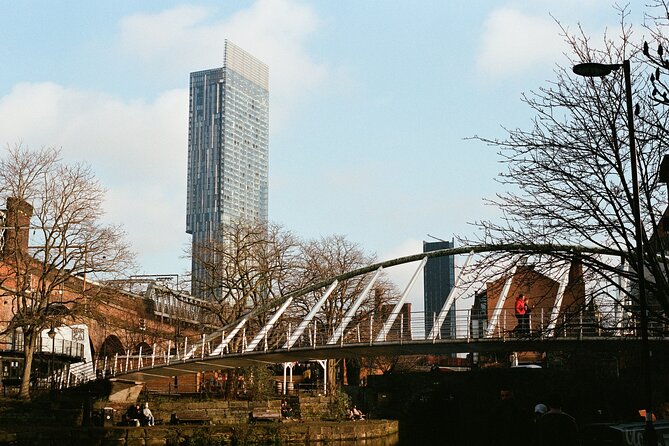
In the Gay Village, you stroll through one of Manchester’s most emblematic areas. The focus here is history, including a look at the dark past of Canal Street and how people worked to turn the odds into the welcoming streets you see today.
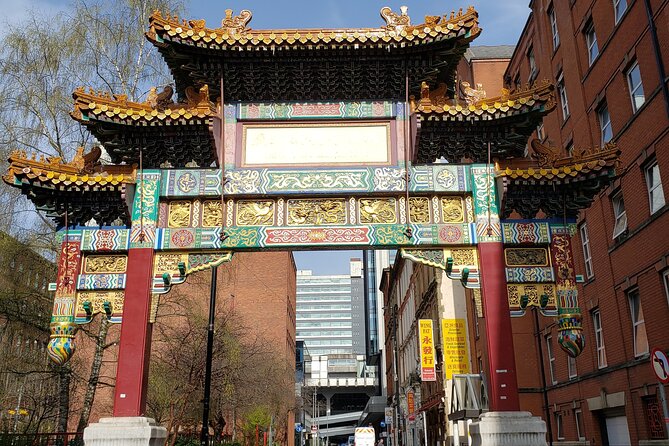
Then you swing into Chinatown. The route highlights the archway, plus shops and restaurants in the enclave. You also get the explanation for Manchester’s twin city in China and why the archway was built here.
These two stops work well back-to-back because they contrast sharply: one is about a community’s survival and reinvention, the other is about cultural connection made visible in public space.
Stops 5 to 8: St Peter’s Square, Bridgewater Hall, Royal Exchange, and The Shambles
St Peter’s Square (Stop 5)
St Peter’s Square is the app’s civic architecture moment. You are guided through key landmarks like Manchester Central Library, described as the oldest free library in the country. You also hear about the Midland Hotel as one of the first luxury hotels in the North, plus Manchester Town Hall and why the square is called St Peter Square.
If you like grand public buildings, this is one of the most satisfying sections of the walk. It is also where you start to notice how much of Manchester’s identity is written in stone and brick.
Bridgewater Hall (Stop 6)
At Bridgewater Hall, the tone shifts from pretty façades to darker stories. The app connects the area to two major tragedies tied to events in the premises of Manchester Central Station, one in 1819 and another in 1963.
This stop is a reminder that you are walking through a city that has survived hard chapters. If you do not want heavy themes, you can still enjoy the hall’s exterior, just know the narration will go there.
Royal Exchange Theatre (Stop 7)
Then you move to the Royal Exchange Theatre and the cotton industry story. You get how cotton helped Manchester grow, and what that meant for the city. The app also brings in the story of the IRA Bomb and how it affected Manchester.
This stop is one of the most “big idea” segments of the tour: industry, money, power, and the human cost.
The Shambles (Stop 8)
The Shambles is a square that feels like it was made for postcards. The tour focuses on the oldest pub in town and why it is typically full, with a nod to prices that are often relatively friendly.
It also ties back to the cotton boom and how markets and trade routes shaped what Manchester built, including mention of the Royal Corn Exchange near this area. If you like places where history shows up in everyday life, this stop delivers.
Stop 9: Manchester Cathedral, a quick hit with a key role
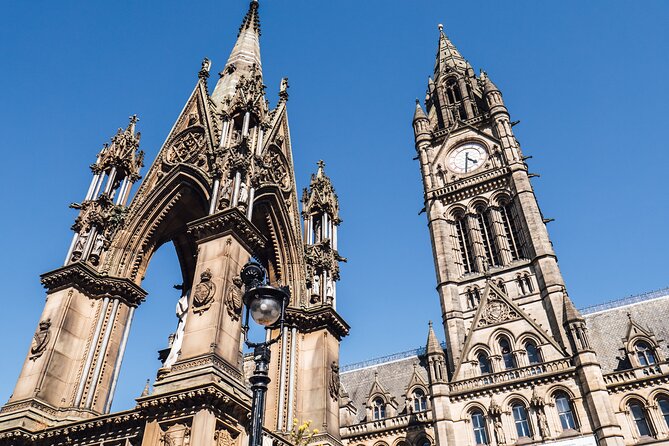
Manchester Cathedral is described as the mother church of the Anglican Diocese of Manchester, the seat of the Bishop of Manchester, and the city’s parish church. The narration frames it as a must-visit emblem of Manchester.
This stop is short in the plan, so treat it as a fast orientation pause. You can still take a moment to look at the exterior and surrounding grounds, and if you decide to go inside, remember that entrance fees are not included in the tour.
Stop 10: John Rylands Library, the bookish pause you might want to extend
John Rylands Library gets labeled as one of Manchester’s best-kept secrets and one of the nicest libraries in the country. The app’s description also leans into the spooky-fun comparison people make, because the interior has that film-set kind of vibe.
This is where you should consider slowing down. The stop is planned for about 30 minutes, and the narration specifically recommends going inside if you have the time. Entrance is not included, so you are choosing based on your interests and budget.
Even if you only do the exterior, the tour’s point is clear: Manchester is not only industry and football. It is also learning spaces built with real pride.
Stops 11 and beyond: Castlefield Urban Heritage Park, Roman clues, and canal walks
Castlefield Urban Heritage Park (Stop 11)
Your next big shift is to Castlefield Urban Heritage Park. The narration focuses on the city’s beginnings and Roman heritage, including reconstructed buildings you can look at like a visitor to an older Manchester.
It also explains why the city is called Manchester, then sets you up for a stroll along the canals of Deansgate. The app offers recommendations for places to do and eat around the area, which helps when you are deciding how to end your day.
The Guardian Telephone Exchange
After the park, you hit the Guardian Telephone Exchange, called the best-kept secret in Manchester. The tour’s angle is that it hides in plain sight, so you are prompted to look carefully rather than just rush past.
This kind of stop is a win if you enjoy under-the-radar engineering and architecture. It also adds variety after the Roman and civic stretches.
Midland Hotel and the long Manchester story (mid-route stop)
The app then calls out the Midland Hotel as a landmark of the city centre. It notes the hotel has been part of Manchester life for over 118 years, and it highlights the architecture and stories connected to the building.
If you did not soak in St Peter’s Square fully, this is a second chance to connect the dots on Manchester’s hotel and civic prestige.
Manchester Central, the Corn Exchange, and ending with a classic pub
Manchester Central (Stop 12)
Manchester Central is next, described as a convention centre today, but once used as Manchester Central Train Station by the Midland Railway. The narration includes a difficult story described as one of the worst massacres in the North, and it also includes the mysterious suitcase story from 1965.
This is a stop that feels like time travel. You are standing where transport and tragedy intersect, and the app makes the place feel specific instead of generic.
The Corn Exchange market story
The next stop turns the spotlight back to commerce. The app explains how market exchange thrived in the North due to cotton industry commercialization of other goods. It mentions that the first Corn Exchange was built on this site in 1837, and it explains how the listed building now houses a food court, a hotel, and more.
If you like practical architecture, this is one of the more useful stops. It shows how older industrial spaces can function today, without erasing what made them important.
The Old Wellington and Sinclair’s Oyster Bar
Finally, you end with one of the city centre’s most famous older pubs, The Old Wellington and Sinclair’s Oyster Bar. The narration points to its historical link to John Shaw’s Punch House and explains why so many people stop by every day.
This is a good ending move because it gives you a built-in option for food or a final pint after walking. Since the tour emphasizes the pub’s ongoing popularity, you will likely have a lively atmosphere to step into.
Who this self-guided Manchester tour suits best
This tour fits best if you like control. You want to stop for photos when you see something cool. You want to skip inside a building when you feel like it. And you want a clear route so you do not waste time zigzagging across town.
It is also a good choice for travellers who enjoy story-based walking, where each stop has a specific angle, like Vimto, Alan Turing, Canal Street’s transformation, and the Roman trace at Castlefield.
I would think twice if you want a live human guide. Since there is no in-person guide included, you cannot ask spontaneous questions or get real-time advice on the fly. And if you know you have trouble setting up apps, plan extra time for activation and making sure GPS permissions are on.
Should you book this Private Manchester Self-Guided Tour?
Book it if you want an affordable way to hit a lot of Manchester’s major landmarks in one go, with a guided audio route by Jake and GPS directions that make it easy to stay oriented. The best part is the combination of big-name sites and surprising details, like Vimto’s origin spot and the Guardian Telephone Exchange.
Skip it if you want a traditional guided walking tour with a human guide walking alongside you, or if you are likely to avoid phone-based experiences. In those cases, the self-guided format might feel like effort instead of fun.
If you are the kind of person who likes to wander with purpose, this one is a strong value. Charge your phone, download ahead, then enjoy Manchester in your own rhythm.
Other Departures With A Guide Attached






Routes You Can Walk Unaccompanied
More Of Manchester On Foot






Fresh off the notebook in Manchester
- Private Cocktail Making Class in Manchester
★ 5.0 · 8 reviews - MANCHESTER: Yorkshire Adventure – Sightseeing Day Trip Tour
★ 5.0 · 9 reviews - Manchester: Luggage Storage Central
★ 5.0 · 10 reviews - Musical MADchester Quest Experience in Manchester
★ 4.0 · 14 reviews - Murder Detective Self-Guided Tour in Manchester
★ 3.5 · 16 reviews - Manchester’s Music Scene with a Local Host, Private + Custom
★ 4.0 · 17 reviews
Manchester Tours, compared.
 ★ 5.0The Manchester City Stadium TourFrom $354,176 reviews
 ★ 5.0Alcotraz Prison Cocktail Experience in ManchesterFrom $701,216 reviews
 ★ 4.0LEGOLAND Discovery Centre ManchesterFrom $221,049 reviews
 ★ 5.0Manchester Afternoon Walking TourFrom $241,033 reviews
 ★ 4.0SEA LIFE Manchester Admission TicketFrom $221,007 reviews
 ★ 5.0Rock and Goal Manchester Walking TourFrom $20587 reviews
 ★ 5.0Manchester Cheese Crawl : Guided Food TourFrom $68559 reviews
 ★ 4.5Manchester iFLY Indoor Skydiving Experience – 2 Flights & CertificateFrom $110387 reviews
Browse the lists this tour appears in