
REVIEW · CITY TOURS
London Self Guided City Tour With an App
That’s a lot of London for one small price. This self-guided walk pairs a fully offline map with an app full of 30+ audio narration points, so you can move at your pace. I love that it connects big landmarks like Sky Garden, Tate Modern, and Shakespeare’s Globe with quieter side streets and river moments. One thing to consider: the route can take longer than the 1 to 2 hour estimate if you stop often or linger indoors.
You start at Monument Station and end at St. Paul’s Churchyard, which makes it feel like a real city loop instead of random sightseeing. I also like the practical setup, especially the offline navigation, which helps when you do not want to burn time or battery hunting for service. The main drawback is tech and navigation, so you’ll want to download the tour ahead of time and use GPS so the app knows where you are.
In This Review
- Key things to know before you set off
- A cheap London “private-style” walk with real structure
- Price and route value: what you get for $9.99
- Offline app setup: the difference between smooth and frustrating
- Start at Monument Station, then work your way toward St Paul’s
- Sky Garden and the Walkie-Talkie: views for free
- The Monument to the Great Fire: 311 steps and a certificate moment
- All Hallows by the Tower: London’s oldest church, plus a hidden Roman road
- Tower Hill Sundial and the slow-motion timeline of London
- Tower Bridge and Queen’s Walk: architecture, ships, and river-side stories
- The Shard and London Bridge: modern skyline on top of old Southwark
- Borough Market: the smart place to pause and snack
- Shakespeare’s Globe: a living replica built for audience participation
- Tate Modern and the former power station idea
- Millennium Bridge: that wobble story, minus the worry
- How long should you plan for?
- Who this walk is best for
- Should you book it?
- FAQ
- How long does the London self-guided city tour take?
- Does the tour work offline?
- What app is used for this experience?
- Where do I start and where do I end?
- What language is the narration available in?
- Are there admission tickets included for attractions?
- What should I do before I start the walk so the app works correctly?
- What are the operating hours?
Key things to know before you set off
- Offline map included, so you can keep going without Wi-Fi or data.
- Audio narration points (30+), timed to locations along your walking route.
- Start at Monument Station, finish at St. Paul’s Churchyard, great for stitching together a day.
- Free-entry stops listed for several major sights, including Sky Garden, The Monument, Tate Modern, and more.
- Route feels longer than advertised if you actually want to see and look around, not just pass through.
Rather go alone? More self led routes here
- Westminster Abbey Entrance Ticket Including Audio Guide★ 4.0 · 661 reviews
- Windsor Castle Tour from London with Transportation & Audio Guide★ 3.5 · 222 reviews
- London Panoramic Open Top Bus Tour with Audio Guide★ 4.0 · 209 reviews
- Buckingham Palace: Walking Tour with Entry & Audio Guide★ 5.0 · 91 reviews
A cheap London “private-style” walk with real structure
For $9.99 per person, this is a low-cost way to get a guided feel without booking a traditional tour. You are not paying for a bus, and you are not paying a guide’s hourly rate. What you are paying for is a route plan that guides your feet, plus narration that adds context as you go.
The value here is not just that the stops are famous. It is that the route is built to connect them into a readable story of London, from the Great Fire era to the modern skyline and back again. If you like history, architecture, and seeing how neighborhoods change, this kind of route can hit the sweet spot.
Price and route value: what you get for $9.99
At $9.99, the experience is best seen as a “smart walking map” with commentary, not as a substitute for ticketed attractions. The app’s offline map is a big part of the value, because it removes a huge headache in London, where signal can be patchy in pockets.
You also get detailed directions to both well-known sights and smaller moments along the way. That matters, because London is not laid out for easy sightseeing. You can easily spend energy zigzagging toward landmarks you already found online. Here, the app pushes you into a sensible walking order.
Tradeoff: you are walking on your own schedule. If you want strict timing or someone to handle lines and entries, you will need a different type of tour.
Offline app setup: the difference between smooth and frustrating
The tour works through the Trippy Tour Guide app, and the provider’s own clarification is clear: download the tour content before you start, and allow GPS. If you do not, you can end up wandering without audio cues at the right times.
Here’s how I’d handle it in real life:
- Download the entire tour while you have Wi-Fi, before you leave your hotel.
- Turn on GPS permission for the app.
- If your phone’s battery is low, start with a charge, not a hope.
One more practical tip: do not expect it to behave exactly like turn-by-turn navigation that magically knows your every twist and turn. The route is guided, but you are still responsible for following streets.
Start at Monument Station, then work your way toward St Paul’s
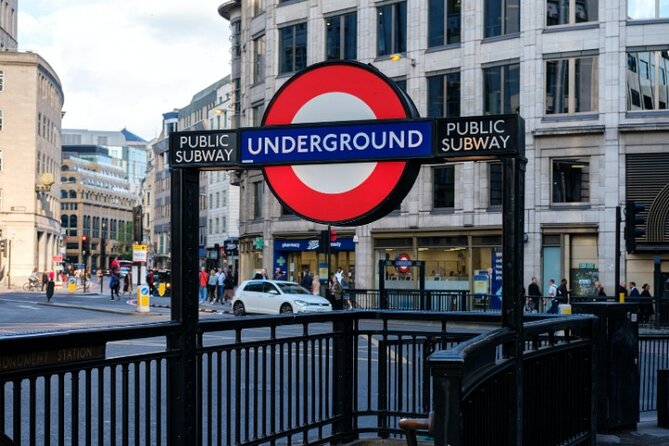
Your day begins at Monument Station (King William St, London EC4R 9AA). Your final stop is 100 St. Paul’s Churchyard near St. Paul’s (London EC4M 8AE). That matters because it puts your walk in the City of London core, then carries you toward the Thames and across into areas like Southwark and the cultural south bank.
The tour is listed as operating Monday through Sunday from 6:00 AM to 9:00 PM (for the overall availability window). That gives you flexibility, especially if you like to walk early to avoid crowds.
More city runs, half day and full


Sky Garden and the Walkie-Talkie: views for free
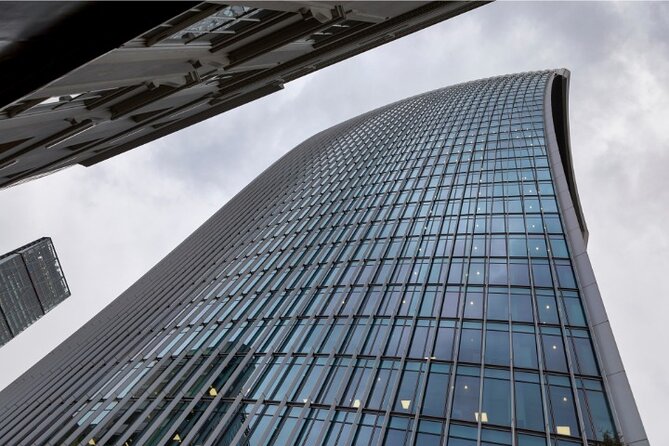
After you start, you head to Sky Garden. This is your first big “wow” moment, tied to the Fenchurch building, often called the Walkie-Talkie for its shape. The viewpoint is described as offering panoramic London views, plus a contrast between tall city geometry and green, indoor calm.
Two practical reasons this stop works well on a self-guided route:
- It is a clear visual anchor, so you quickly get your bearings.
- It is a “stand and look” type of activity, which matches audio tours well.
Note: the tour notes admission ticket free for this stop. If you care about exact entry timing, double-check what the day allows when you arrive, since free does not always mean frictionless.
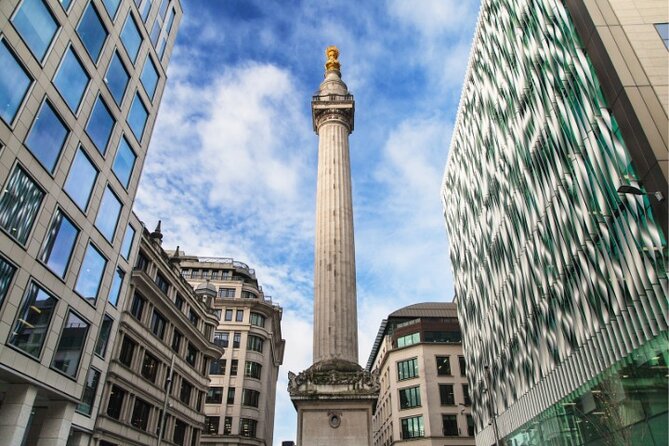
The Monument to the Great Fire: 311 steps and a certificate moment
Next up is The Monument to the Great Fire of London, a major symbol of resilience in the City. It was designed by Sir Christopher Wren, and it marks the spot where the Great Fire began. You get history without having to memorize it, because the place itself is the message.
The standout here is the option to climb. The Monument climb is described as 311 steps, and it also includes a commemorative certificate. That gives you something tangible at the end, which you can treat like a little personal souvenir of the walk.
If you do the climb, build time. If you do not, you still get plenty out of the exterior and the context in the narration.
All Hallows by the Tower: London’s oldest church, plus a hidden Roman road
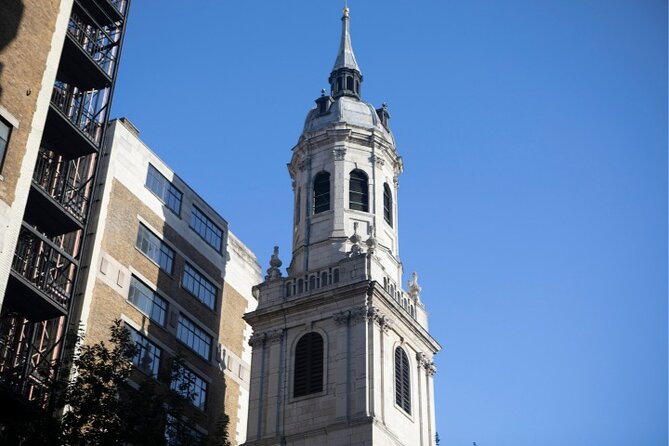
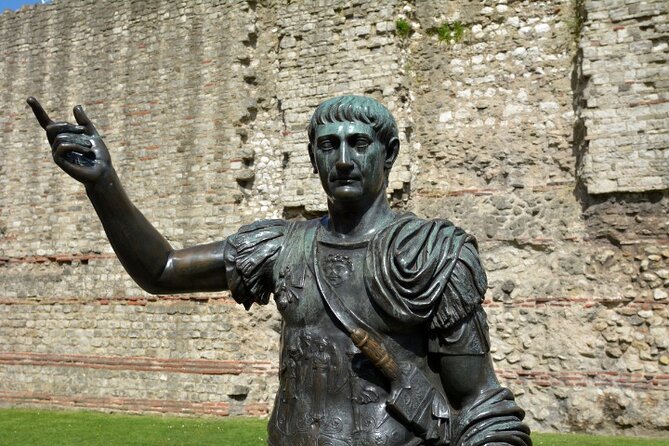
You then reach All Hallows by the Tower, dating back to 675 AD and described as London’s oldest church, surviving the Great Fire. Inside, the tour notes remnants from the 13th and 14th centuries plus a hidden Roman road.
This is the kind of stop that makes self-guided tours feel worth it. You are not just looking at a façade. You get a layered sense of how many eras can occupy the same street corner.
Also mentioned is that John Quincy Adams once visited, and that proximity to the Tower of London echoes darker moments from Henry VIII’s era. It’s a strong combo for history buffs who like context without a lecture.
Tower Hill Sundial and the slow-motion timeline of London
At Tower Hill Underground Station, you’ll find The Sundial at Tower Hill, which is more than a time-teller. The bronze plaques described here cover key moments, from the Roman invasion to the end of World War II. As sunlight moves, the sundial helps guide you through those events like a living timeline.
This is a subtle stop, but it can be memorable because it connects history to something you can physically see changing in real time. If the sun is out, you’ll probably enjoy this more.
Tower Bridge and Queen’s Walk: architecture, ships, and river-side stories
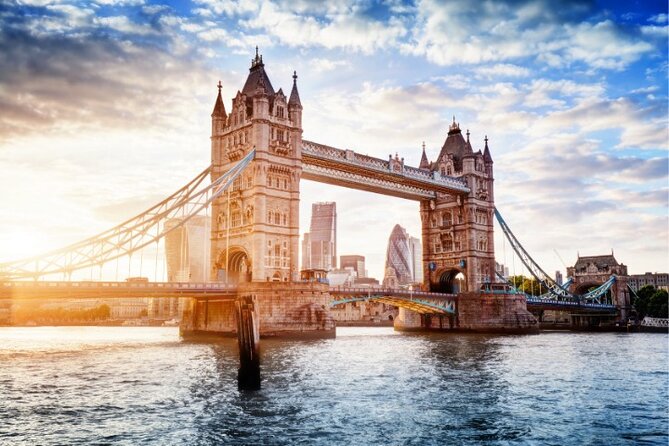
From the Tower Hill area, the route brings you to Tower Bridge, often confused with London Bridge. Tower Bridge is described as a mix of bascule and suspension design that allows ships to pass, and it has been a Thames landmark since the 16th century.
If you like standout engineering details, Tower Bridge is a great time to slow down. The narration style here helps you see how the bridge is not just a photo spot, it is part of how the river works.
Then comes Queen’s Walk, a riverside tribute to queens who shaped London. The tour notes a stretch that goes from a 15th-century Thames setting into grand houses after King Henry VIII’s reign, plus a link to the 1666 Great Fire. Today, it pairs history with modern landmarks, including the London Eye alongside older structures.
The Shard and London Bridge: modern skyline on top of old Southwark
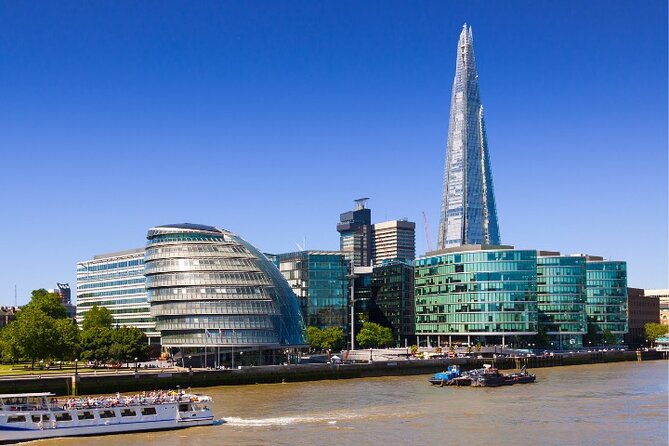
Next, you reach The Shard, described as Western Europe’s towering icon at 310 meters. This is your modern punctuation mark, the kind of landmark you can spot from far away.
The narration adds context about where the Shard sits, pointing to historical Southwark, once tied to inns and the Shakespeare Globe Theatre. That helps the stop feel less like an isolated skyline shot and more like a layered London spot.
After that, you land at London Bridge. The tour describes the bridge as more than crossing, noting that in the 15th century it functioned almost like a street with shops, homes, and even a chapel. That is a great reminder that London’s biggest infrastructure has always been mixed-use.
Borough Market: the smart place to pause and snack
Then you hit Borough Market, described as central to London since 1014 AD. It also connects to London Bridge as a trading hub, and it grew into a vital market by the 16th century.
For a self-guided tour, Borough Market is a gift. It is the moment when you can take a real break, grab food, and recharge while the walking day is still fresh.
The tour notes this stop as admission ticket free, which makes it easy to fit into your schedule. Even if you do not buy anything, the market atmosphere alone can be worth the time.
Shakespeare’s Globe: a living replica built for audience participation
Next is Shakespeare’s Globe Theatre. The modern Globe opened in 1997, inspired by actor-director Sam Wanamaker. The replica is described as using traditional materials, including unseasoned oak and thatch, aiming to recreate the Elizabethan theatre experience.
The narration also emphasizes interaction, encouraging a lively audience-style dynamic and bridging past and present. For you, that means this stop is more than a photo. If your timing works, it can be a chance to see how London turns history into an active experience.
The tour notes admission ticket free for this stop. If you want to be inside for any performances or specific areas, it is smart to check what is running when you arrive.
Tate Modern and the former power station idea
Then you arrive at Tate Modern, a major art museum that has been repurposed from an old power station designed by Sir Giles Gilbert Scott. The tour notes that it was repurposed in 2001, with transformation by Herzog and de Meuron.
Inside, the story continues: the former turbine hall creates large open spaces, while upper floors offer panoramic views of the Thames. That combination is a practical win. If you are not in a museum mood, the views alone can sell the stop. If you are in a museum mood, the scale helps the art feel different than in smaller galleries.
The tour notes admission ticket free here too, which makes it a strong value stop within a walking route.
Millennium Bridge: that wobble story, minus the worry
Near the finish, you reach Millennium Bridge. The tour notes that when it opened in 2001 it became famous for an unexpected wobble, but that it now stands firm.
I like using this stop as a “finish line” moment. Even if you do not care about engineering, it helps you wrap the walk with something you can feel as you cross. Then you end at St. Paul’s Churchyard, which is an ideal place to pause before heading off to dinner or a late afternoon plan.
How long should you plan for?
The experience is listed as about 1 to 2 hours, but the route includes a lot of stop points along the way. In practice, if you actually want to look around each sight, expect it to stretch.
My advice: treat it as a short half-day if you are doing photo stops and a couple indoor moments, not as a quick two-settlement sprint. If you are trying to fit it into a tight schedule, pick your must-sees in advance, then let the app guide you only to those.
Who this walk is best for
This experience is best for:
- First-time visitors who want a clear backbone through central London.
- History buffs who like seeing how one era leads into another.
- People who prefer flexible pacing over guided group schedules.
- Budget travelers who still want commentary and direction, not just a map.
It may not be ideal if:
- You want a fully turn-by-turn feel with zero need to interpret street layouts.
- Your schedule is too tight to allow for quick entry checks and breaks.
- You dislike app-based navigation and would rather have a human guide handle everything.
Should you book it?
I’d book it if you want high value, love audio-led walking, and you are comfortable managing a phone for directions. The offline map is the big selling point, and the stop mix is smart: fire history, Roman-era hints, theatre culture, modern art, and Thames views.
Skip it if you need guaranteed access to every interior space, or if you want someone to troubleshoot tech on your behalf while you are standing on a busy sidewalk. With the right setup, though, this is an easy way to make a London walk feel guided, without the guided-tour cost.
FAQ
How long does the London self-guided city tour take?
It is listed as about 1 to 2 hours.
Does the tour work offline?
Yes. The tour includes a fully offline map, so you do not need Wi-Fi or data during the walk.
What app is used for this experience?
You access the London Self Guided City Tour on the Trippy Tour Guide app.
Where do I start and where do I end?
You start at Monument Station (King William St, London EC4R 9AA, UK) and end at 100 St. Paul’s Churchyard (London EC4M 8AE, UK).
What language is the narration available in?
The tour is offered in English.
Are there admission tickets included for attractions?
The stop notes list admission ticket free for several locations, but tickets are not listed under what is included in the experience details. So plan for the possibility that you may need to handle any entry requirements yourself.
What should I do before I start the walk so the app works correctly?
Download the tour before you begin, and allow GPS access, since those are described as essential for the tour to guide you correctly.
What are the operating hours?
The experience is listed as available Monday through Sunday from 6:00 AM to 9:00 PM.
Other Departures With A Guide Attached






More City Runs In London






Routes You Can Walk Unaccompanied






Fresh off the notebook in London
- Private Rock ‘n’ Roll Music Tour of Central London
★ 5.0 · 7 reviews - London Walking Tour: Camden Town Photography Walkabout
★ 5.0 · 7 reviews - Private Transfer from London accommodation to Cruise terminal
★ 5.0 · 7 reviews - Amazing Nightlife in London East Tour
★ 4.5 · 7 reviews - The British Museum: a highlights tour with a TV historian
★ 5.0 · 7 reviews - Heathrow Airport to Cambridge private taxi transfers
★ 5.0 · 7 reviews
City Tours, compared.
 ★ 5.0Liverpool: “Blue Route” – City & Beatles TourFrom $278,562 reviews
 ★ 5.0The Manchester City Stadium TourFrom $354,176 reviews
 ★ 4.5Liverpool City Sights Hop On Hop Off City Tour – 24hr TicketFrom $192,555 reviews
 ★ 4.51.5-hour Oxford City and University Walking TourFrom $381,383 reviews
 ★ 4.0City Sightseeing London Hop-On Hop-Off Bus Tour & Bookable ExtrasFrom $371,224 reviews
 ★ 5.0Oxford Official University & City TourFrom $411,134 reviews
 ★ 4.5City Sightseeing Oxford Hop-On Hop-Off Bus TourFrom $271,042 reviews
 ★ 4.5Roman Baths and Bath City Walking TourFrom $35762 reviews
Browse the lists this tour appears in